
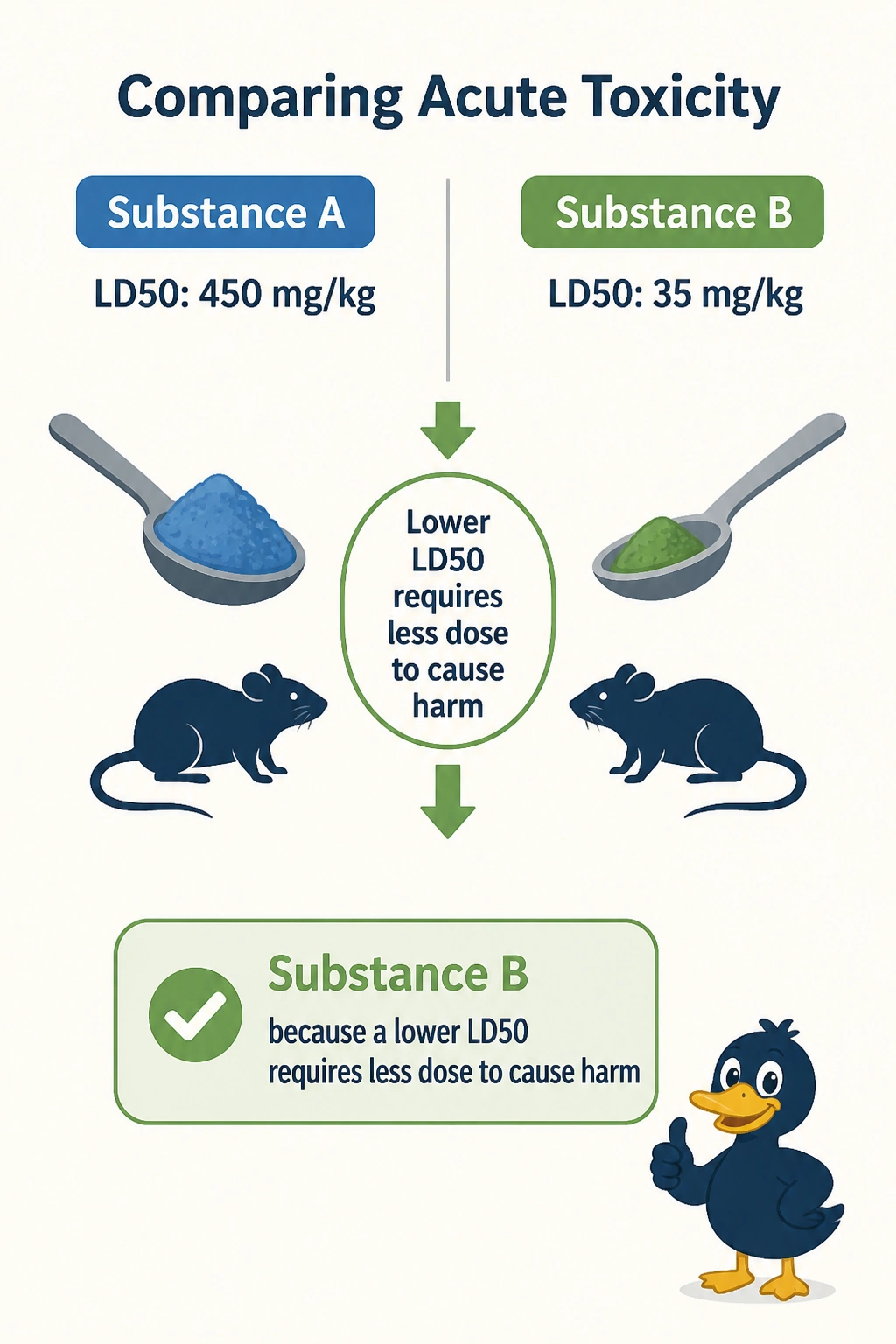
An industrial hygienist compares oral acute toxicity data for two industrial solvents: Substance A has a rat oral LD50 of 450 mg/kg, while Substance B has a rat oral LD50 of 35 mg/kg. Which conclusion accurately describes their relative acute toxicity?
Select an answer to reveal the explanation.
Short Explanation
Think of LD50 like a golf score—the lower the number, the more potent the hazard! The classic exam trap is seeing a bigger number and assuming bigger means deadlier, when it actually means you need a larger dose to reach the lethal threshold.
Full Explanation
Median Lethal Dose (LD50) represents the single dose of a substance, expressed in milligrams per kilogram of body weight, expected to cause death in 50 percent of a defined test animal population. Therefore, Substance B, because a lower LD50 requires less dose to cause harm is substantially more acutely toxic than Substance A, since only 35 mg/kg reaches the 50-percent lethality benchmark compared with 450 mg/kg. Selecting Substance A, because a higher LD50 indicates faster systemic absorption reverses the dose-response relationship; a higher LD50 means a larger quantity of chemical is required to produce lethality, indicating lower acute potency. Selecting Both substances have equal acute toxicity when administered orally ignores a more than tenfold difference in lethal dose. Selecting Neither value reflects acute toxicity without an eight-hour TWA confuses single-dose oral toxicity metrics with airborne occupational time-weighted average exposure limits. Caveat: LD50 measures acute lethality only and does not capture chronic effects such as carcinogenicity or sensitization, nor does it account for differences in volatility or exposure route. As an operational check, always review Section 11 toxicological data alongside Section 8 exposure limits on the Safety Data Sheet.
Prefer to study offline? Printable PDF study book + test engine ($7.50, unofficial). These questions stay free here.