
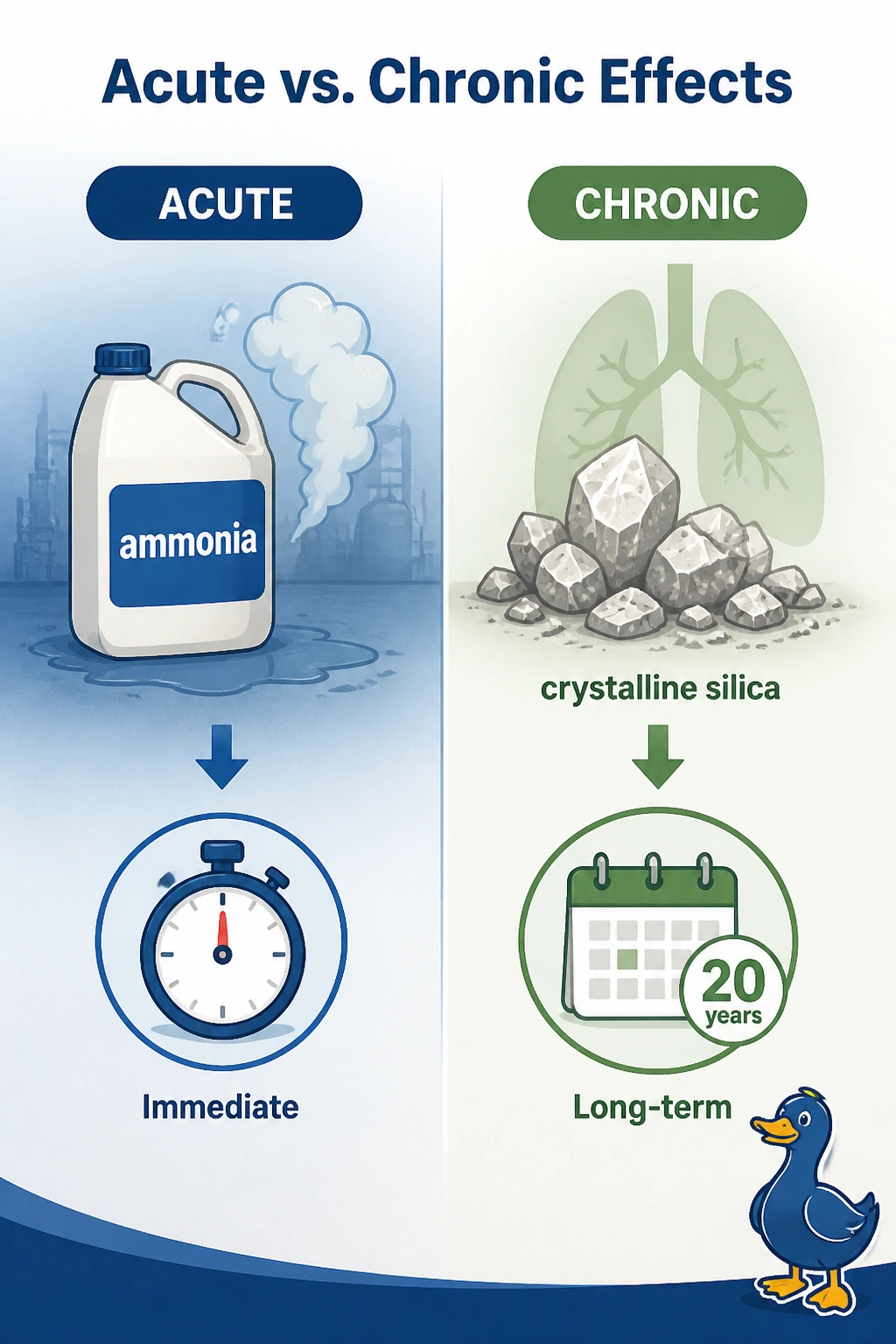
An industrial hygienist investigates two workplace health complaints: a maintenance worker develops immediate eye and throat irritation after a brief ammonia valve leak, while a retired foundry grinder is diagnosed with silicosis after 20 years of low-level crystalline silica exposure. How should the hygienist classify these two health effects?
Select an answer to reveal the explanation.
Short Explanation
Think of acute effects like a lightning strike and chronic effects like slow rust on a steel beam—one hits you right away, while the other builds silently over years. The trap is mixing up the route of exposure with the timeline; track how fast symptoms appear after the dose.
Full Explanation
In occupational toxicology, the ammonia reaction is acute, and the silicosis is chronic because health effects are classified by both exposure pattern and onset speed. Acute effects appear rapidly—within seconds, minutes, or hours—following a single or short-term high-concentration exposure, such as ammonia gas irritating mucous membranes during a valve leak. Chronic effects develop gradually over months or years of repeated low-level exposure, such as inhaled respirable crystalline silica causing progressive lung scarring. Claiming that the ammonia reaction is chronic, and the silicosis is acute reverses the fundamental definitions of short-term versus long-term disease progression. Stating that both conditions are chronic because chemical inhalation caused them wrongly assumes the inhalation route determines toxicity timing, when inhalation can produce either acute or chronic outcomes. Stating that both conditions are acute because each began after a work shift confuses occupational origin with rapid clinical onset. As a caveat, some substances can cause both acute and chronic harm depending on dose and duration. When reviewing exposure logs, pair air-sampling records with symptom timelines so both immediate peak controls and long-term medical surveillance are addressed.
Prefer to study offline? Printable PDF study book + test engine ($7.50, unofficial). These questions stay free here.