
An industrial hygienist evaluates two airborne dusts in a stone fabrication shop: coarse sawdust fragments averaging 30 micrometers and freshly cut crystalline silica particles under 4 micrometers. Why do the fine silica particles pose a far greater risk of permanent fibrotic lung damage?
Select an answer to reveal the explanation.
Short Explanation
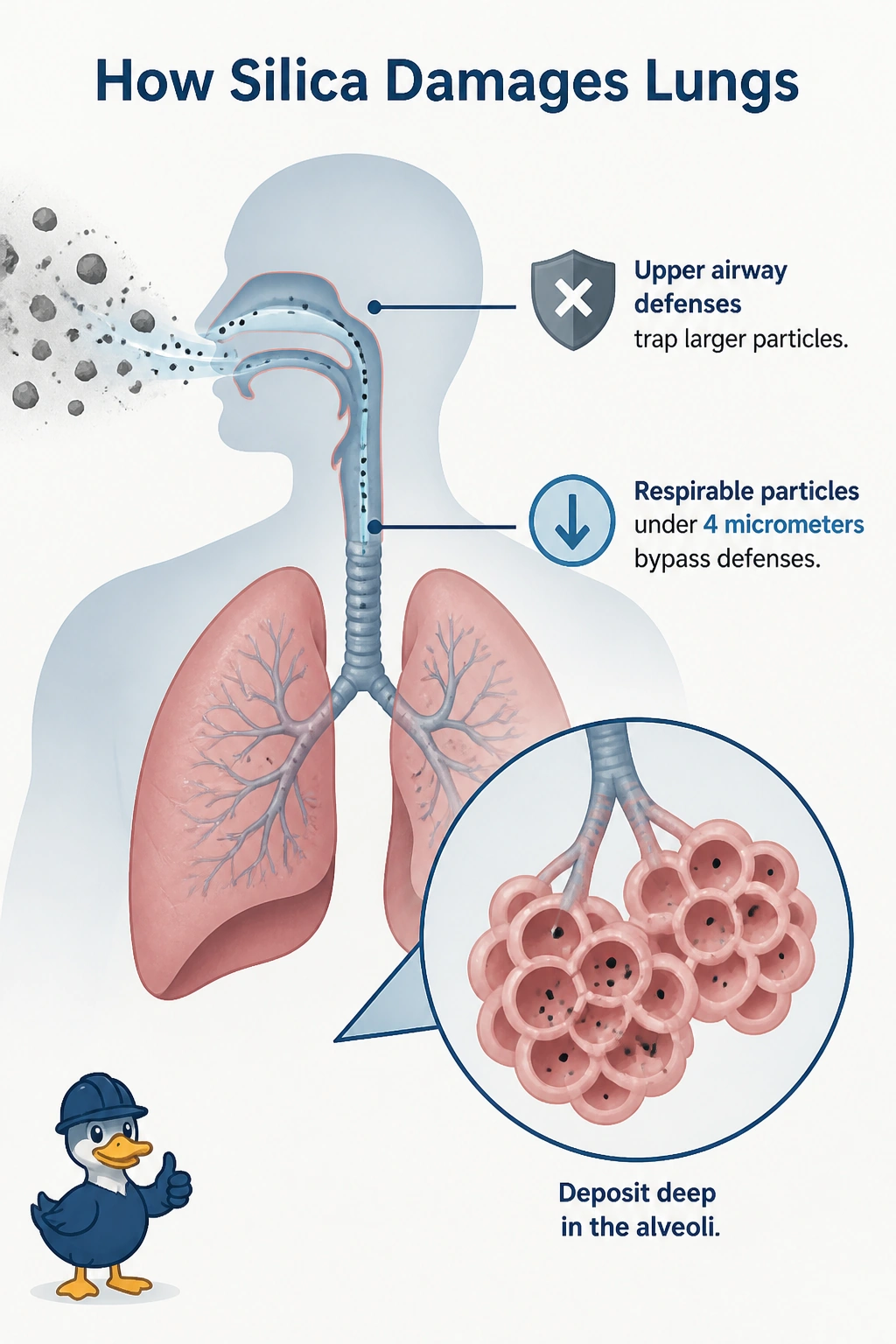
Your upper airway acts like a coarse screen door that catches big debris, while microscopic dust slips right through to the gas-exchange zone. Watch out for the trap of thinking bigger particles cause more damage; in occupational lung disease, smaller aerodynamic size means deeper penetration.
Full Explanation
Aerodynamic diameter dictates where airborne particulates land in the respiratory tract, so Respirable particles under 4 micrometers bypass upper airway defenses and deposit deep in the alveoli. Once respirable crystalline silica reaches the alveolar sacs, where there are no cilia to sweep debris upward, alveolar macrophages engulf the crystals and trigger chronic inflammation and irreversible scarring known as silicosis. Believing that Coarse particles dissolve rapidly in nasal mucus and enter the bloodstream immediately is incorrect because wood sawdust is largely insoluble and is cleared by mucociliary action rather than systemic absorption. Claiming that Larger dust fragments carry a stronger electrostatic charge that burns bronchial tissue invents a thermal mechanism that does not explain fibrotic lung disease. Asserting that Fine particles are trapped by nasal hairs and swallowed into the digestive tract reverses respiratory physics, because nasal impaction captures coarse particles above 10 micrometers while fine respirable fractions remain airborne into the deep lung. As a caveat, standard total-dust sampling cassettes overcollect large non-respirable particles and underestimate alveolar hazard unless a cyclone separator is used. Operationally, pair wet-cutting engineering controls with respirable cyclone air sampling to verify silica exposures remain below the OSHA permissible exposure limit.
Prefer to study offline? Printable PDF study book + test engine ($7.50, unofficial). These questions stay free here.