
A chemical plant technician must enter a tank room where hydrogen sulfide concentrations exceed the Immediately Dangerous to Life or Health (IDLH) level. Under OSHA's Respiratory Protection standard, which respirator type is permitted for this entry?
Select an answer to reveal the explanation.
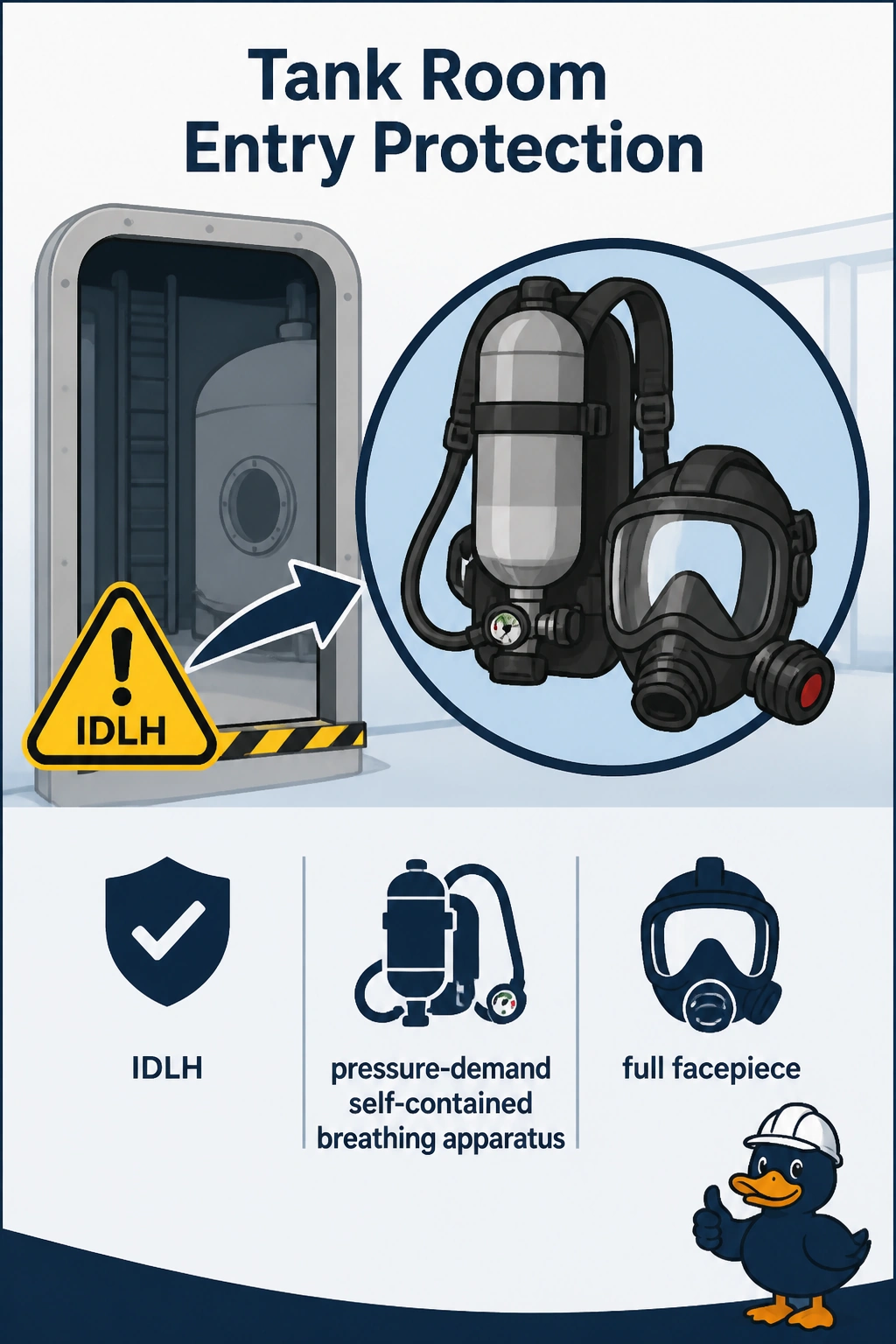
Short Explanation
When a toxic gas crosses into IDLH territory, you cannot filter your way out of danger or gamble on an air hose alone. The trap is trusting a powered air-purifying respirator or an airline rig that lacks an escape bottle.
Full Explanation
Entering an Immediately Dangerous to Life or Health (IDLH) atmosphere under OSHA 29 CFR 1910.134 requires A pressure-demand self-contained breathing apparatus with full facepiece among the listed choices. Positive pressure inside the full facepiece prevents inward leakage of lethal hydrogen sulfide even if the face seal flexes, while the self-contained air cylinder ensures breathable air independent of ambient contaminants or external hoses. Selecting A half-mask air-purifying respirator equipped with organic vapor cartridges fails because air-purifying respirators do not supply oxygen or protect reliably at IDLH concentrations, and a half-mask leaves the eyes exposed. Choosing A full-facepiece powered air-purifying respirator with acid-gas canisters is also prohibited in IDLH atmospheres because cartridge breakthrough, high vapor concentrations, or battery failure could be fatal. Relying on A continuous-flow airline respirator without an auxiliary escape cylinder leaves the technician stranded without breathable air if the supply hose is severed or the compressor fails. As a caveat, IDLH entries also require at least one standby person outside the hazard zone with appropriate rescue equipment and communication. For an operational check, inspect the SCBA cylinder pressure, facepiece seal, and low-air alarm before entering.
Prefer to study offline? Printable PDF study book + test engine ($7.50, unofficial). These questions stay free here.