
An occupational health specialist conducts full-shift personal noise dosimetry in a beverage canning facility and records an 8-hour Time-Weighted Average of 87 dBA for line operators. Under OSHA's Occupational Noise Exposure standard (29 CFR 1910.95), what does this exposure level require?
Select an answer to reveal the explanation.
Short Explanation
Noise damage creeps up silently, so OSHA draws an early warning line long before the maximum limit is reached. Don't fall for the trap of waiting until noise hits 90 dBA; once your dosimetry crosses 85 dBA, you must put hearing conservation in motion.
Full Explanation
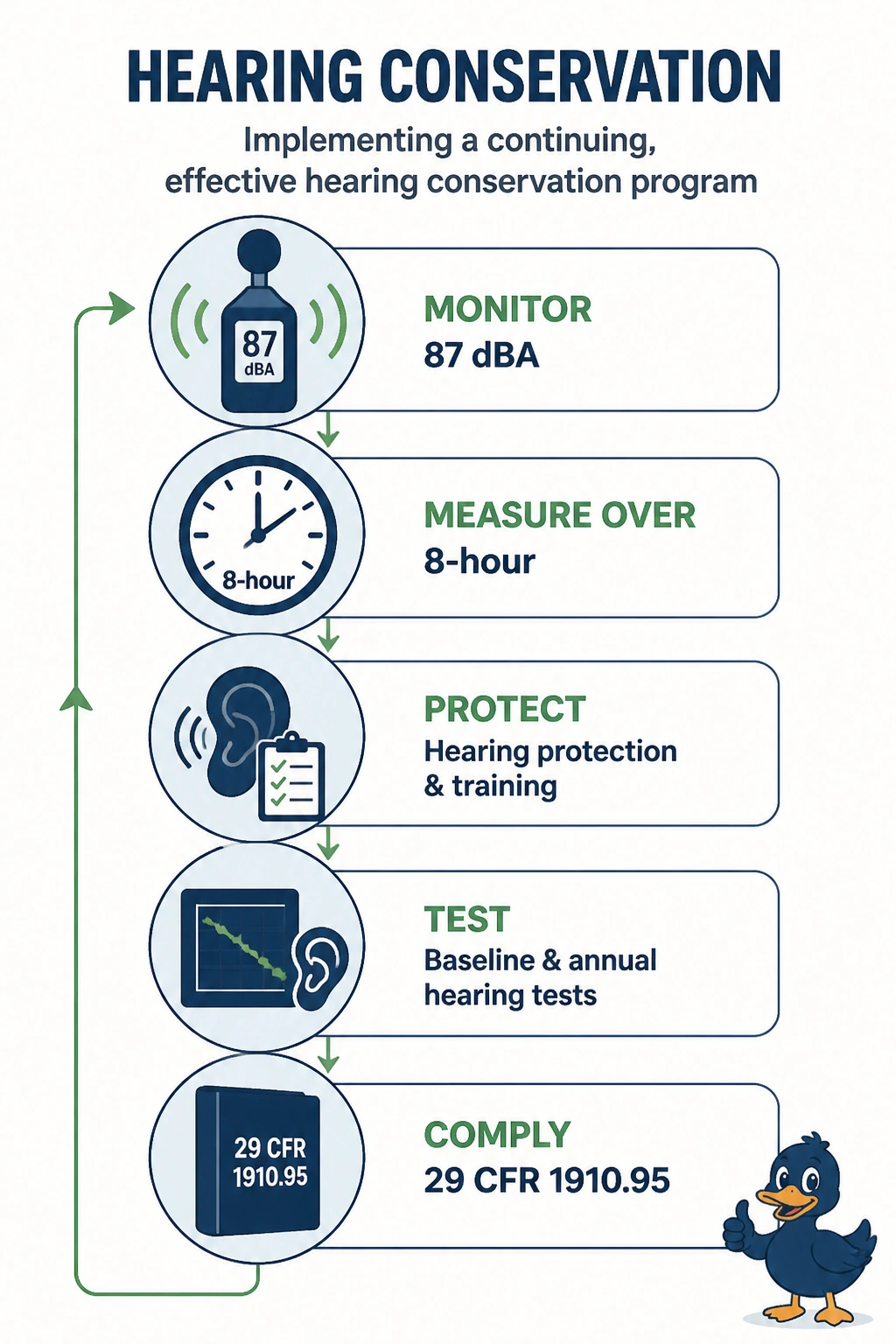
Under 29 CFR 1910.95, an 8-hour Time-Weighted Average of 85 dBA is OSHA's Action Level, which triggers Implementing a continuing, effective hearing conservation program. At 87 dBA, the employer must provide baseline and annual audiometric testing, make hearing protectors available, conduct annual training, and maintain exposure and audiogram records. Shutting down the canning line immediately until noise drops below 80 dBA fails because 80 dBA is the integration threshold for noise dosimetry rather than a mandatory shutdown limit, and 87 dBA is still below the 90 dBA Permissible Exposure Limit. Enrolling affected operators in a formal respiratory protection program is incorrect because 29 CFR 1910.95 addresses acoustic hazards, not airborne chemical or particulate exposures. Exempting the facility from annual audiometric testing requirements is the opposite of the rule, as crossing 85 dBA is precisely what mandates annual audiograms. As an exam caveat, if an employee experiences a Standard Threshold Shift, hearing protector use becomes mandatory even between 85 and 90 dBA. For an operational check, review personal dosimetry logs with an 80 dBA threshold and confirm every worker at or above 85 dBA is scheduled for an annual audiogram.
Prefer to study offline? Printable PDF study book + test engine ($7.50, unofficial). These questions stay free here.