
At a specialty chemical plant, operators pour non-conductive dry resin powders from plastic-lined fiber drums into a mixer containing flammable solvent vapors, creating static sparks. Which engineering approach best controls this electrostatic discharge ignition hazard?
Select an answer to reveal the explanation.
Short Explanation
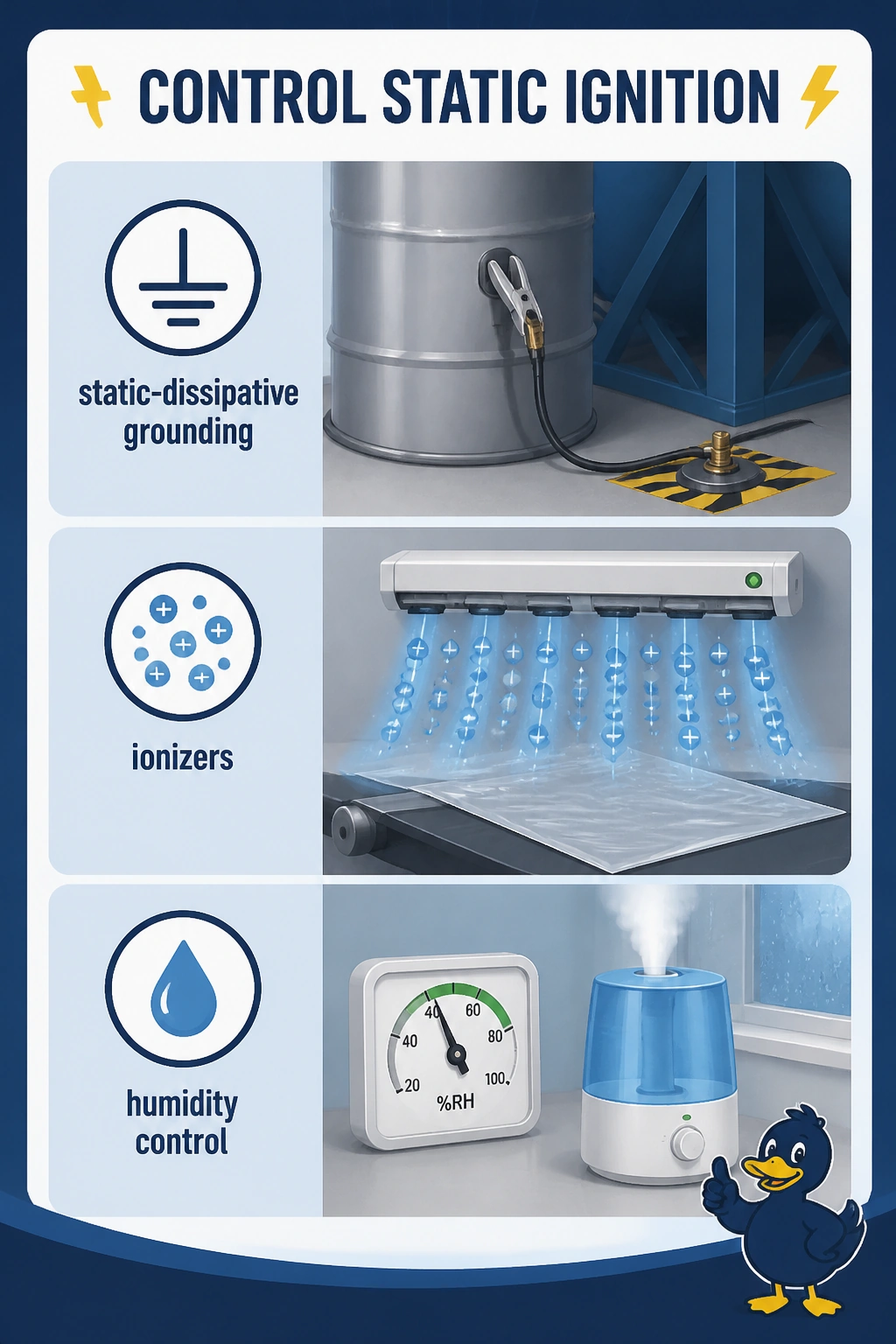
When you pour dry resin into a solvent mixer, friction can build static charge until a spark ignites the vapors. Static-dissipative grounding, ionizers, and humidity control address that hazard; cotton gloves, a faster agitator, and incandescent bulbs do not control charge on the powder or plastic liners.
Full Explanation
Static-dissipative grounding, ionizers, and humidity control best control the electrostatic-discharge ignition hazard. Non-conductive resin powder and plastic liners can accumulate charge through friction during pouring. Grounding conductive equipment, ionizing the air to neutralize charge on insulating surfaces, and maintaining controlled relative humidity help dissipate charge before it can produce a spark capable of igniting solvent vapors. Replacing the mixer with a higher-speed agitator does not address charge on the powder or liners; added turbulence and friction may generate more static. Standard cotton work gloves do not dissipate charge from falling powder or a plastic drum liner, so sparks between charged materials and equipment remain possible. Switching the overhead fluorescent fixtures to standard incandescent bulbs likewise leaves the static hazard at the mixer uncontrolled and may introduce hot-surface ignition risks if the fixtures are not rated for the hazardous area. Exam caveat: grounding clamps alone cannot drain charge from non-conductive plastics, so ionizers and humidity control are important parts of the approach. Practical check: before batch charging, verify ground-bond continuity with a resistance tester and check the humidity logs.
Prefer to study offline? Printable PDF study book + test engine ($7.50, unofficial). These questions stay free here.