
A maintenance supervisor at a metal fabrication shop plans to issue half-mask elastomeric air-purifying respirators to three welders and schedules qualitative fit testing for Monday morning. What must the employer complete before any welder undergoes fit testing or wears the respirator on the job?
Select an answer to reveal the explanation.
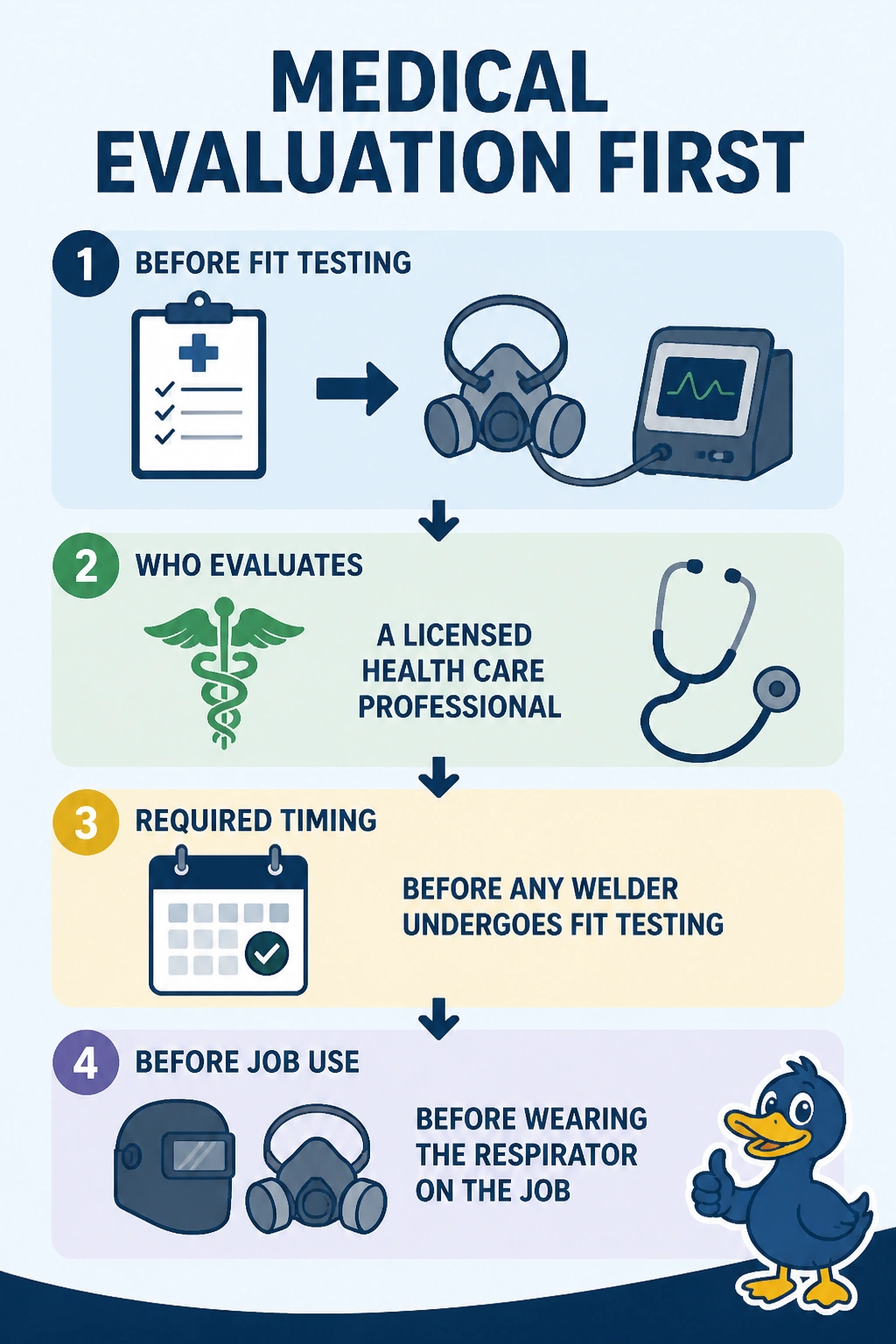
Short Explanation
Think of a respirator like a scuba tank for the shop floor—you never strap it on until a doctor clears your lungs for the extra breathing resistance. The classic trap is jumping straight to fit testing, which puts physical stress on an unscreened worker.
Full Explanation
Under OSHA 29 CFR 1910.134(e), an employer must provide A medical evaluation by a licensed health care professional before an employee is fit tested or required to wear a respirator in the workplace. Tight-fitting air-purifying respirators increase inhalation and exhalation resistance and can add physiological strain, so screening for cardiovascular or pulmonary conditions comes first. Quantitative fit testing using a particle-counting aerosol instrument is an alternative fit-testing method, not a prerequisite to fit testing itself, and still requires prior medical clearance. A written hazard communication refresher on welding fume safety data sheets informs workers about chemical hazards, yet it does not evaluate whether a welder can safely tolerate respirator use. Seven-day personal air sampling to confirm exposure below the IDLH limit misapplies exposure monitoring; air sampling determines respirator selection and assigned protection factors rather than medical fitness. As an exam caveat, even voluntary use of elastomeric respirators requires medical evaluation under the standard. Operationally, verify written medical clearance is filed before scheduling any fit test.
Prefer to study offline? Printable PDF study book + test engine ($7.50, unofficial). These questions stay free here.