
An industrial hygienist reviews air sampling results for a chemical that carries an OSHA Permissible Exposure Limit designated as a Ceiling (C) value. How must the hygienist interpret this exposure limit when evaluating worker protection?
Select an answer to reveal the explanation.
Short Explanation
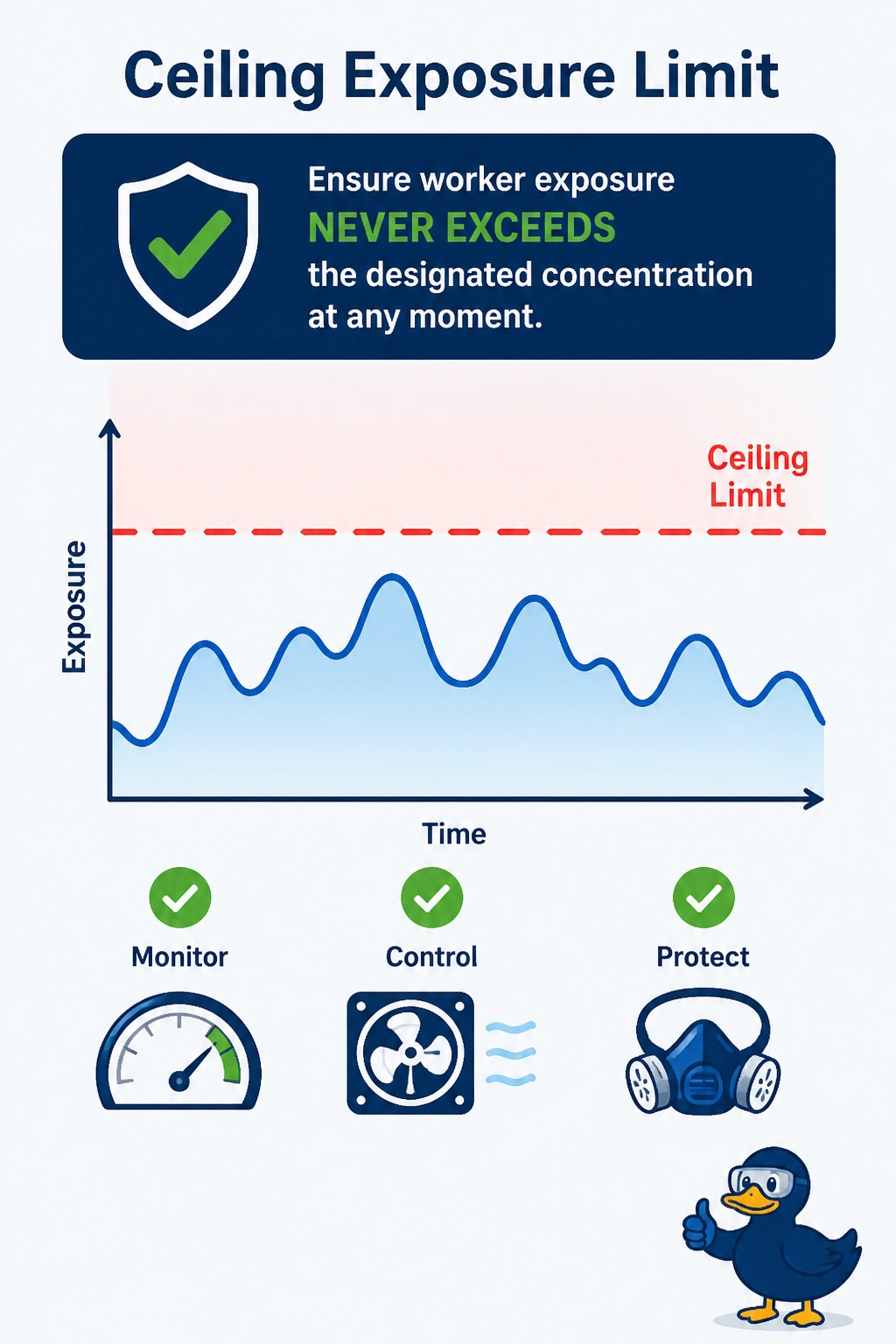
Think of a ceiling limit like a low bridge clearance sign—your truck cannot be taller than the bridge even for a single second. The trap is treating every exposure limit like an 8-hour average, which hides dangerous short-term spikes that can cause acute injury.
Full Explanation
Under OSHA 29 CFR 1910.1000, a Ceiling designation means employers must Ensure worker exposure never exceeds the designated concentration at any moment during the workday. Ceiling limits protect workers from fast-acting irritants, asphyxiants, or toxins where even a brief peak can cause immediate harm. Choosing to Average the exposure concentrations across an 8-hour workshift before comparing to the limit describes an 8-hour Time-Weighted Average (TWA), which allows temporary highs to be offset by periods of zero exposure. Choosing to Allow brief excursions above the limit as long as 15-minute samples remain below it describes a Short-Term Exposure Limit (STEL), which permits controlled 15-minute exposures rather than an absolute cap. Choosing to Apply the limit only when workers enter immediately dangerous to life atmospheres confuses a Ceiling limit with an IDLH concentration used for respirator selection and escape planning. Caveat: When an instantaneous reading is not feasible, compare a 15-minute time-weighted average with the ceiling, and that 15-minute value may not be exceeded at any time. Operational check: review direct-reading instrument peak logs rather than shift averages alone whenever a substance carries a Ceiling designation.
Prefer to study offline? Printable PDF study book + test engine ($7.50, unofficial). These questions stay free here.