
A 20-ampere branch circuit breaker feeding several packaging-line heat sealers trips repeatedly during peak production, and a maintenance worker proposes installing a 30-ampere breaker instead. Why must the safety manager prohibit this change?
Select an answer to reveal the explanation.
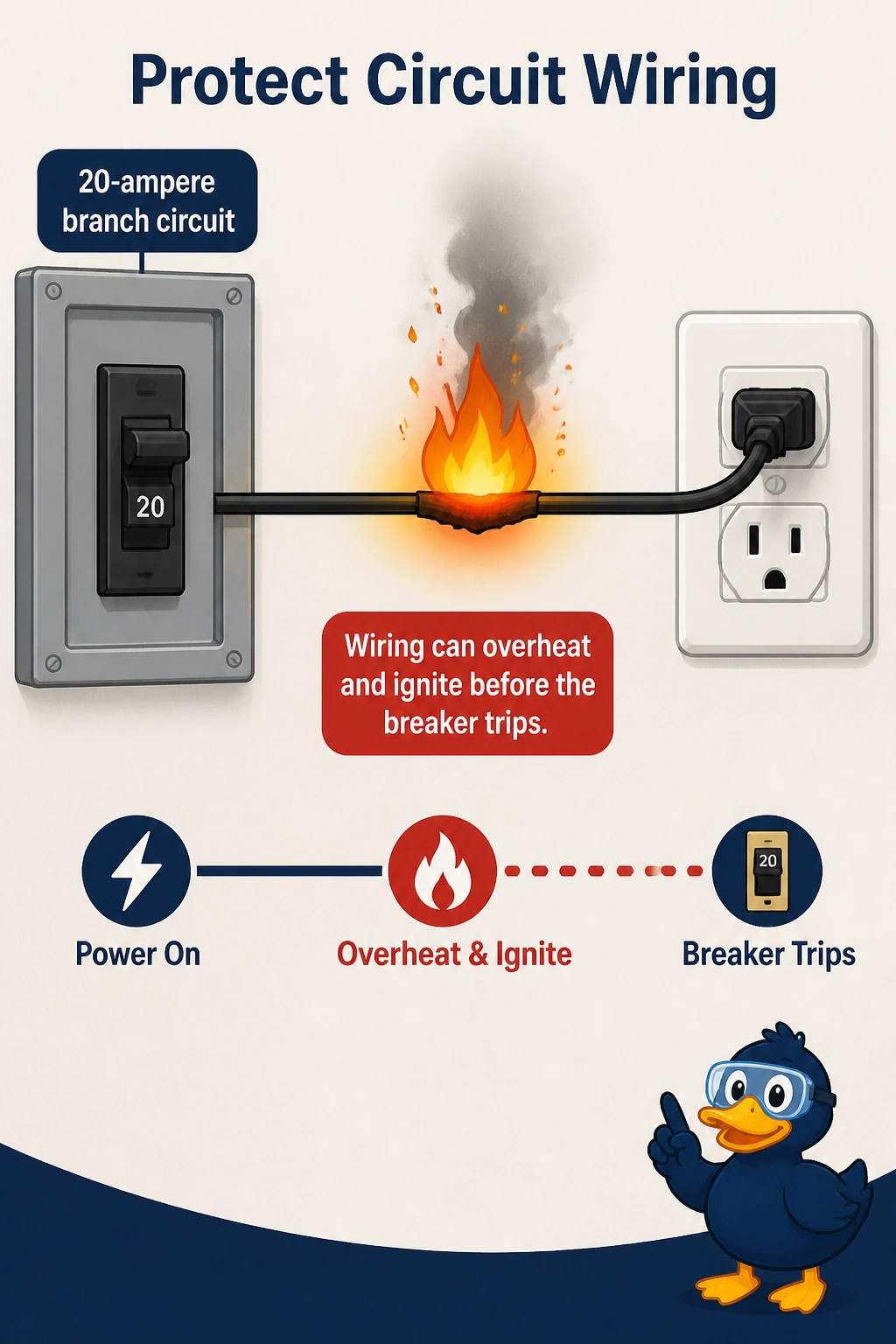
Short Explanation
A breaker is the weak link on purpose—it trips to save the wires inside your walls from turning into toaster coils. The trap is upsizing the breaker to stop nuisance trips, which lets dangerous current overheat insulation before the device ever opens.
Full Explanation
Overcurrent protective devices—fuses and circuit breakers—are sized specifically to protect the ampacity of the downstream conductors and connected equipment. The circuit wiring can overheat and ignite before the oversized breaker trips explains why replacing a 20-ampere breaker with a 30-ampere unit creates a severe fire hazard: 12 AWG branch conductors can carry excessive current long enough to melt insulation and start an electrical fire inside walls or conduit. A larger breaker increases utility demand charges during equipment startup is false because circuit breaker ratings govern fault and overload interruption, not billing demand. Higher-rated breakers require replacing all downstream grounded receptacles first misses the core thermal hazard to the conductors themselves. A 30-ampere breaker cannot fit into a standard commercial distribution panelboard is incorrect because many 30-ampere breakers share the same physical frame and bus stab footprint as 20-ampere units. As a caveat, repeated tripping signals an overloaded circuit, failing heating element, or short circuit that requires troubleshooting. Operationally, measure actual load current with a clamp meter and split loads across dedicated circuits.
Prefer to study offline? Printable PDF study book + test engine ($7.50, unofficial). These questions stay free here.