
A facility manager is laying out portable fire extinguishers inside a new solvent-mixing room classified as a Class B flammable liquid hazard area. Under OSHA's Portable Fire Extinguishers standard (29 CFR 1910.157), what is the maximum travel distance from any point in this area to an extinguisher?
Select an answer to reveal the explanation.
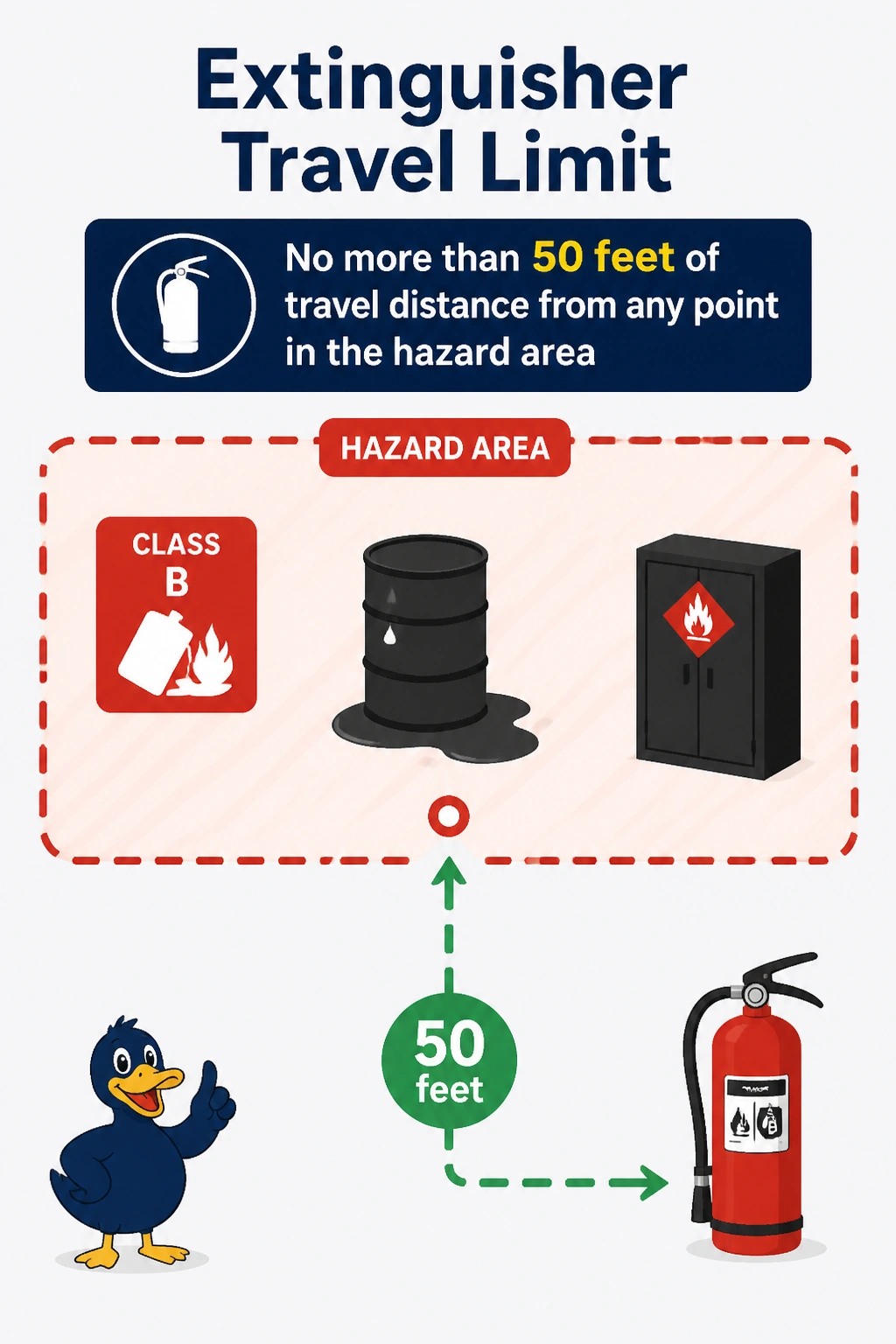
Short Explanation
Flammable liquid fires escalate in seconds, so you cannot afford a long sprint across the shop to grab an extinguisher. The classic exam trap is mixing up the 75-foot rule for ordinary combustibles with the tighter 50-foot limit required for Class B hazards.
Full Explanation
Under 29 CFR 1910.157, portable fire extinguishers for Class B flammable liquid and gas hazards must be distributed so that the travel distance from the Class B hazard area to any extinguisher is No more than 50 feet of travel distance from any point in the hazard area. Because flammable vapors can flash rapidly across a room, shortening the reach time gives trained personnel a realistic chance to suppress an incipient fire safely. Selecting No more than 75 feet of travel distance from any point applies the limit for Class A ordinary combustibles and Class D combustible metals, which leaves a solvent room underprotected. Choosing No more than 100 feet of unobstructed walking distance or No more than 150 feet along a designated exit route exceeds OSHA's maximum spacing for both Class A and Class B hazards and would delay response past the incipient stage. Keep in mind the caveat that travel distance means the actual walking path around vats, racks, and walls rather than a straight line drawn on a floor plan. As an operational check, walk the solvent-mixing room with a measuring wheel from the farthest corner around every physical obstruction to verify an appropriately rated extinguisher sits within 50 feet.
Prefer to study offline? Printable PDF study book + test engine ($7.50, unofficial). These questions stay free here.