
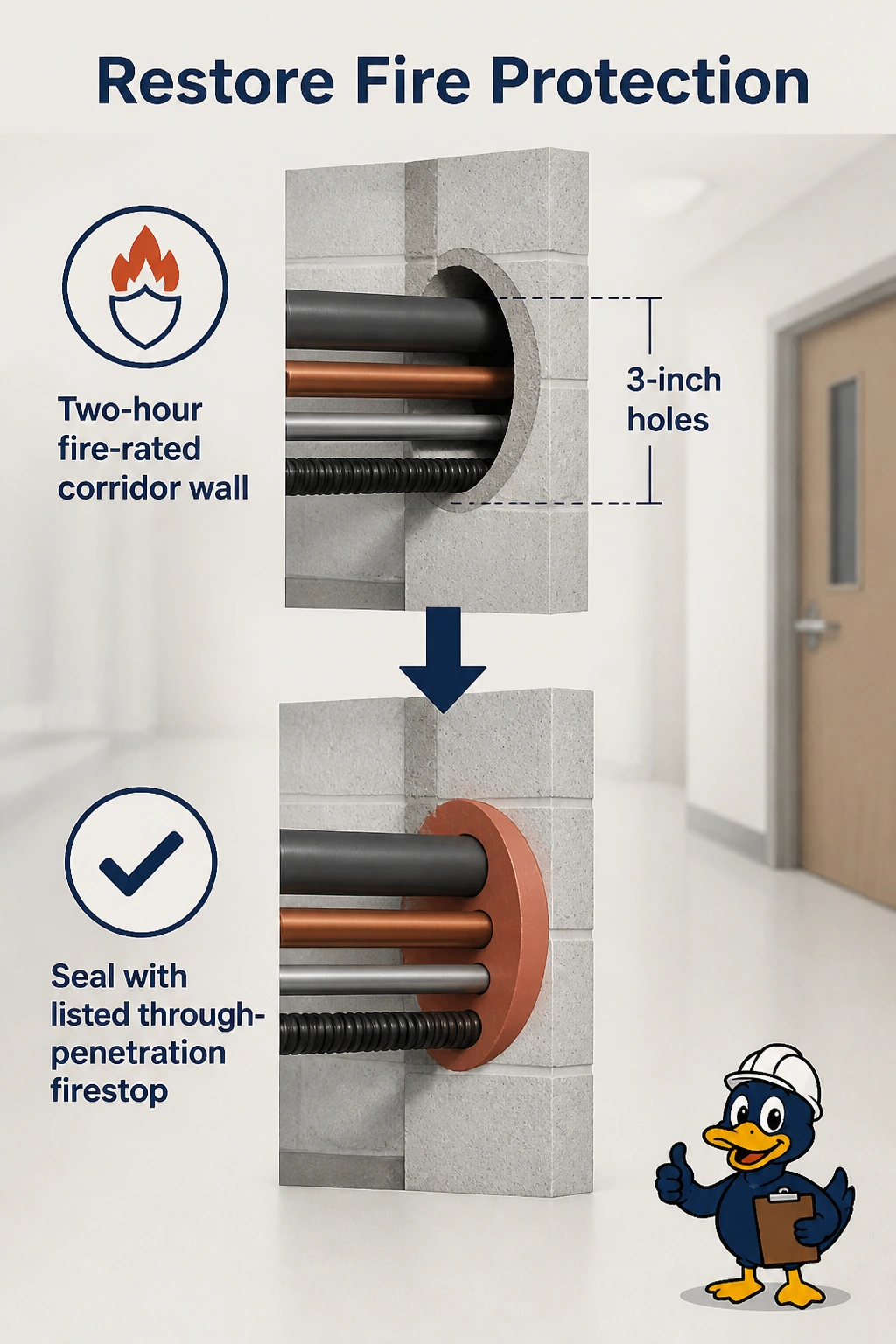
During a facility inspection at a hospital, a safety specialist finds that IT contractors drilled three-inch holes through a two-hour fire-rated corridor wall to run data cables and left the gaps open around the conduit. Which corrective action restores the wall's fire protection rating?
Select an answer to reveal the explanation.
Short Explanation
A two-hour fire wall is only as strong as the smallest hole punched through it—leaving cable gaps open turns a life-safety barrier into a chimney for smoke and flame. To restore the barrier, you need a tested, listed firestop assembly rather than ordinary caulk or insulation that melts away in heat.
Full Explanation
Fire-rated walls and floors are designed to compartmentalize a fire, keeping smoke and flames contained long enough for occupants to evacuate and sprinklers to control the blaze. When cables or pipes pass through these barriers, the facility must Seal the penetrations using a listed through-penetration firestop system rated for the exact wall construction, penetrating item, and annular gap size. Choosing to Pack the openings tightly with fiberglass batt fails because standard thermal insulation is not tested as a fire-rated seal and allows hot gases and smoke to pass through. Deciding to Cover the gaps on both sides with steel escutcheons only hides the opening cosmetically without providing an intumescent or smoke-tight barrier. Similarly, opting to Fill the annular spaces with standard latex caulking is unsafe because ordinary architectural caulk burns, shrinks, and fails rapidly under fire exposure. As a caveat, firestop materials must be installed strictly according to the manufacturer's tested assembly listing, including backing depth and collar hardware. For an operational check, require a hot-work or penetration permit for all contractor cabling work and inspect completed seals against the wall's fire-rating labels.
Prefer to study offline? Printable PDF study book + test engine ($7.50, unofficial). These questions stay free here.