
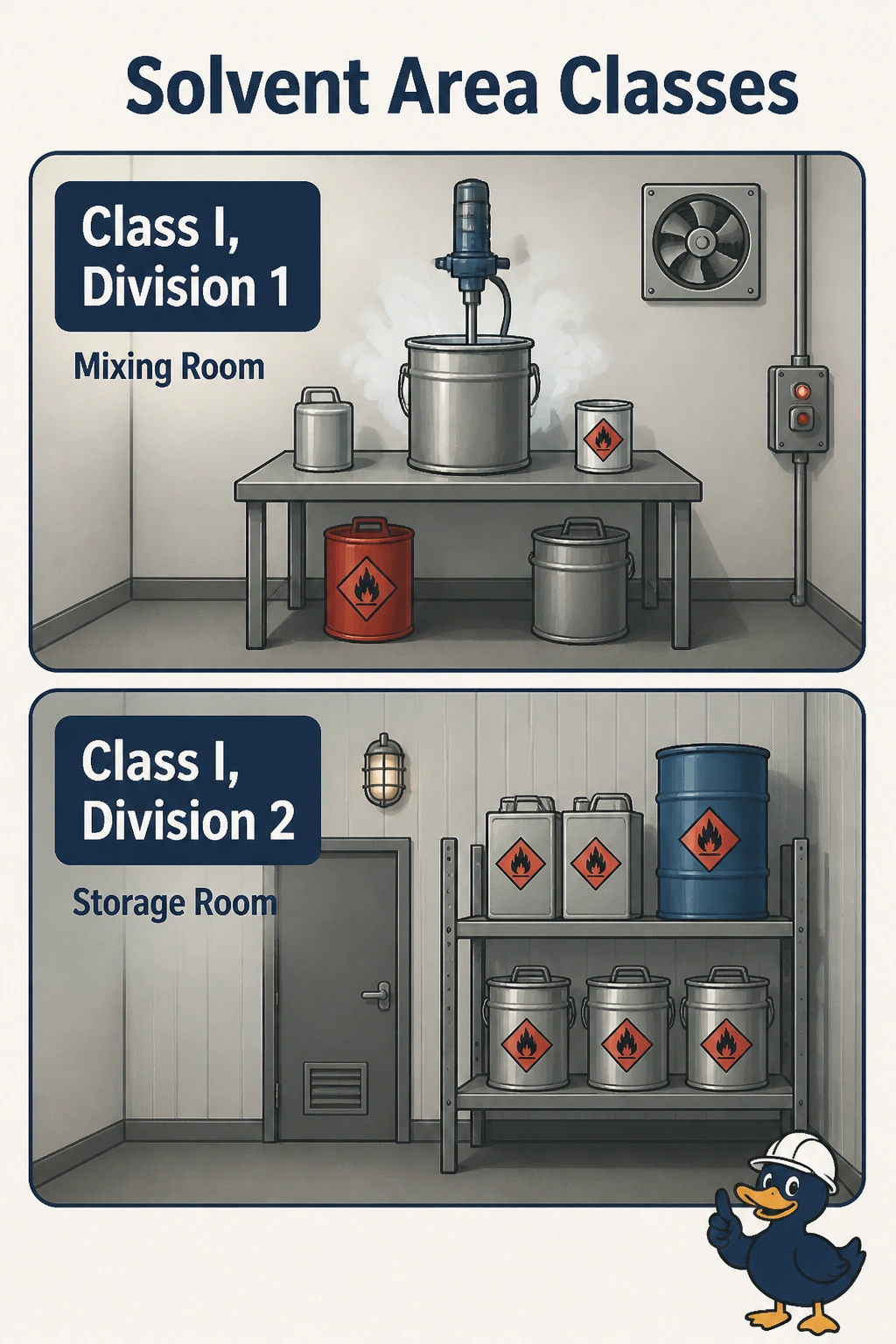
An electrical engineer is specifying motors for two areas of a solvent-blending plant: the inside of an open mixing room where ignitable vapors are present continuously during normal operation, and an adjacent storage room where vapors only escape during an accidental drum rupture. How are these two areas classified?
Select an answer to reveal the explanation.
Short Explanation
Think of the hazardous-location class as what is in the air and the division as how often it escapes. Once you match flammable vapors to the first class and normal operations to the first division, you will dodge the classic trap of flipping the divisions.
Full Explanation
Under OSHA 29 CFR 1910.307 hazardous location classifications, Class I locations are those in which flammable gases or vapors are or may be present in the air in quantities sufficient to produce explosive or ignitable mixtures. Division 1 applies where ignitable concentrations exist continuously, intermittently, or periodically under normal operating conditions, whereas Division 2 applies where volatile flammable liquids or gases are handled in closed containers or systems and escape only during accidental rupture or abnormal operation. Therefore, Class I, Division 1 for the mixing room and Class I, Division 2 for the storage room is correct. Class II, Division 1 for the mixing room and Class II, Division 2 for storage is incorrect because Class II covers combustible dusts rather than solvent vapors. Class I, Division 2 for the mixing room and Class I, Division 1 for storage reverses the normal-versus-abnormal presence definitions. Class III, Division 1 for the mixing room and Class III, Division 2 for storage is incorrect because Class III applies to easily ignitable fibers and flyings. Caveat: electrical equipment must also match the specific gas group and temperature rating for the solvent used. Operational check: compare area classification drawings against installed motor nameplates during pre-startup safety reviews.
Prefer to study offline? Printable PDF study book + test engine ($7.50, unofficial). These questions stay free here.