
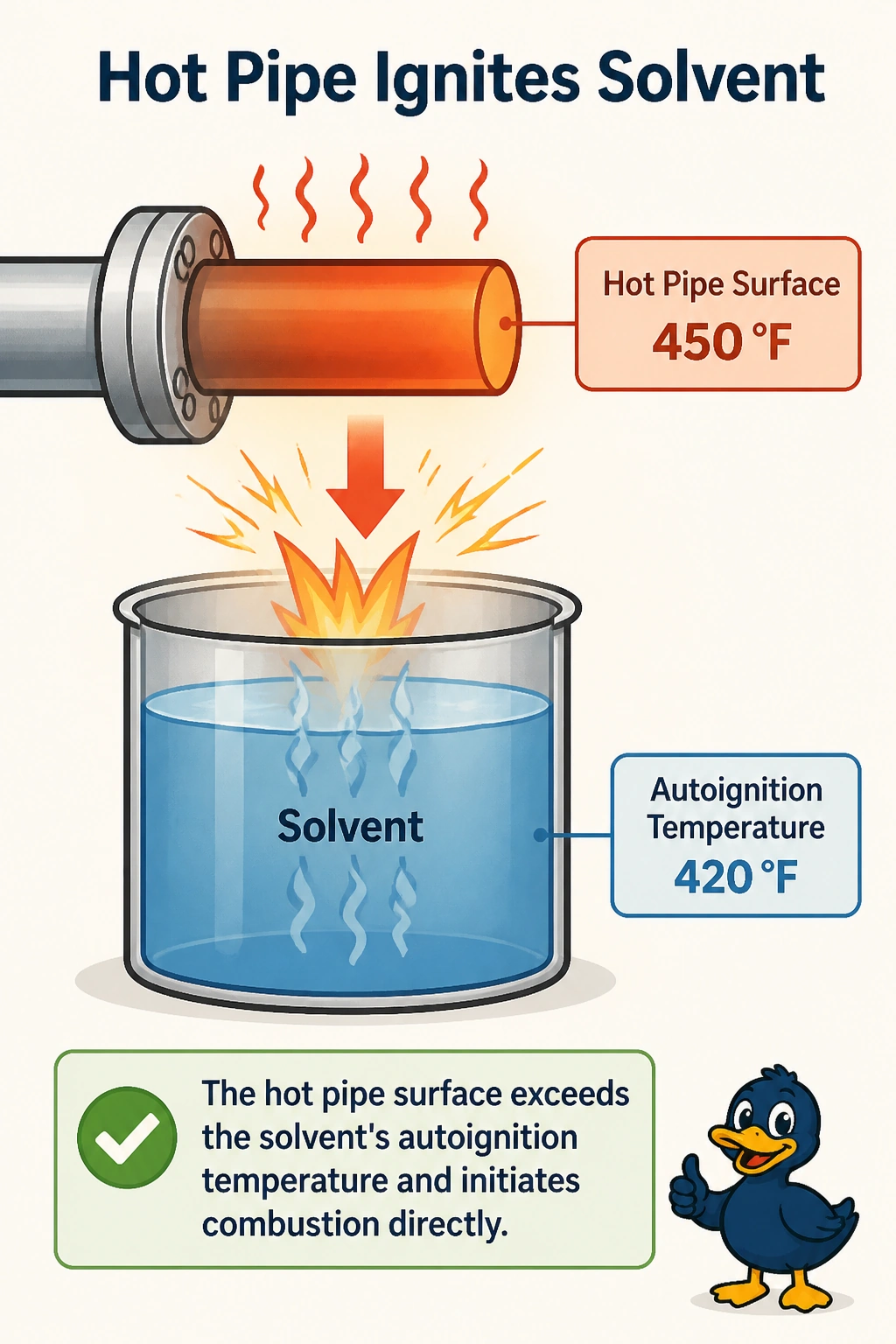
During a process safety review at a plastics plant, engineers route an uninsulated 450-degree-Fahrenheit steam line near an open cleaning trough containing a solvent whose flash point is 55 degrees Fahrenheit and whose autoignition temperature is 420 degrees Fahrenheit. Why can the solvent ignite upon contacting the steam pipe even without an open spark or pilot flame?
Select an answer to reveal the explanation.
Short Explanation
Think of flash point as needing a match, while autoignition temperature brings its own heat to light the fire for you. The common trap is assuming ignition is impossible without a spark, when your uninsulated hot process piping can supply enough thermal energy on its own.
Full Explanation
Because the steam line operates at 450 degrees Fahrenheit, The hot pipe surface exceeds the solvent's autoignition temperature and initiates combustion directly without needing an external spark or flame. Autoignition temperature is the minimum temperature required to initiate self-sustained combustion in air solely from thermal energy. By contrast, claiming that Any surface warmer than the solvent's flash point automatically causes spontaneous ignition without a spark confuses flash point with autoignition; flash point only marks the lowest liquid temperature that releases enough vapor to ignite when an external ignition source is present. Stating that Steam pressure inside the pipe generates static electricity that arcs across the solvent trough misidentifies the ignition mechanism, because conductive metal steam piping grounded to the structure does not create an arc simply from internal steam pressure. Suggesting that The solvent vapors cool below their lower explosive limit and condense into an unstable mist on the pipe is physically backward, since vapors below the lower explosive limit are too lean to burn and a 450-degree pipe heats rather than cools surrounding vapor. As a caveat, autoignition temperatures in Safety Data Sheets are measured under standardized laboratory conditions, while hot surfaces in confined spaces can ignite vapors even near those thresholds. Operationally, audit process piping routes and insulate or shield all hot surfaces near flammable liquid handling areas.
Prefer to study offline? Printable PDF study book + test engine ($7.50, unofficial). These questions stay free here.