
A chemical safety specialist at an adhesive manufacturing plant reviews Safety Data Sheets for two solvents to evaluate ignition risks during open-tray mixing at room temperature. Which property defines the lowest temperature at which a liquid emits enough vapor to ignite momentarily when exposed to an external spark or flame?
Select an answer to reveal the explanation.
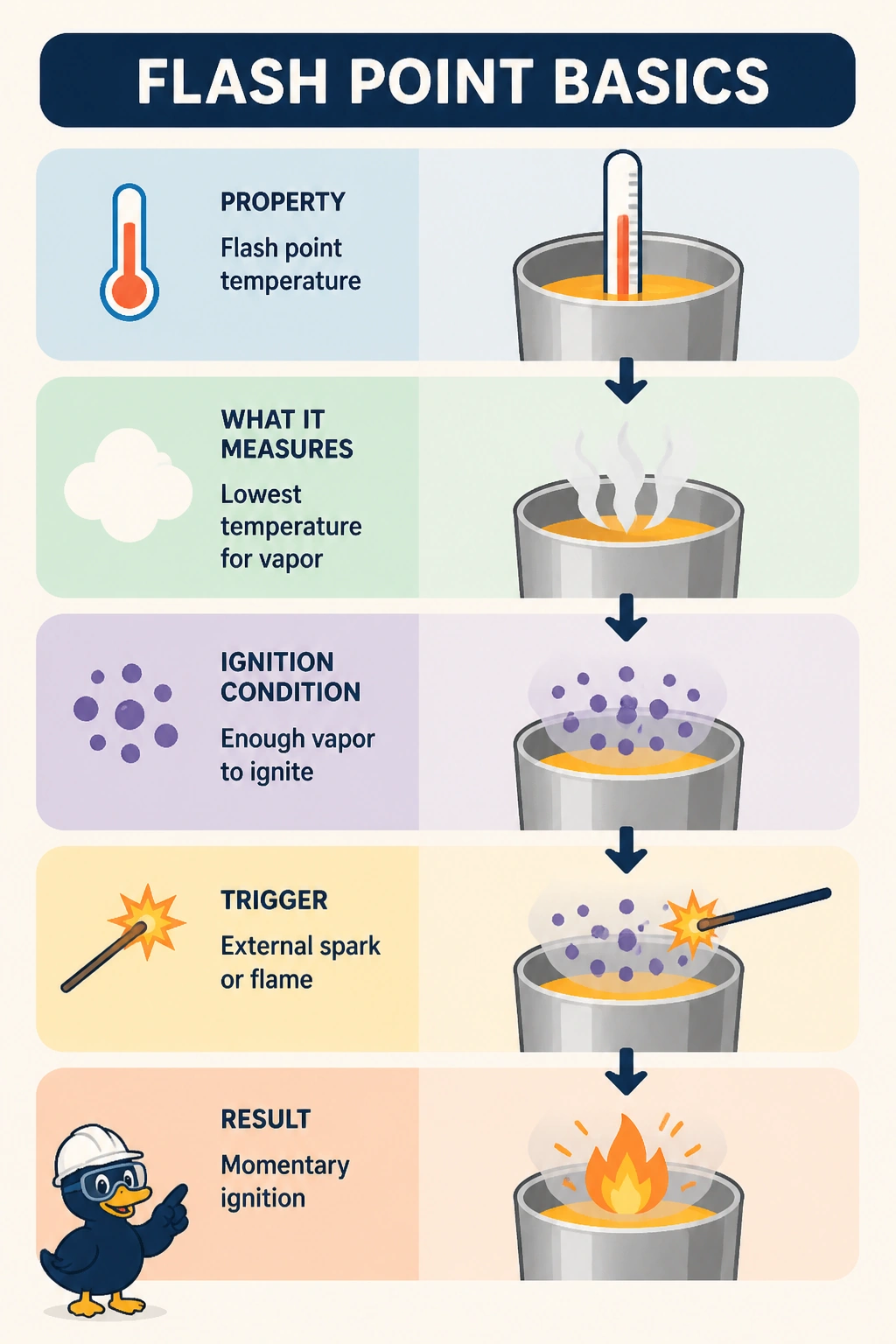
Short Explanation
Think of a solvent’s vapor as kindling waiting for a match: at its flash point, enough vapor can ignite briefly when you introduce a spark or flame. When you review Safety Data Sheets, check whether ignition requires an external source, rather than happening spontaneously.
Full Explanation
The flash point temperature of the liquid is the lowest temperature at which it releases enough vapor near its surface to form an ignitable mixture with air and flash momentarily when an external spark or flame is introduced. Under OSHA 29 CFR 1910.106, flash point is a primary metric for classifying flammable liquids and assessing ignition hazards at ambient operating temperatures. Autoignition temperature describes spontaneous ignition without an external spark or flame, so it does not define the temperature threshold asked about. Lower explosive limit value is the minimum vapor concentration in air, usually expressed as a percentage by volume, needed to propagate a flame; it is a concentration, not a liquid temperature. Boiling point temperature is where vapor pressure equals atmospheric pressure, but a liquid can release dangerous concentrations of ignitable vapor well below that temperature. As an exam caveat, reaching the flash point does not guarantee sustained combustion; a higher temperature is needed for continuous burning. For a practical check, compare each solvent’s flash point in Section 9 of its Safety Data Sheet with maximum process and room temperatures before approving open-tray handling.
Prefer to study offline? Printable PDF study book + test engine ($7.50, unofficial). These questions stay free here.