
A tank-cleaning crew measures hexane vapor inside an empty storage tank and finds the concentration is above the Upper Explosive Limit (UEL). Why does this condition still present a severe fire and explosion hazard?
Select an answer to reveal the explanation.
Short Explanation
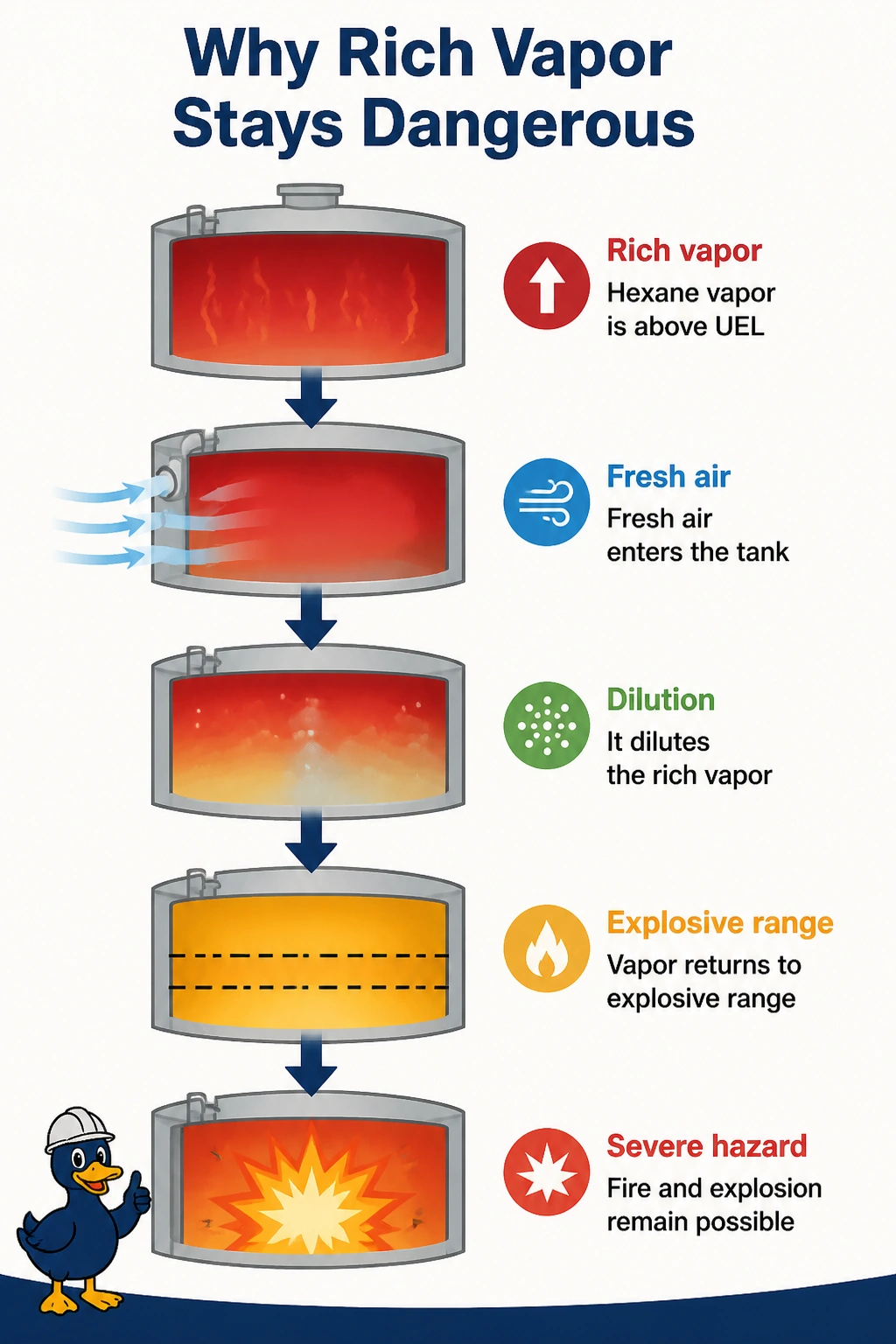
An above-UEL reading can lull you into a false sense of security because the mixture is too rich to burn right now. The trap is forgetting that opening a hatch or starting a blower adds fresh air, diluting the vapor back into the explosive range.
Full Explanation
Flammable vapors ignite only when their concentration in air lies between the Lower Explosive Limit and the Upper Explosive Limit. An atmosphere above the UEL is temporarily too fuel-rich to support combustion, but introducing fresh air dilutes the vapor back into the explosive range, creating an ignitable mixture as ventilation begins or a hatch is opened. The claim that above- UEL vapor spontaneously ignites at room temperature is wrong: autoignition depends on temperature, not exceeding the UEL, and an overly rich mixture lacks sufficient oxygen to burn. The claim that an above- UEL atmosphere contains excess oxygen and accelerates flame speed reverses the chemistry; it is oxygen-starved, not oxygen-enriched. The claim that such vapors permanently disable mechanical ventilation blowers is also false, though a non-explosion-proof blower can provide a fatal ignition source during purging. Exam caveat: catalytic-bead combustible gas sensors can read artificially low in oxygen-deficient, above- UEL atmospheres, so verify oxygen levels first. Practical check: purge with bonded, intrinsically safe ventilation and retest continuously until readings fall well below 10 percent of the LEL.
Prefer to study offline? Printable PDF study book + test engine ($7.50, unofficial). These questions stay free here.