
A maintenance crew uses portable corded power tools on a damp concrete floor inside a water treatment plant, plugged into a Ground-Fault Circuit Interrupter (GFCI) receptacle. How does the GFCI protect a worker from fatal electric shock if tool insulation fails?
Select an answer to reveal the explanation.
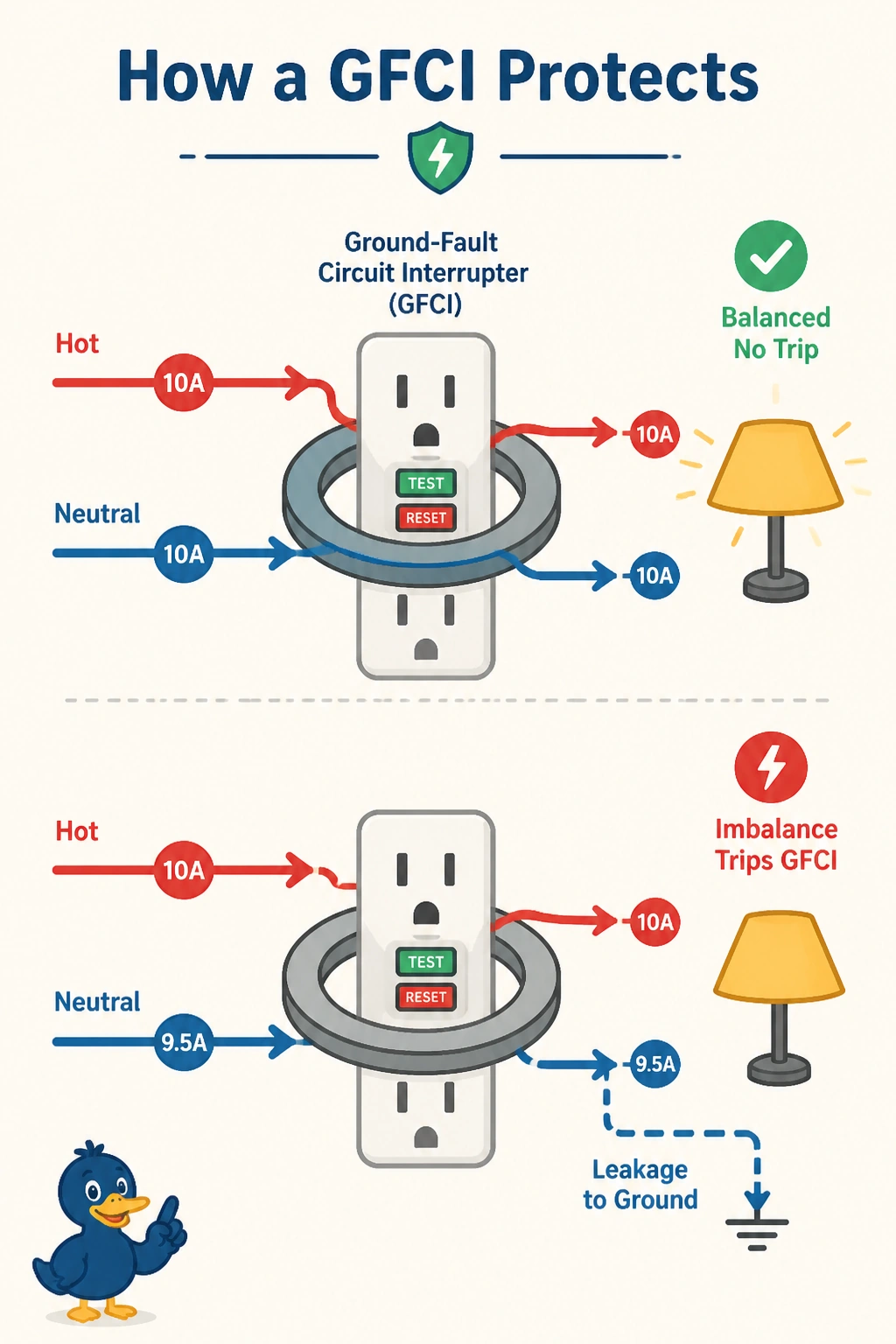
Short Explanation
Think of a GFCI as a vigilant tollbooth counting every amp going out and coming back. The trap is confusing a GFCI with a standard circuit breaker or surge protector, when its real job is tripping in milliseconds the moment your tool leaks a tiny fraction of current through a wet floor or a worker.
Full Explanation
A Ground-Fault Circuit Interrupter protects personnel from electrocution by sensing current escaping the intended circuit path: It compares hot and neutral current and trips when a small imbalance indicates leakage to ground. Inside the GFCI, a differential transformer monitors current flowing out on the ungrounded hot conductor and returning on the grounded neutral conductor; if a worker touches a faulted housing on damp concrete, a few milliamperes divert to ground and the device opens the circuit rapidly. In contrast, the statement that It limits total circuit amperage to prevent branch-circuit wiring from overheating describes a standard overcurrent circuit breaker or fuse, which protects equipment and wiring rather than human heart rhythm. The idea that It lowers line voltage to a safe level before current reaches the portable power tool describes a step-down isolation transformer, not a GFCI receptacle. Likewise, the claim that It absorbs transient voltage spikes caused by inductive motors starting under load refers to a surge protective device, which does not detect ground-fault leakage. Caveat: a GFCI does not protect against shock if a worker contacts both hot and neutral conductors simultaneously without a path to ground. Operational check: press the built-in test and reset buttons on portable and receptacle GFCIs before each shift in damp locations.
Prefer to study offline? Printable PDF study book + test engine ($7.50, unofficial). These questions stay free here.