
An electronics plant introduces two-hour job rotation to reduce carpal tunnel complaints among circuit-board assemblers, rotating them between manual wire crimping and small-part screwdriving. Why does this schedule fail to reduce wrist strain?
Select an answer to reveal the explanation.
Short Explanation
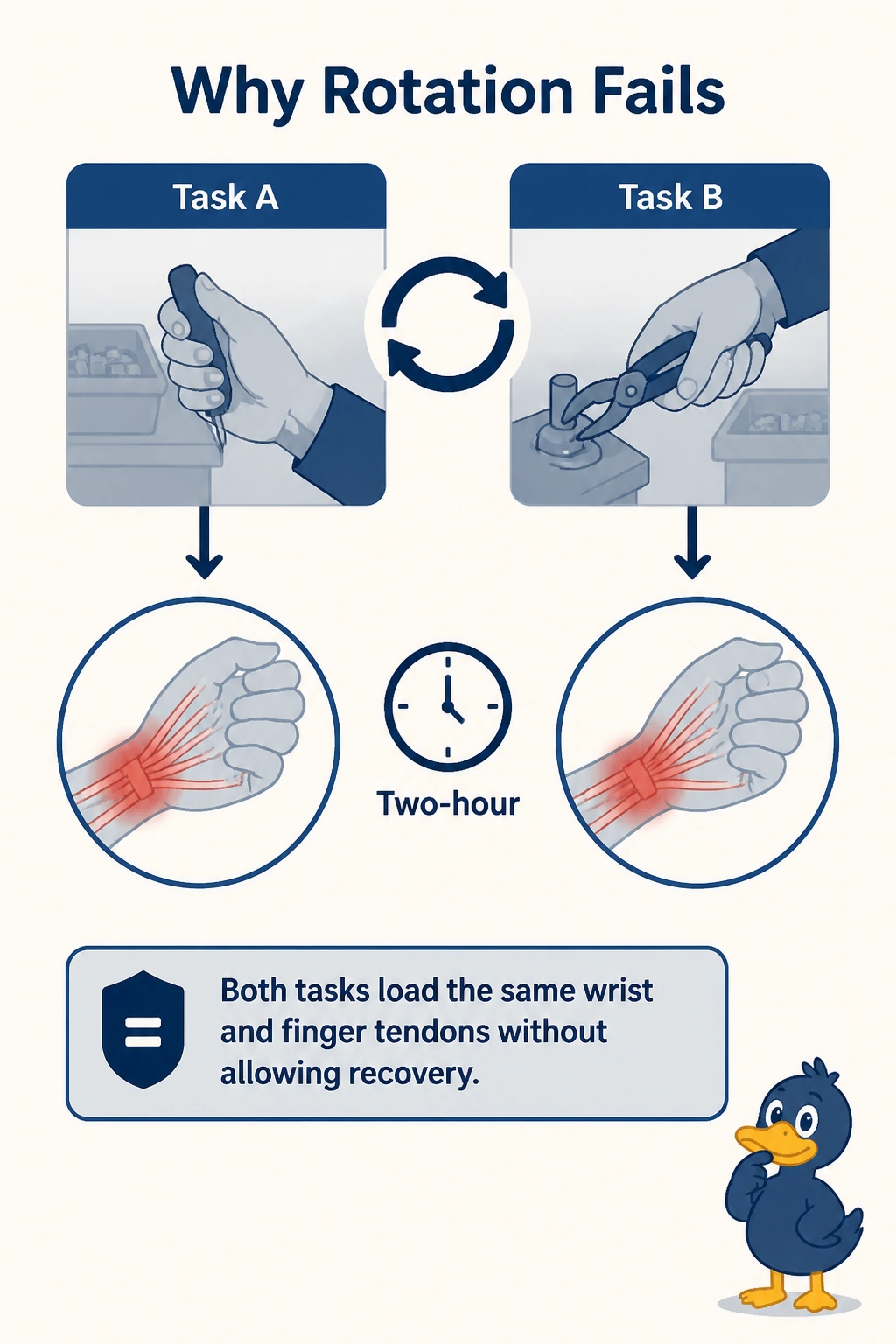
Swapping from manual wire crimping to small-part screwdriving is like resting your sore legs by switching from jogging to climbing stairs. For job rotation to protect your workers, the next task must use different muscle groups instead of hammering the same tendons.
Full Explanation
Administrative controls such as job rotation only reduce musculoskeletal disorder risk when employees move between tasks that place biomechanical demands on different anatomical regions. Recognizing that Both tasks load the same wrist and finger tendons without allowing recovery explains why alternating between crimping and screwdriving fails: both operations require repetitive pinch grips, forearm rotation, and wrist flexion, giving the median nerve and flexor tendons zero rest. Claiming that Job rotation only works when shifts are shortened to four hours total is incorrect; full-shift rotation can succeed when tasks genuinely vary physical demands. Noting that Wire crimping requires standing while screwdriving requires a seated stool changes lower-body posture but does nothing to relieve repetitive upper-extremity loading. Arguing that Rotating every two hours prevents workers from building muscle endurance over time misunderstands cumulative trauma disorders, where continuous high-repetition loading causes tendon inflammation rather than conditioning. As an ergonomic caveat, job rotation is an administrative control that distributes exposure across more workers rather than eliminating the hazard, so engineering controls like pneumatic crimpers and powered inline screwdrivers remain the preferred long-term fix. As an operational check, map the primary joint and grip demands of every station in a rotation sequence to confirm that consecutive tasks stress distinct muscle groups.
Prefer to study offline? Printable PDF study book + test engine ($7.50, unofficial). These questions stay free here.