
During a walkthrough of a forklift battery-charging room where technicians handle sulfuric acid electrolyte, a safety specialist finds pallets stacked in front of the emergency eyewash and shower behind a locked storage door. Why does this violate OSHA's Medical Services and First Aid standard (29 CFR 1910.151(c))?
Select an answer to reveal the explanation.
Short Explanation
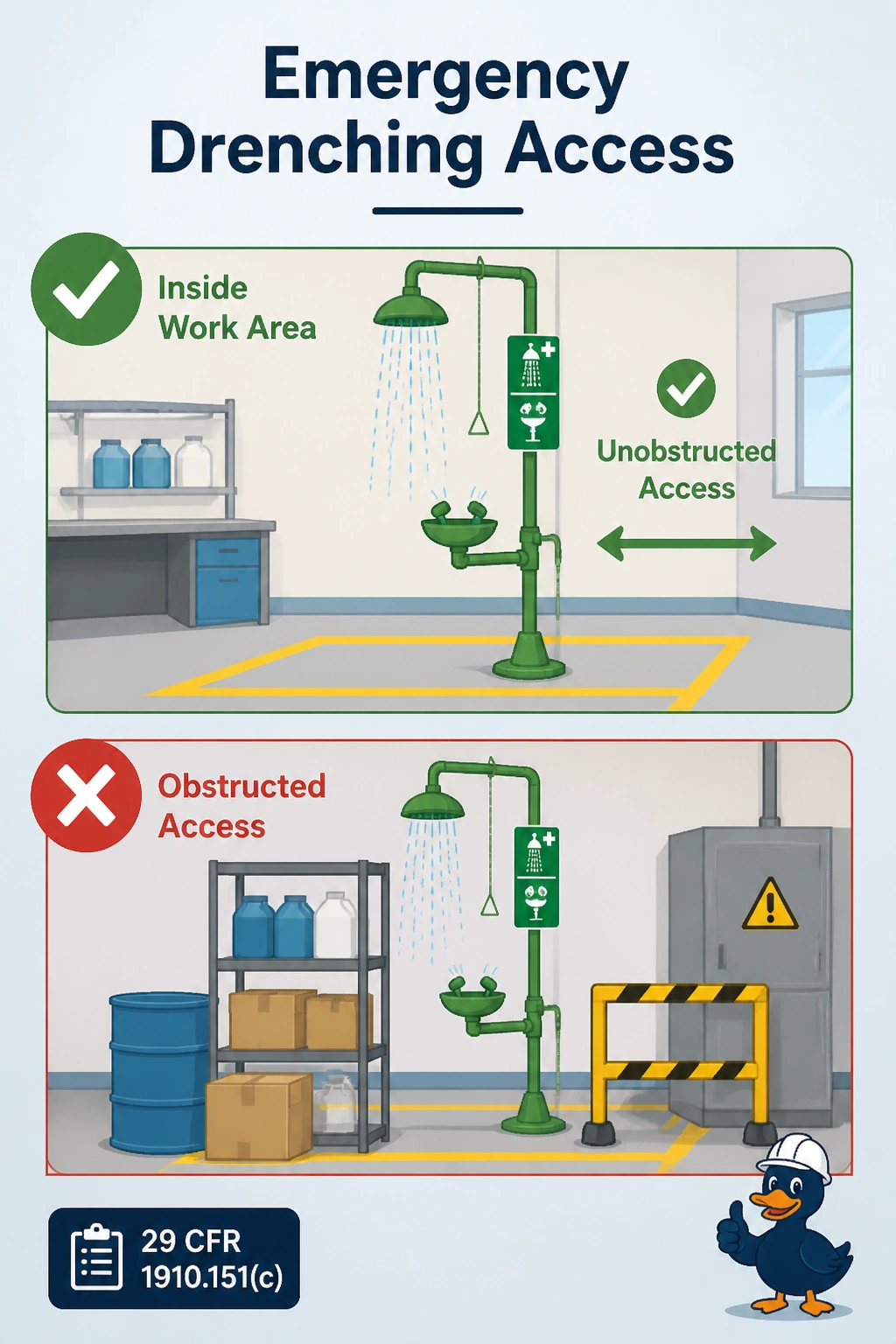
When corrosive acid splashes into a worker's eyes, every second of delay turns a minor exposure into permanent tissue damage. The trap is thinking a locked door with a supervisor key or a pocket squeeze bottle satisfies your emergency flushing duty. OSHA requires quick-drenching facilities inside the work area, completely unobstructed for immediate use.
Full Explanation
Under 29 CFR 1910.151, wherever employees may be exposed to injurious corrosive materials, suitable facilities for quick drenching or flushing of the eyes and body must be provided within the work area for immediate emergency use. Consequently, quick-drenching facilities must be inside the work area and kept unobstructed for immediate emergency use, because a blinded worker cannot climb over pallets or unlock doors. Claiming that battery-charging rooms only require small portable saline squeeze bottles rather than plumbed flushing stations fails because small bottles cannot deliver continuous, high-volume flushing for a full 15-minute decontamination. Stating that locked storage doors are permitted on eyewash rooms as long as every shift supervisor carries a master key is wrong because waiting for a supervisor wastes critical seconds while acid burns ocular tissue. Believing that emergency eyewash stations are only required when employees handle concentrated acids above 50 gallons invents a volume threshold that does not exist in 29 CFR 1910.151. Caveat: ANSI/ISEA Z358.1 guidance commonly referenced by OSHA specifies locating stations within 10 seconds travel time on the same level as the hazard. Operational check: clear all pallets immediately, keep access doors unlocked, and flush-test the unit weekly to confirm flow and clean water.
Prefer to study offline? Printable PDF study book + test engine ($7.50, unofficial). These questions stay free here.