
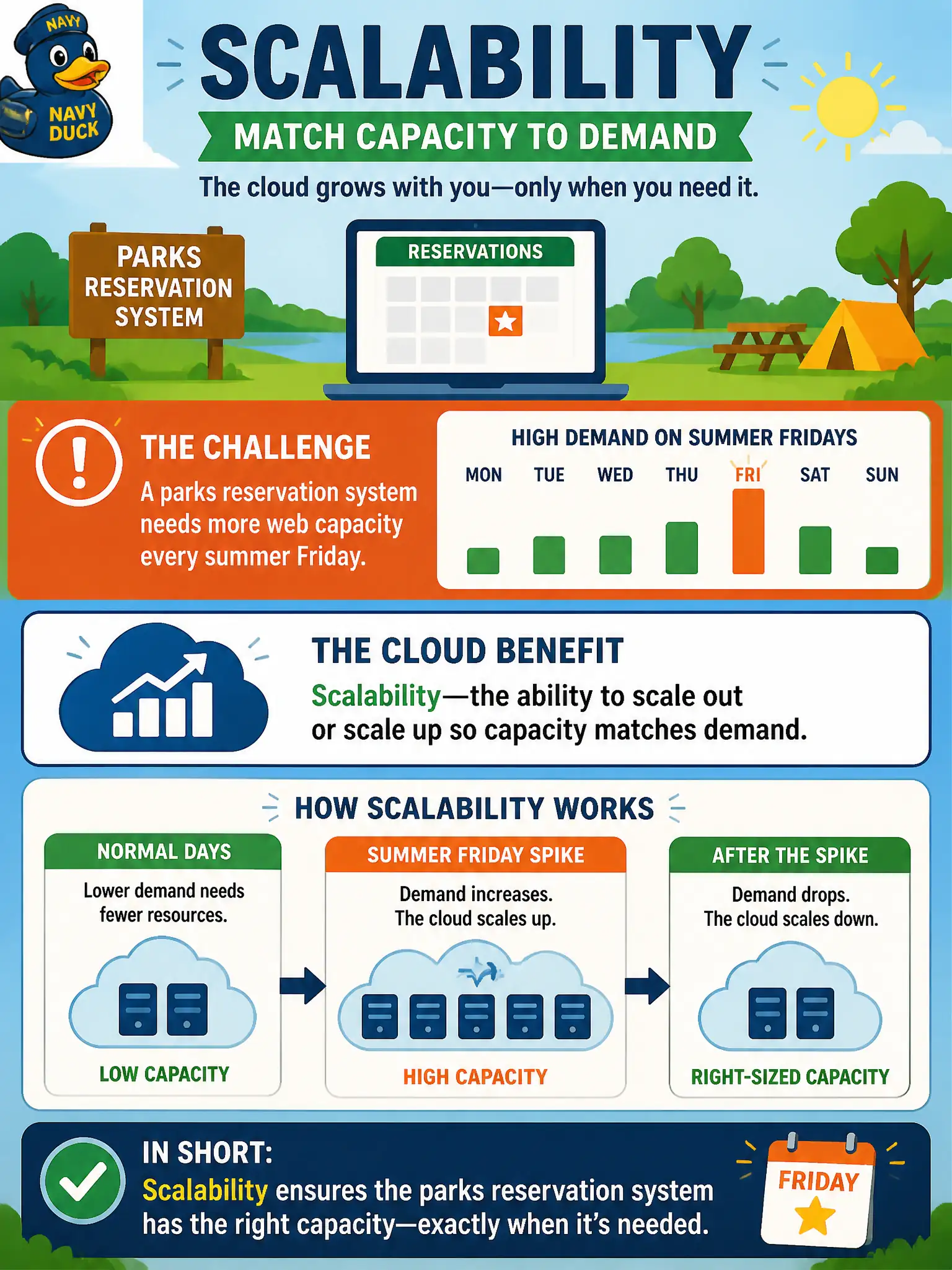
A parks reservation system needs more web capacity every summer Friday. Which cloud benefit describes adjusting capacity to that demand?
Select an answer to reveal the explanation.
Short Explanation
Summer Fridays at the lake are predictable stampedes. Scalability is letting the reservation site grow for the rush—add more instances or a bigger box—then settle back down. Cloud makes that stretch-and-relax story realistic.
Full Explanation
Needing more web capacity every summer Friday is a demand-matching problem. Scalability is the cloud benefit that describes adjusting capacity—scale out (more instances) or scale up (larger resources)—so the parks reservation system can stretch for the rush and settle when demand drops. Cloud makes that stretch-and-settle cycle practical without buying a permanent peak-sized CapEx box in May.
Fixed CapEx sizing that never changes after the first purchase is the rigidity cloud scalability avoids. Deleting the reservation system each Thursday to avoid Friday load is not a capacity strategy. Defining scalability as never being able to add instances or resources inverts the term.
Exam caveat: scalability includes both scale out and scale up; AZ-900 often emphasizes the ability to grow with demand, while elasticity emphasizes how quickly you can expand and contract—related ideas, not always interchangeable wording on every item. Read which verb the question stresses.
Operational check: enable autoscale rules or a documented Friday scale-out checklist for the reservation web tier, then compare Friday peak instance counts and response times against midweek baselines to prove capacity tracked demand rather than a fixed winter-sized box sitting idle all week.