
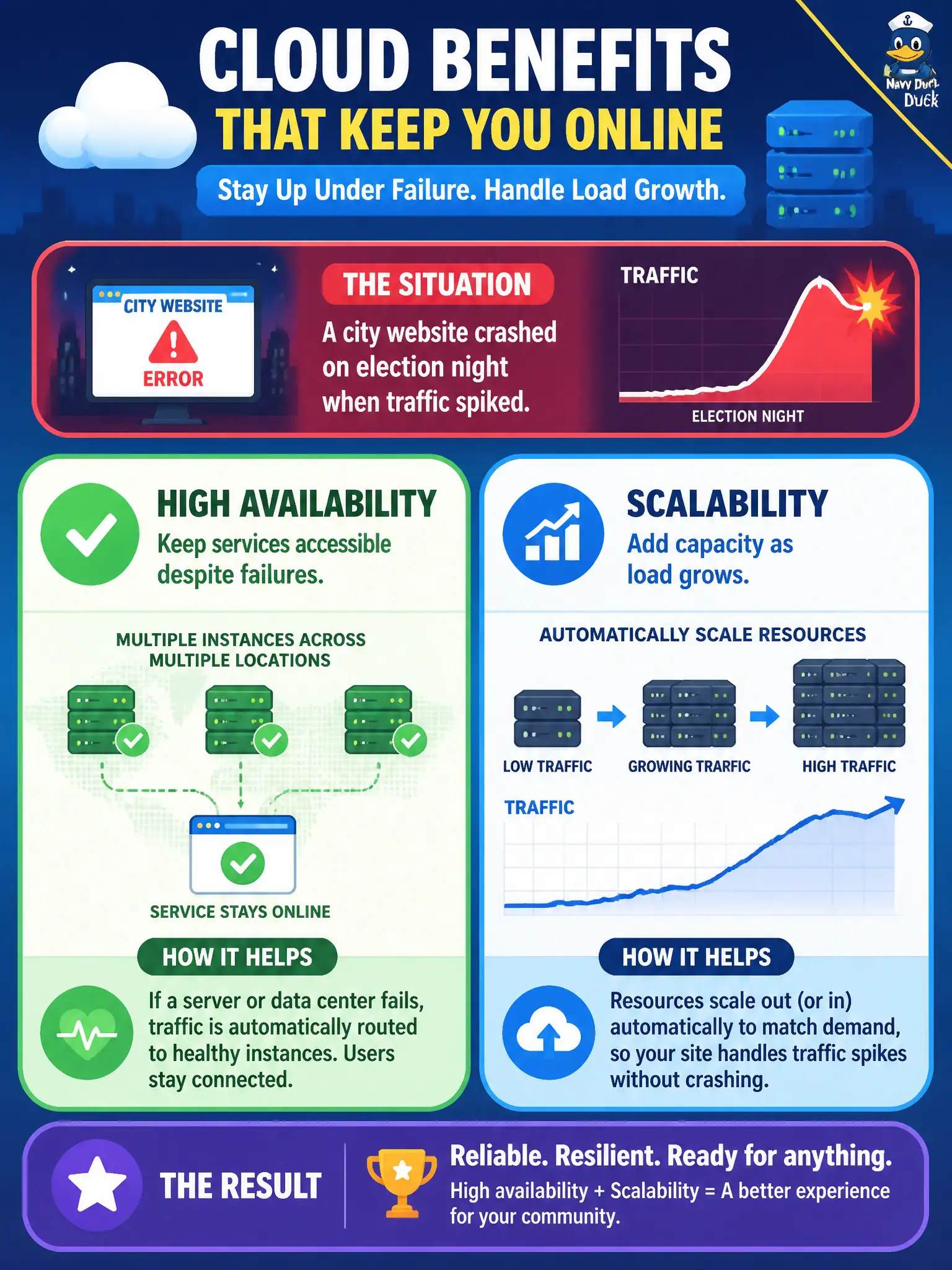
A city website crashed on election night when traffic spiked. Which cloud benefits address staying up under failure and handling load growth?
Select an answer to reveal the explanation.
Short Explanation
Election night is the busiest café in town. High availability is having more than one espresso machine so one breakdown does not close the shop. Scalability is calling in extra baristas when the line hits the door—cloud makes both practical.
Full Explanation
Staying up under failure and handling load growth map to two foundational cloud benefits: high availability (keeping services accessible despite component failures) and scalability (adding capacity as load grows). Election-night traffic needs both—redundancy so one failure does not take the site down, and the ability to grow capacity when voters flood the pages.
Only purchasing a single larger CapEx tower with no redundancy addresses neither HA nor elastic scale. Disabling monitoring so spikes go unnoticed blocks the signals that drive scaling and incident response. Replacing the website with paper ballots because cloud cannot handle traffic is not a cloud-benefit answer and ignores why cities adopt these patterns.
Exam caveat: high availability and scalability are related but not identical—HA is about remaining operational through failures; scalability is about meeting demand. Exam items may test one or both; do not treat every capacity question as purely HA or vice versa.
Operational check: after the next load test or real spike, review whether instances scaled and whether any single-instance failure would have blacked out the site; document gaps as HA versus scale actions so the remediation backlog matches the right benefit.