
A utilities IT manager contrasts buying a five-year physical server with paying monthly for Azure capacity. Which statement correctly frames CapEx versus OpEx in a consumption-based cloud?
Select an answer to reveal the explanation.
Short Explanation
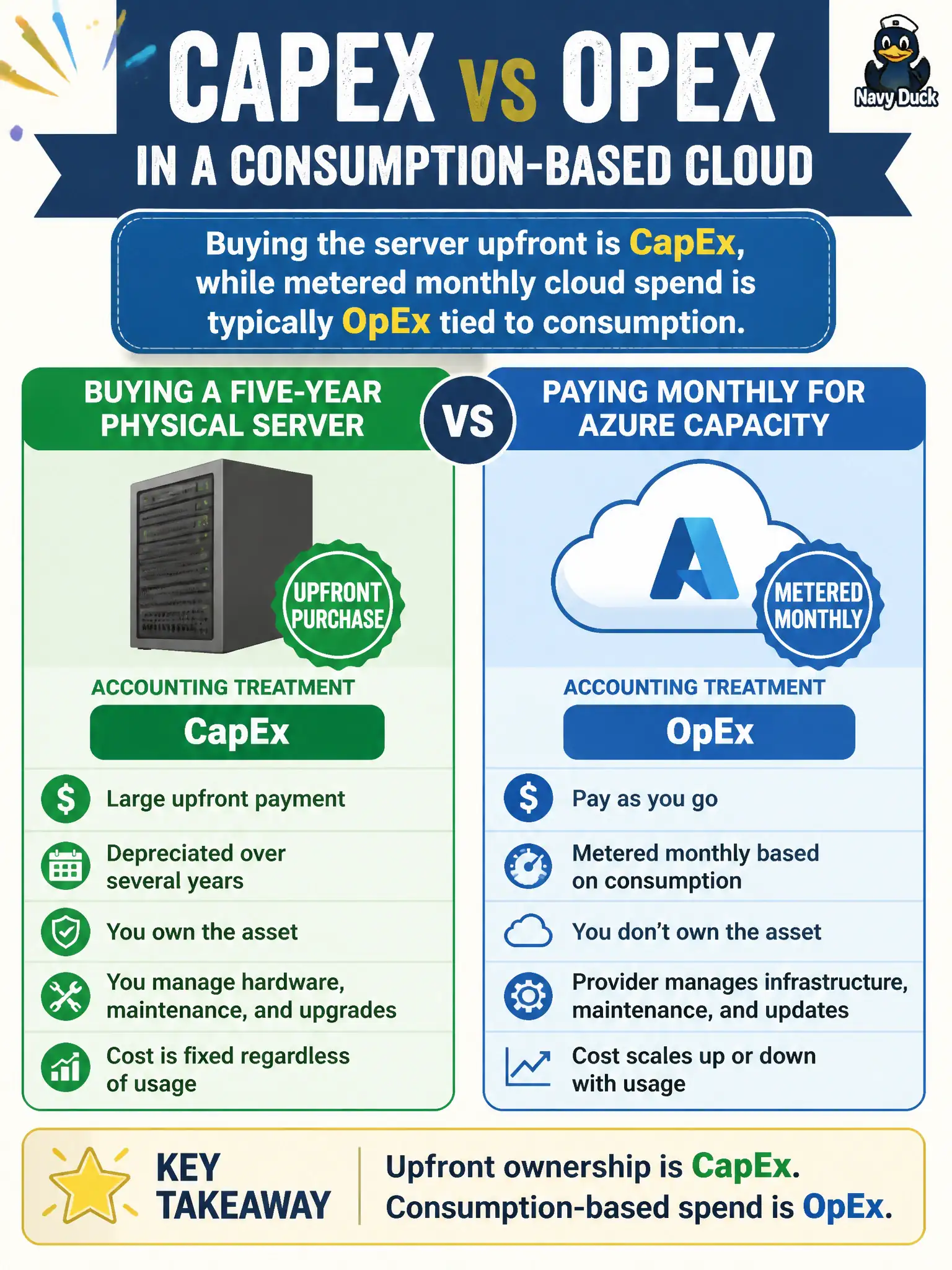
Buying the big server is like paying cash for a city plow truck you own for years—that is capital spend. Renting Azure by the month is more like leasing fuel and garage space as you go—operating spend that follows how much you actually use.
Full Explanation
Capital expenditure (CapEx) is money spent upfront to acquire assets the organization owns and depreciates over years—buying a five-year physical server for the utilities shop is classic CapEx. Operating expenditure (OpEx) covers ongoing operating costs. Metered monthly Azure capacity is typically treated as OpEx because the city pays for consumption as it goes rather than purchasing hardware to own. In a consumption-based cloud, that OpEx link to usage is the point: spend tracks what the department actually runs instead of a large capital outlay sitting on the balance sheet.
Calling the five-year server purchase OpEx mislabels ownership spend as operating cost. Treating monthly Azure invoices as CapEx that must be capitalized for five years confuses cloud rent with buying an asset. Saying CapEx and OpEx are identical so the purchase-versus-rent choice does not matter erases a core fundamentals contrast AZ-900 expects you to describe for public-sector budgeting conversations.
Exam caveat: accounting treatment can vary by jurisdiction and finance policy—AZ-900 teaches the conceptual CapEx-versus-OpEx framing for cloud versus owned hardware, not a substitute for the city’s GAAP or municipal finance rules.
Operational check: when comparing quotes for the next utilities refresh, list the upfront server hardware CapEx line separately from the projected monthly Azure compute and storage OpEx, and walk finance through how scaling the cloud footprint up or down changes OpEx without another capital purchase cycle.