
A council member asks why a shut-down test virtual machine should cost less than a running one. Under a consumption-based cloud model, what best explains the difference?
Select an answer to reveal the explanation.
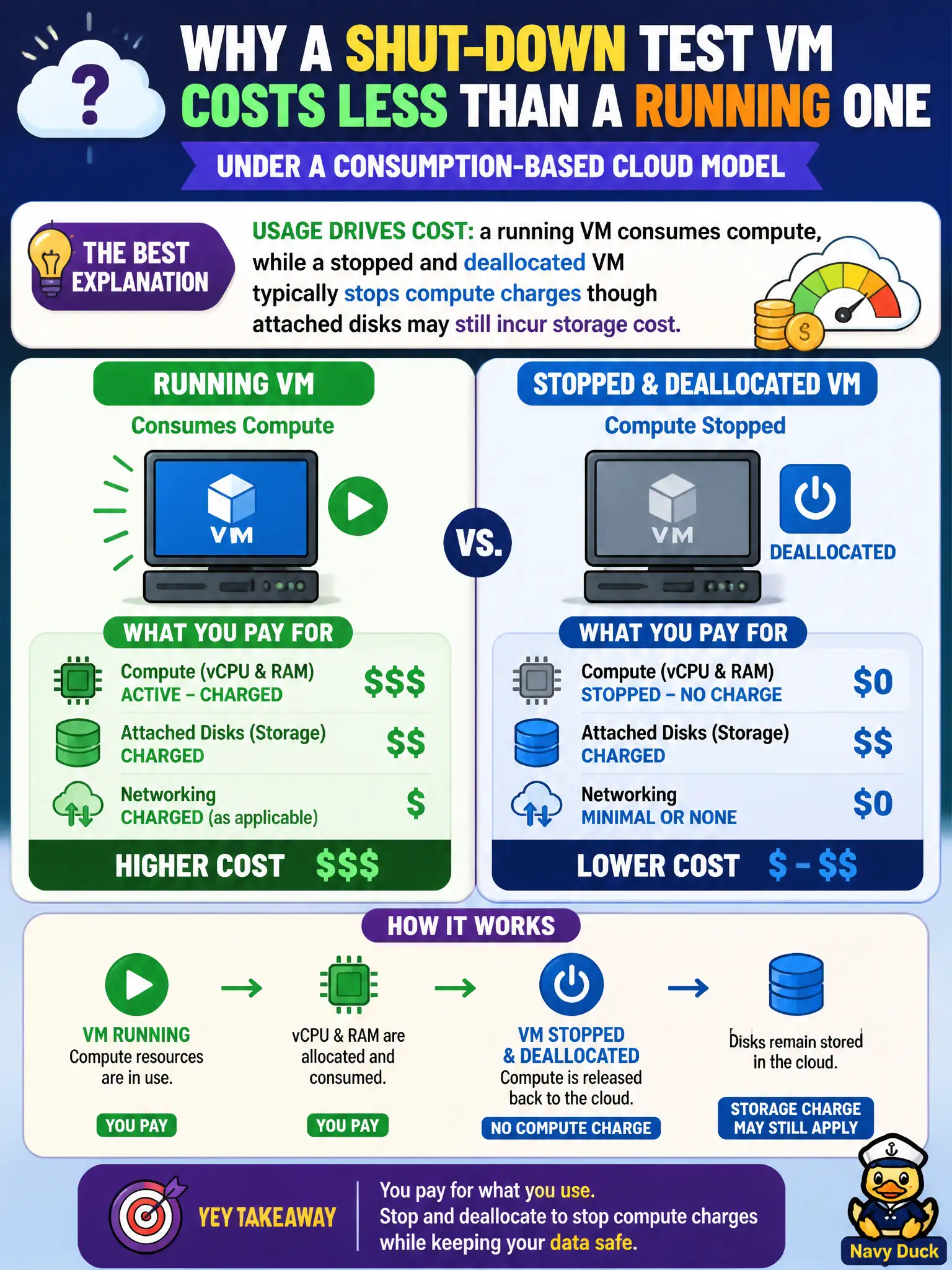
Short Explanation
Picture a taxi meter: it ticks while you are riding, not while the car sits unused in the garage. A deallocated test VM is like parking the taxi—you stop paying for the ride (compute), though you might still pay to keep the suitcase (disk) in storage.
Full Explanation
Under a consumption-based cloud model, cost follows what you actually use. A running virtual machine consumes compute (vCPU and memory) continuously, so compute meters keep accruing. When the test VM is stopped and deallocated, that compute capacity is released back to the platform and typical compute charges stop for that instance. Attached managed disks and some networking or public IP resources can still incur storage or reservation-style charges because those assets remain provisioned even while the VM is not running. That distinction answers the council member: shut-down and deallocate the test box to cut compute spend, but expect residual storage cost for disks you keep.
A flat fee for every VM regardless of power state contradicts consumption metering—Azure does not bill all VMs as always-on CapEx clones. Assuming shut-down permanently deletes disks is wrong and dangerous for a pilot; deallocation is not the same as deleting disks or the VM resource. Claiming consumption billing applies only to on-premises CapEx servers reverses the model: CapEx is the upfront hardware purchase; consumption is the cloud’s metered OpEx path.
Exam caveat: “stopped” wording can be ambiguous—know that deallocated (compute released) differs from a stopped-but-still-allocated state in some contexts, and AZ-900 focuses on the concept that unused compute should not keep the full running meter.
Operational check: in Cost Management or the VM overview, confirm the test VM is deallocated after hours, then verify disk SKUs and sizes still appear on the bill so finance understands residual storage spend for the city’s retained OS and data disks.