
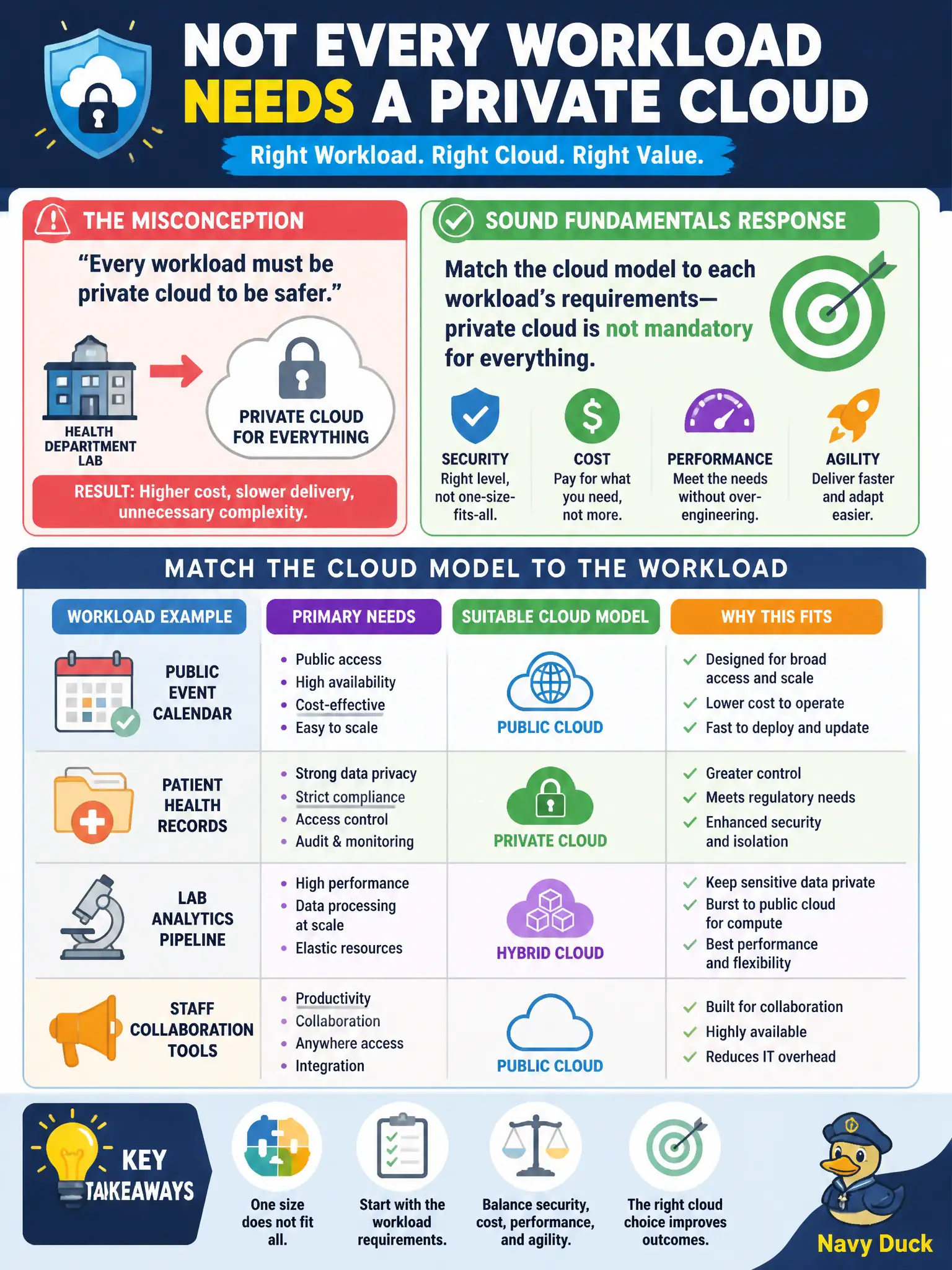
A health-department lab insists every workload must be private cloud "to be safer," including a public event calendar. What is the sound fundamentals response?
Select an answer to reveal the explanation.
Short Explanation
Safer is about the right controls for the data, not slapping "private" on every toaster. A public event calendar rarely needs a private cloud fortress. Pick the model that fits the risk, not a one-size slogan.
Full Explanation
Cloud models should match each workload’s requirements. Private cloud is not mandatory for everything, and insisting every health-department workload—including a public event calendar—must be private “to be safer” confuses slogan with risk management. Low-sensitivity public information often fits public cloud with appropriate controls, while higher-sensitivity lab systems may justify stronger isolation.
Agreeing that private cloud is required for every workload including public calendars over-applies isolation and usually wastes cost and staff effort. Requiring hybrid for an event calendar when no on-premises system is involved misuses hybrid. Declaring public cloud illegal for any municipal website regardless of sensitivity is not a fundamentals rule.
Exam caveat: “safer” depends on identity, configuration, encryption, and monitoring as much as on private versus public tenancy. Operational check: classify the event calendar’s data, select public cloud if appropriate, apply least-privilege access and content controls, and reserve private/dedicated patterns for workloads whose requirements actually demand them. Workload-by-workload model selection also improves budget conversations: isolate spend on high-control private environments to systems that truly need them, and avoid taxing every low-risk public page with private-cloud overhead that does not improve citizen outcomes.