
Council confuses "private cloud" with renting a cage in someone else's datacenter. Which clarification is correct?
Select an answer to reveal the explanation.
Short Explanation
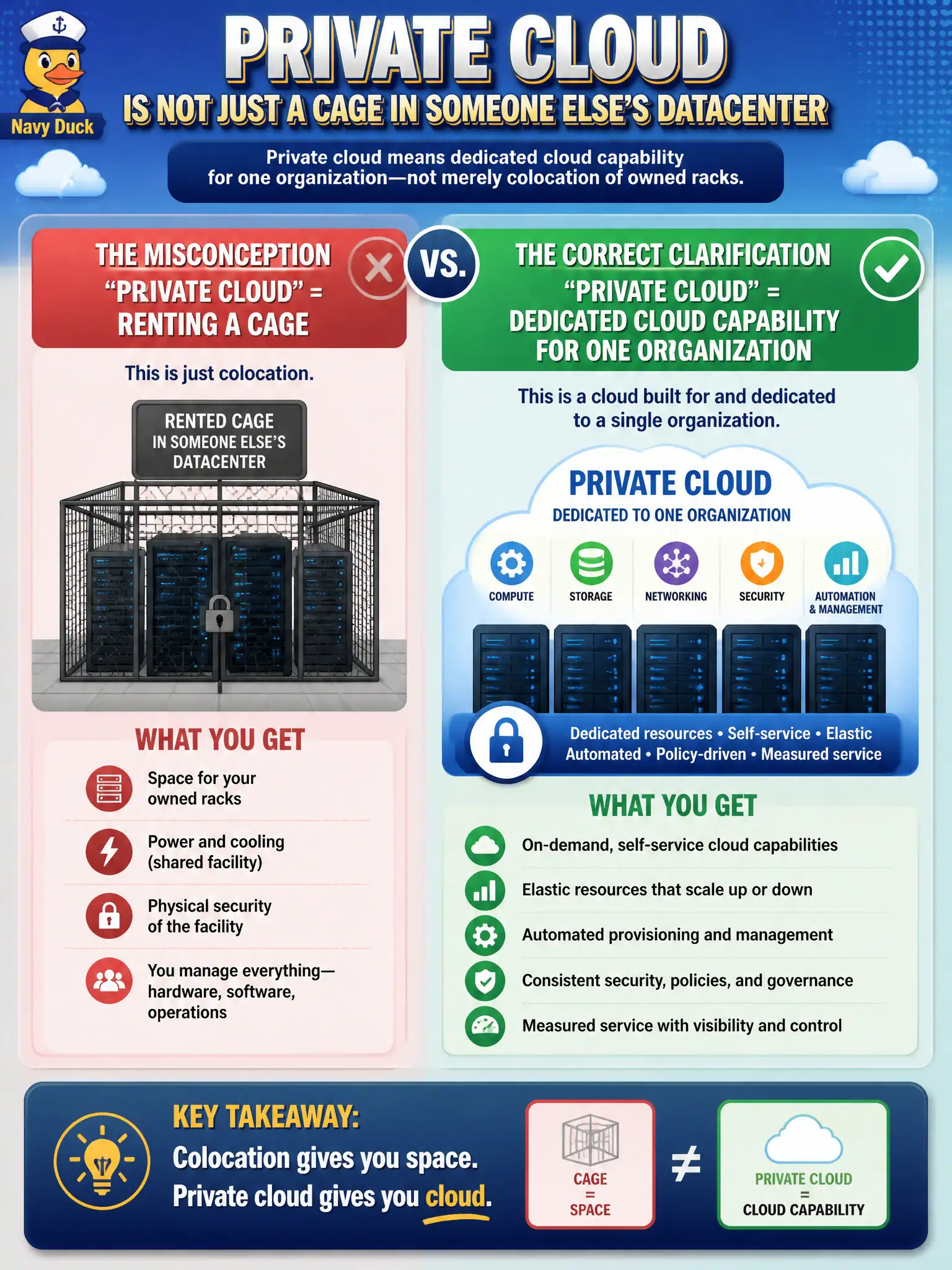
A cage with your servers is still mostly old-school hosting. Private cloud implies dedicated cloud-style services for one org—pooling, self-service, the works—not just a different street address for the same unmanaged metal.
Full Explanation
Private cloud means dedicated cloud capability for one organization—pooling, elasticity, and self-service oriented to a single tenant—not merely renting a cage for owned racks. Colocation primarily supplies facility services while the customer continues traditional server ownership and administration. Council should separate “different street address for our metal” from “dedicated cloud services for our organization.”
Treating private cloud and colocation as identical AZ-900 terms collapses that distinction. Assuming any rented cage automatically becomes private cloud without self-service or elasticity mistakes facility rental for a cloud model. Claiming private cloud only exists inside Microsoft Azure public regions confuses private cloud with public Azure and often with the opposite tenancy model.
Exam caveat: exclusively hosted private cloud can live in a third-party facility, but the offering must still provide dedicated cloud capability—not just power and cooling. Operational check: when a vendor says “private cloud,” ask whether the city receives self-service cloud APIs/portals and dedicated capacity for one organization, or only cage/power/remote hands for customer-managed servers.