
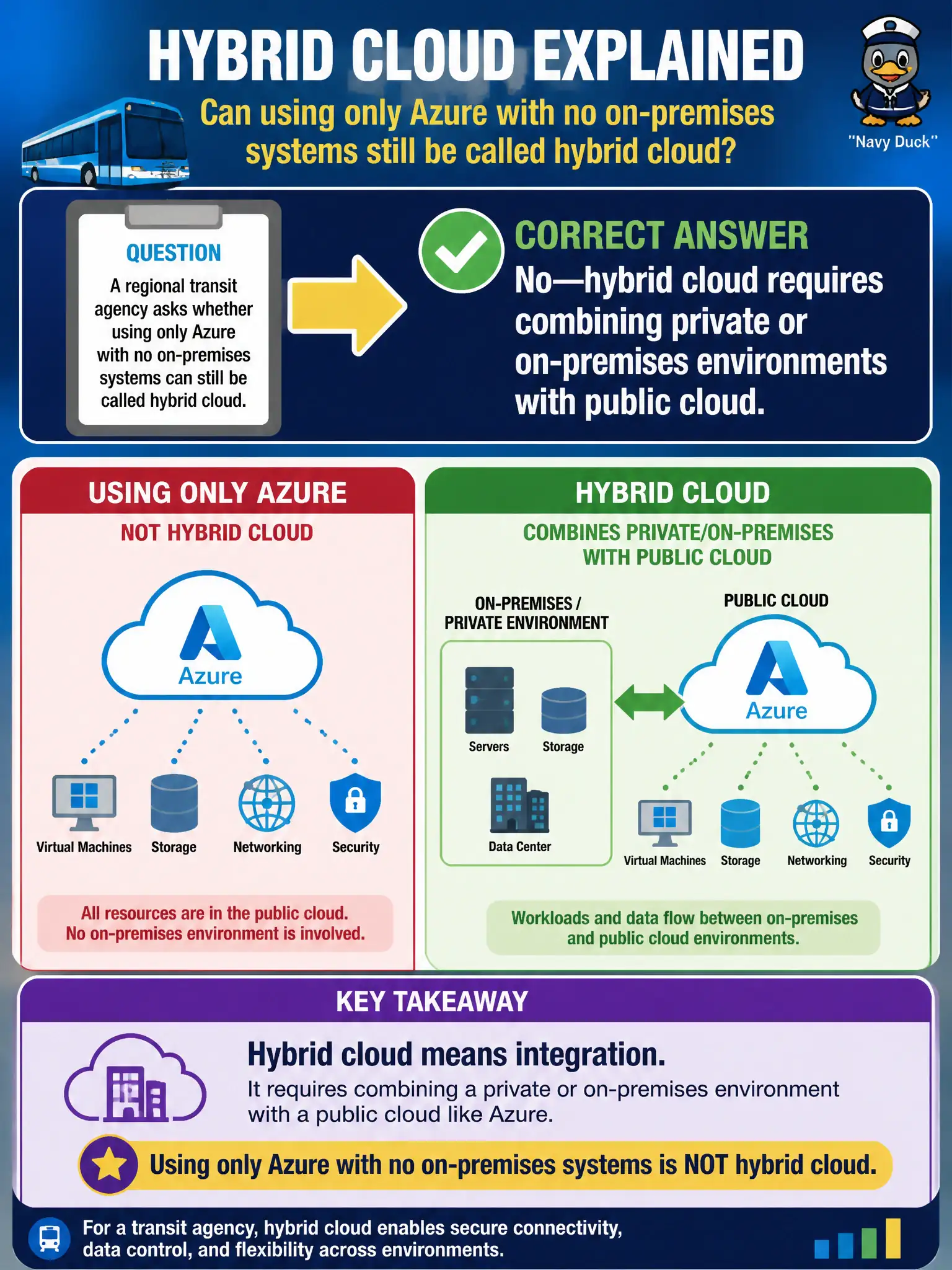
A regional transit agency asks whether using only Azure with no on-premises systems can still be called hybrid cloud. What is the correct answer?
Select an answer to reveal the explanation.
Short Explanation
Hybrid needs both neighborhoods: something private or on-premises plus public cloud. Azure-only is public cloud, full stop. Two Azure regions or two compute types do not invent a hybrid estate.
Full Explanation
Hybrid cloud requires combining private or on-premises environments with public cloud. An agency that uses only Azure with no on-premises or private counterpart is operating in public cloud, not hybrid. The transit scenario’s correct answer is therefore no: Azure-only is not hybrid by default.
Claiming any Azure subscription is hybrid by default empties the word of meaning. Equating hybrid with using more than one Azure region confuses geographic resiliency with cloud models. Equating hybrid with mixing Virtual Machines and App Service in the same subscription confuses service types inside one public cloud with a hybrid estate.
Exam caveat: connecting Azure to an on-premises network for identity or data exchange is a common hybrid pattern—but the on-premises side must actually exist; multi-region Azure alone does not qualify. Operational check: inventory whether any production systems or private cloud remain outside Azure; if the answer is none, document the estate as public cloud and stop labeling it hybrid in council materials. If the agency later interconnects Azure with a retained on-premises system for identity or data exchange, revisit the label—then hybrid may become accurate. Until that private or on-premises counterpart exists, keep council language precise and call the estate public cloud.