
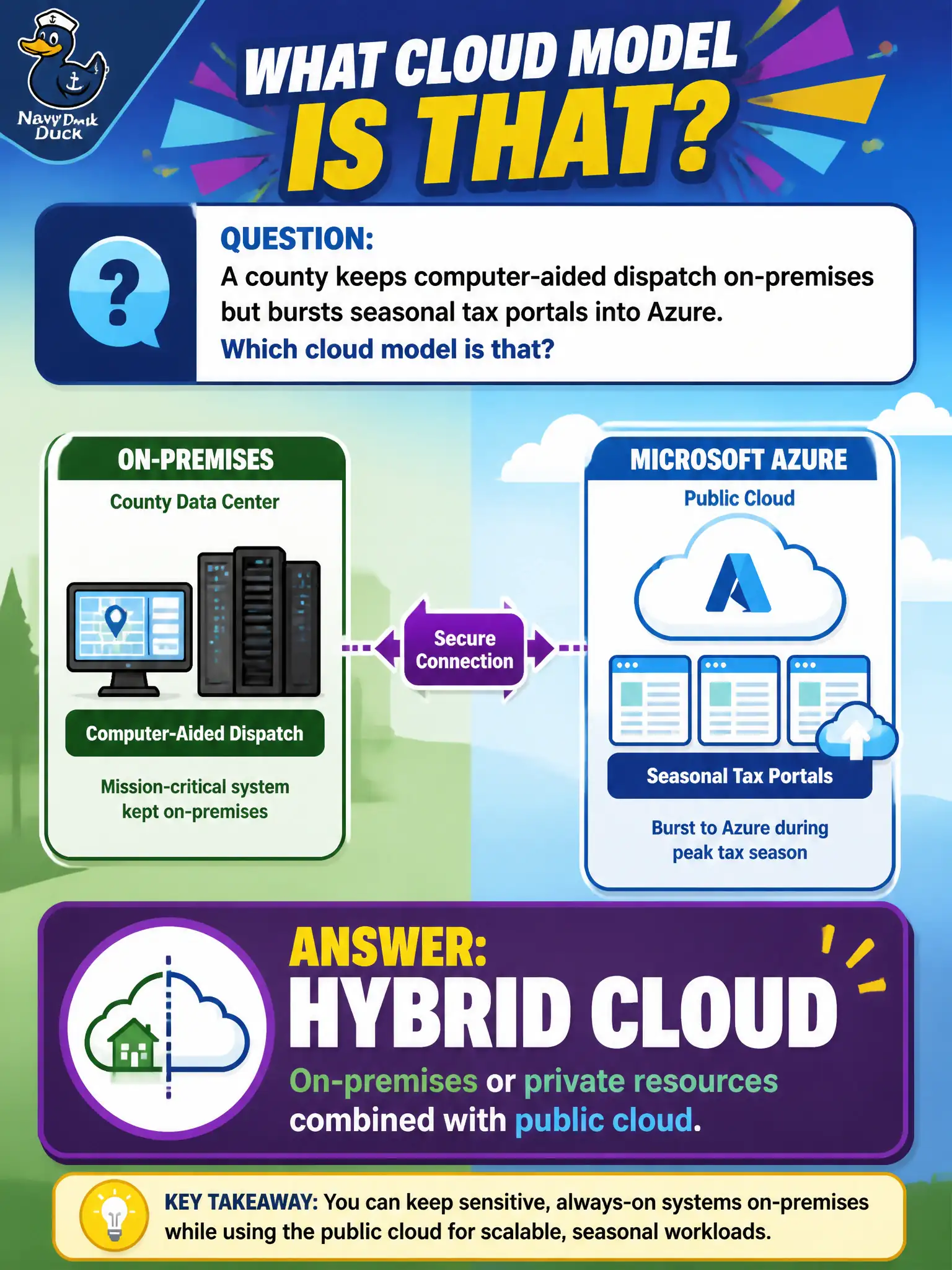
A county keeps computer-aided dispatch on-premises but bursts seasonal tax portals into Azure. Which cloud model is that?
Select an answer to reveal the explanation.
Short Explanation
Keep the critical radio-room systems local, stretch the tax website into Azure when filings spike—that mash-up is hybrid. One foot on-premises, one foot in public cloud. Naming it "public only" ignores the CAD half.
Full Explanation
Hybrid cloud combines on-premises or private resources with public cloud. Keeping computer-aided dispatch local while bursting seasonal tax portals into Azure is a classic hybrid pattern: one side stays constrained to local systems, the other uses public cloud elasticity for variable citizen load. AZ-900 expects candidates to name the combination, not erase half the estate.
Calling the whole design “public cloud only” because Azure appears somewhere ignores the on-premises CAD half. Calling it “private cloud only” because CAD remains local ignores the Azure tax portal. Inventing “edge-only cloud” as a primary AZ-900 model that replaces hybrid for seasonal workloads is not the fundamentals triad of public, private, and hybrid.
Exam caveat: hybrid can include many connectivity and identity patterns; the defining trait is the combination of environments, not a specific product. Operational check: diagram which systems must remain local (CAD) versus which may scale in Azure (tax portals), and verify network, identity, and data-flow controls across that boundary. Seasonal burst patterns are common municipal hybrids: keep always-critical public-safety systems local when policy or latency demands it, and place elastic citizen-facing portals on public cloud where measured capacity tracks filing deadlines rather than year-round peak hardware.