
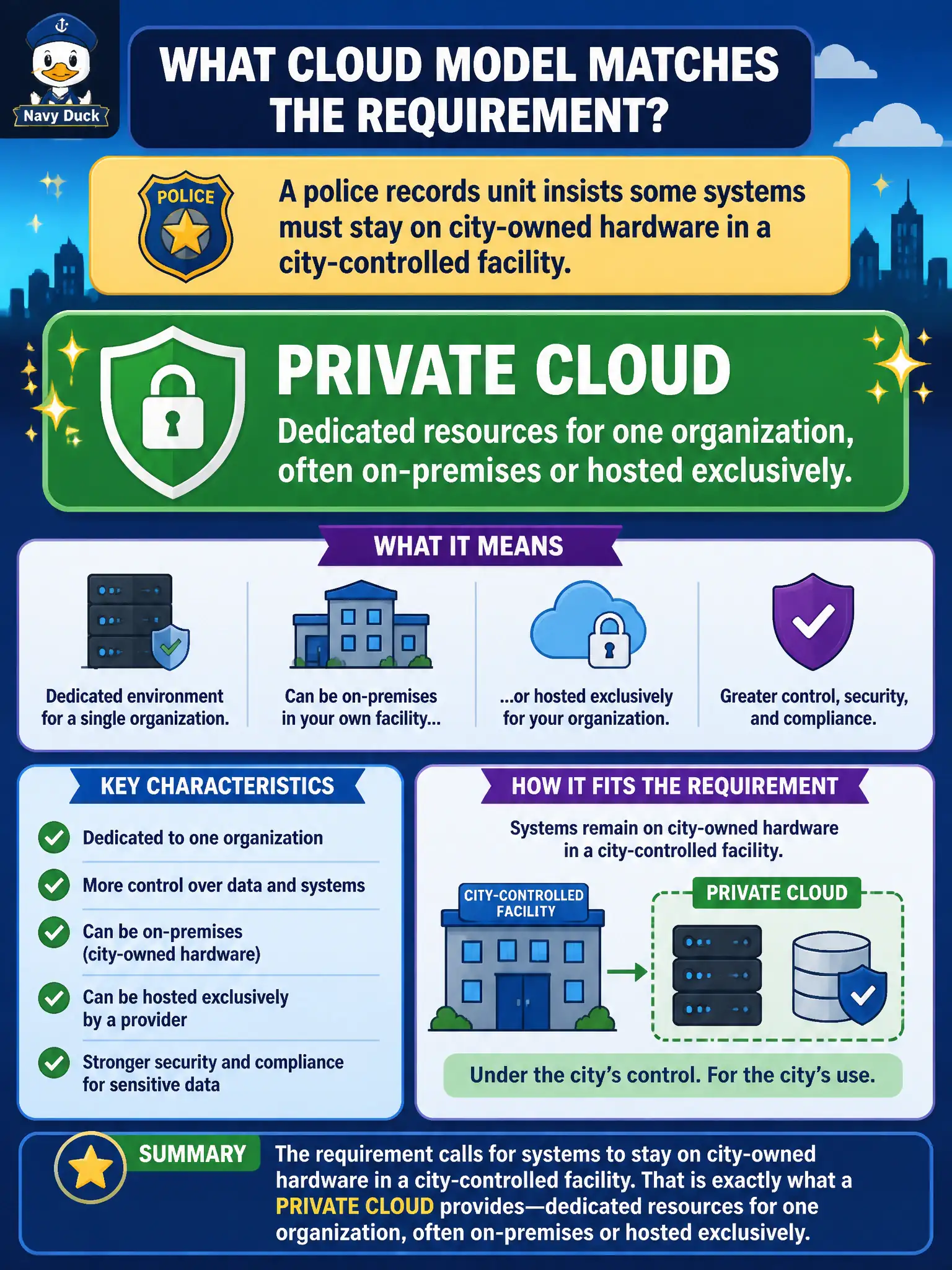
A police records unit insists some systems must stay on city-owned hardware in a city-controlled facility. Which cloud model matches that requirement?
Select an answer to reveal the explanation.
Short Explanation
When one agency needs dedicated gear under its own roof or exclusive hosting, that is private cloud thinking. Public cloud is shared tenancy; hybrid needs both sides. Exclusive city-controlled hardware is the private-cloud story.
Full Explanation
Private cloud provides dedicated cloud-style resources for one organization, often on-premises or in an exclusively hosted environment. A police records unit that insists systems stay on city-owned hardware in a city-controlled facility is describing that exclusive, organization-dedicated posture. The requirement maps to private cloud (or private infrastructure operated with cloud characteristics), not to shared public tenancy.
Forcing police systems into public cloud because shared tenancy supposedly always saves money ignores explicit exclusive-control needs. Claiming community SaaS is the only option and that private cloud is unrecognized contradicts AZ-900’s public/private/hybrid model set. Calling any on-premises system “hybrid” even with no public-cloud connection misuses hybrid, which requires combining private/on-premises with public cloud.
Exam caveat: “private cloud” implies more than owning hardware—it implies cloud capabilities dedicated to one org; pure traditional servers without pooling/self-service may be private infrastructure without fully meeting a cloud definition. Operational check: capture the policy drivers (chain of custody, residency, exclusive control) and confirm whether the unit needs dedicated facilities only, or dedicated facilities plus cloud-style automation.