
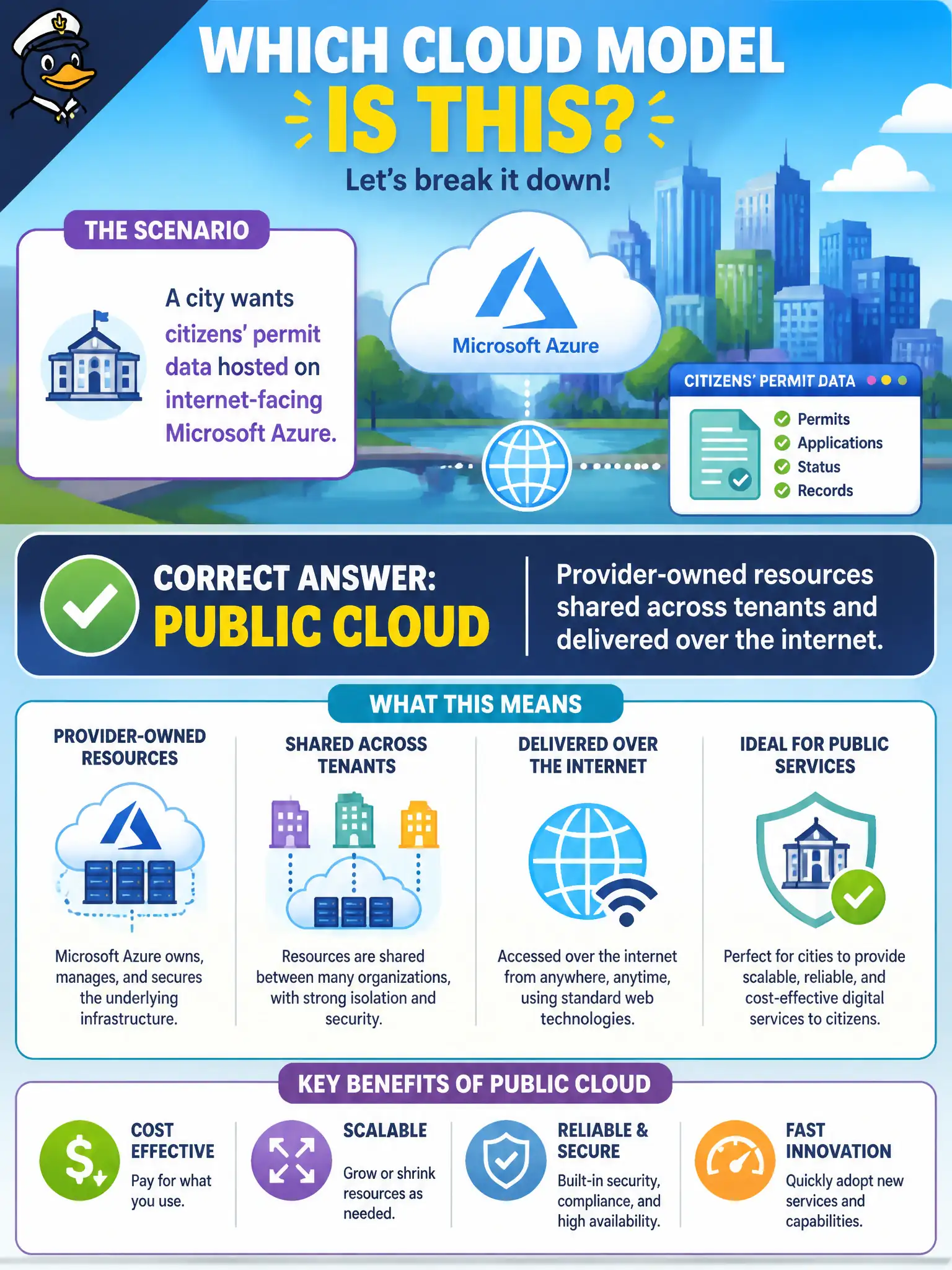
A city wants citizens' permit data hosted on internet-facing Microsoft Azure. Which cloud model does that describe?
Select an answer to reveal the explanation.
Short Explanation
Azure's everyday multi-tenant offering is public cloud: Microsoft's gear, shared platform, reached over the internet. Calling it "private" just because the data matters mixes up sensitivity with the model name. Home browsers do not magically make it hybrid either.
Full Explanation
Hosting citizens’ permit data on internet-facing Microsoft Azure multi-tenant services describes public cloud: provider-owned resources shared across tenants and delivered over the internet. Sensitivity of permit data affects encryption, access control, and compliance design, but sensitivity alone does not rename a public multi-tenant platform as private cloud.
Calling any Azure use “private cloud” because the data is sensitive confuses data classification with deployment model. Labeling the workload hybrid merely because citizens access the portal from home networks confuses user location with architecture; hybrid requires combining private/on-premises environments with public cloud. Inventing “colocation cloud” as an official AZ-900 model that means rented cages inside Azure regions mixes colo hosting with cloud model vocabulary.
Exam caveat: Azure offers mechanisms for isolation and residency controls within public cloud; those controls strengthen a public-cloud posture—they do not automatically convert it into private cloud. Operational check: document the tenancy model, region/residency choices, and identity boundaries for the permit system, and use the term “public cloud” when the platform is Azure’s shared multi-tenant services.