
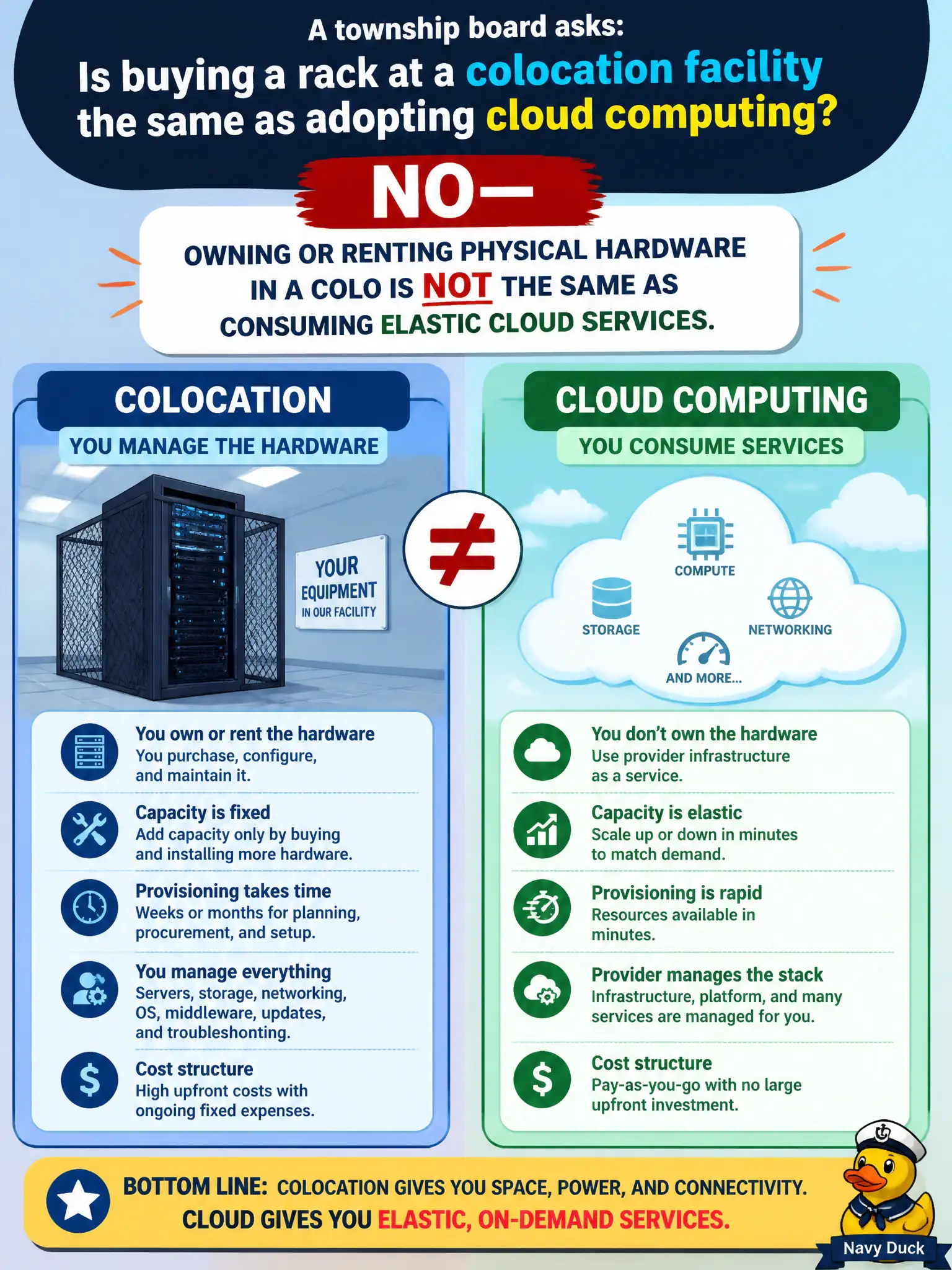
A township board asks if buying a rack at a colocation facility is the same as adopting cloud computing. Which answer is most accurate?
Select an answer to reveal the explanation.
Short Explanation
A rented cage is still your gear with a different landlord. Cloud is when you consume elastic services instead of owning the metal. Location alone does not flip the model.
Full Explanation
Colocation and cloud computing solve different problems. Buying or renting a rack in a colo facility typically means the township still owns or leases the hardware and continues to administer servers much like traditional infrastructure, while the facility provides space, power, and cooling. Cloud computing is defined by consuming elastic, on-demand services over the internet—not by moving metal out of city hall. Therefore owning or renting physical hardware in a colo is not the same as adopting elastic cloud services.
Treating any off-site rack as automatically meeting the cloud definition confuses location with service model. Equating colo and public cloud merely because both move servers away from city hall repeats that location fallacy. Asserting that shared power and cooling alone make a workload “cloud by definition” mistakes facility outsourcing for on-demand elastic capacity.
Exam caveat: some hosted private-cloud offerings can sit in third-party facilities, but the differentiator remains dedicated cloud capability and service traits—not the mere presence of a rented cage. Operational check: if staff still purchase servers, schedule maintenance windows like on-premises gear, and cannot elastically consume metered capacity through a cloud control plane, the board is discussing colo or traditional hosting, not cloud adoption.