
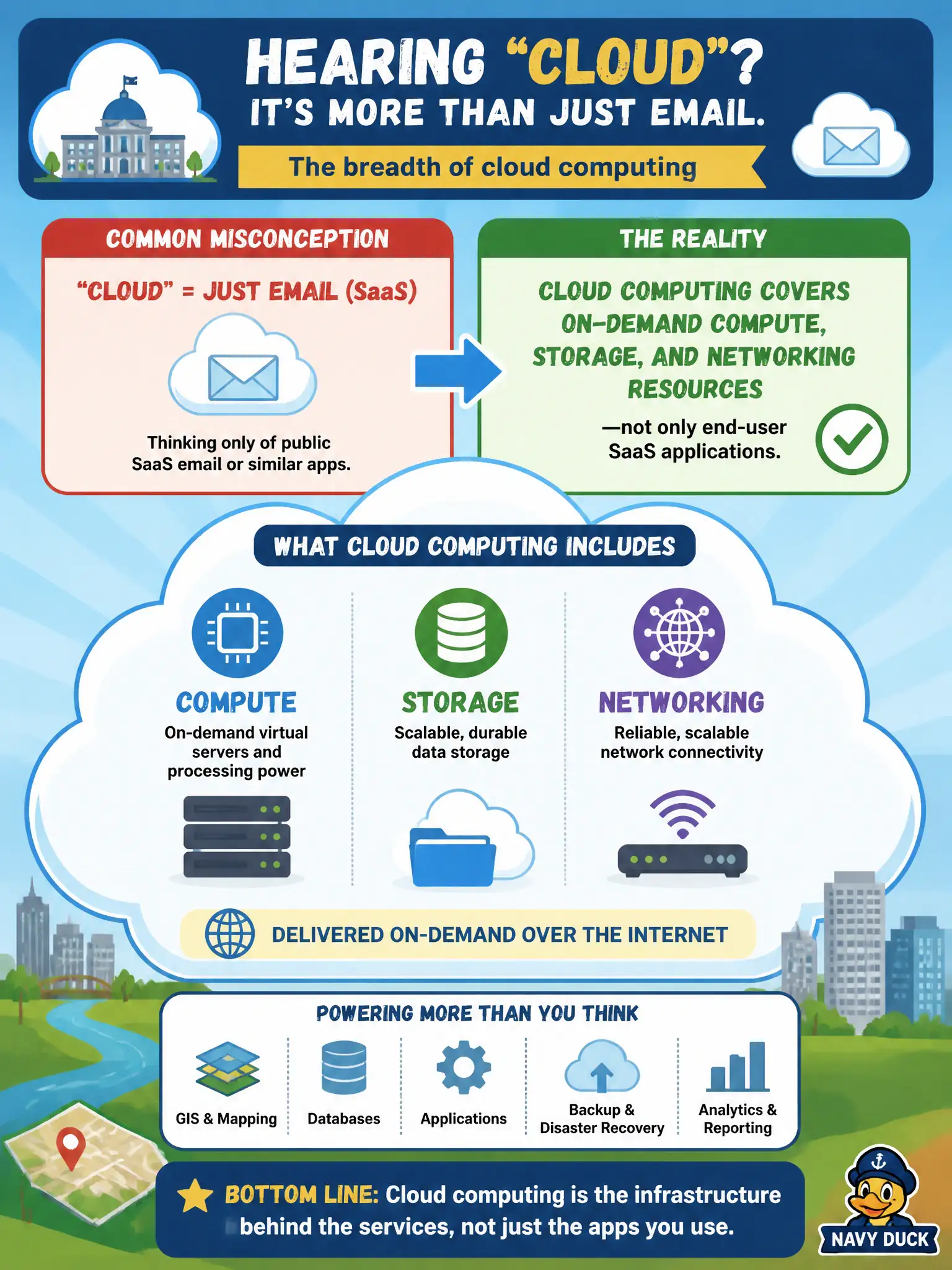
A municipal GIS team hears "cloud" and thinks only of public SaaS email. Which statement correctly describes the breadth of cloud computing?
Select an answer to reveal the explanation.
Short Explanation
Email-in-the-sky is one flavor, not the whole menu. Cloud also means renting compute, storage, and network when you need them. SaaS is part of the picture, but so are the building blocks underneath.
Full Explanation
Cloud computing is broader than any single end-user application category. It covers on-demand compute, storage, and networking resources as well as higher-level platform and software services. A municipal GIS team that equates “cloud” only with public SaaS email is recognizing one familiar SaaS example while missing infrastructure- and platform-style services that remain squarely inside the fundamentals definition.
Limiting cloud exclusively to Microsoft 365-style SaaS mailboxes collapses a delivery model into one product family. Claiming cloud applies only to virtual machines and never includes storage or networking ignores core resource types that Azure and other providers expose as services. Restricting cloud to artificial intelligence APIs while excluding basic infrastructure services swaps a trendy workload category for the actual breadth of cloud computing.
Exam caveat: SaaS, PaaS, and IaaS are service types within cloud computing; naming one SaaS app does not exhaust what “cloud” means on AZ-900. Operational check: when staff say “we moved to the cloud,” ask which resource layers are consumed as services—compute, storage, networking, platforms, or SaaS apps—and confirm the answer is not limited to email alone.