
A public-works IT lead wants one sentence for council explaining how cloud differs from their current always-on servers. Which traits best capture that difference?
Select an answer to reveal the explanation.
Short Explanation
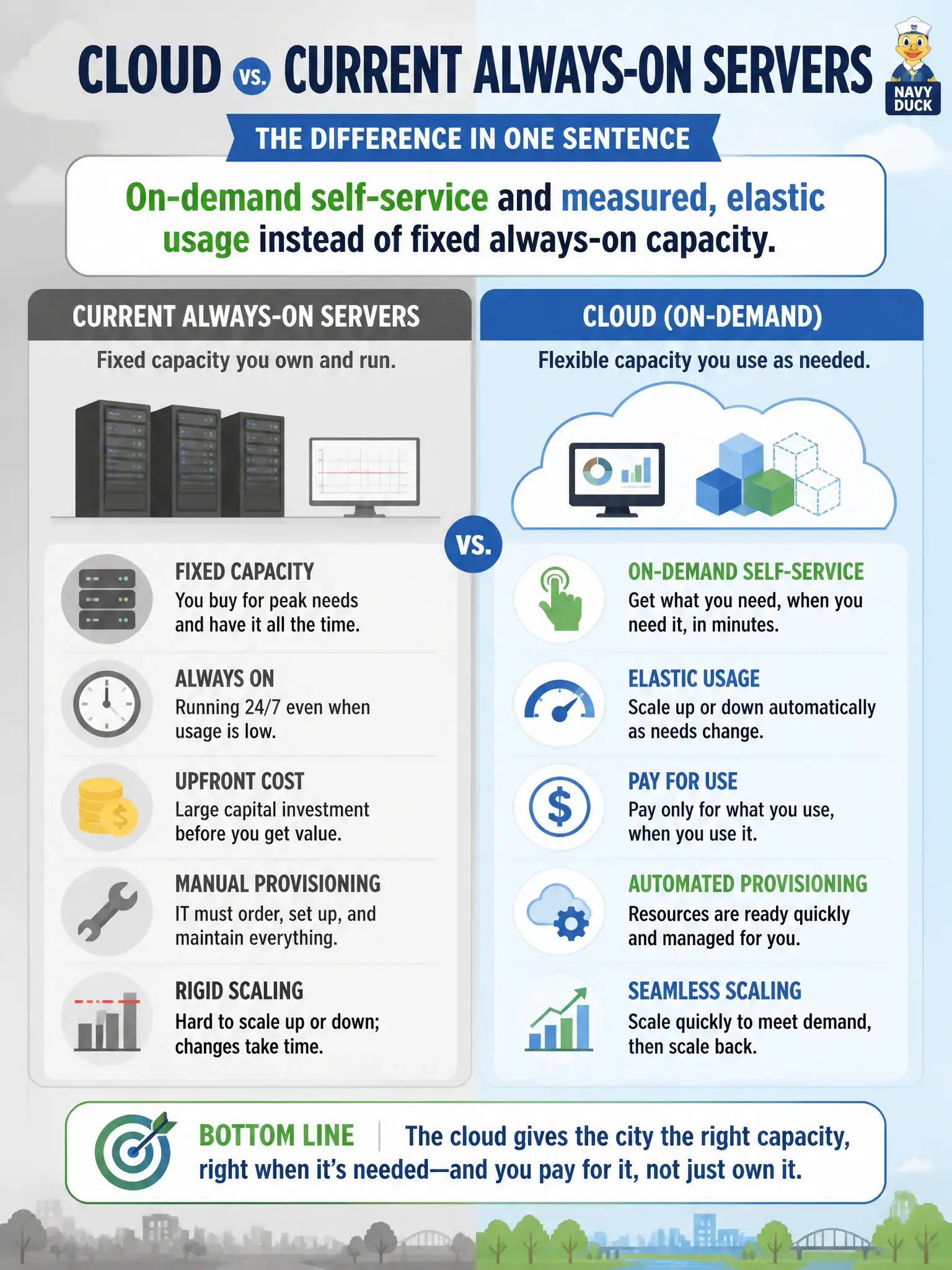
Always-on basement boxes are like leaving every light on in city hall. Cloud is more like flipping switches and paying for what you use, when you use it. On-demand self-service plus measured elasticity is the council-friendly one-liner.
Full Explanation
The clearest contrast between always-on municipal servers and cloud consumption is on-demand self-service plus measured, elastic usage instead of fixed capacity that stays powered for peak forever. Cloud lets authorized staff provision what they need when they need it and aligns cost more closely with actual use, whereas basement servers often force continuous provisioning for rare peaks. That pairing of self-service and elasticity is the council-friendly difference the public-works lead needs.
Claiming cloud always costs more because meters never stop is a finance stereotype, not a definition; well-managed elastic usage can reduce waste from idle always-on gear. Requiring the city to abandon networking and store everything only on USB drives is nonsense and unrelated to cloud traits. Suggesting Microsoft staff must log into every municipal application nightly to resize VMs by hand invents a managed-services fantasy; self-service means the customer initiates scaling through cloud controls.
Exam caveat: elasticity and measured use describe the model; actual invoices still depend on architecture choices, reserved capacity, and idle resources left running. Operational check: compare a peak-sized always-on VM estate to an autoscaled or on-demand pattern for the same workload and verify whether capacity and spend track demand rather than permanent peak sizing.