
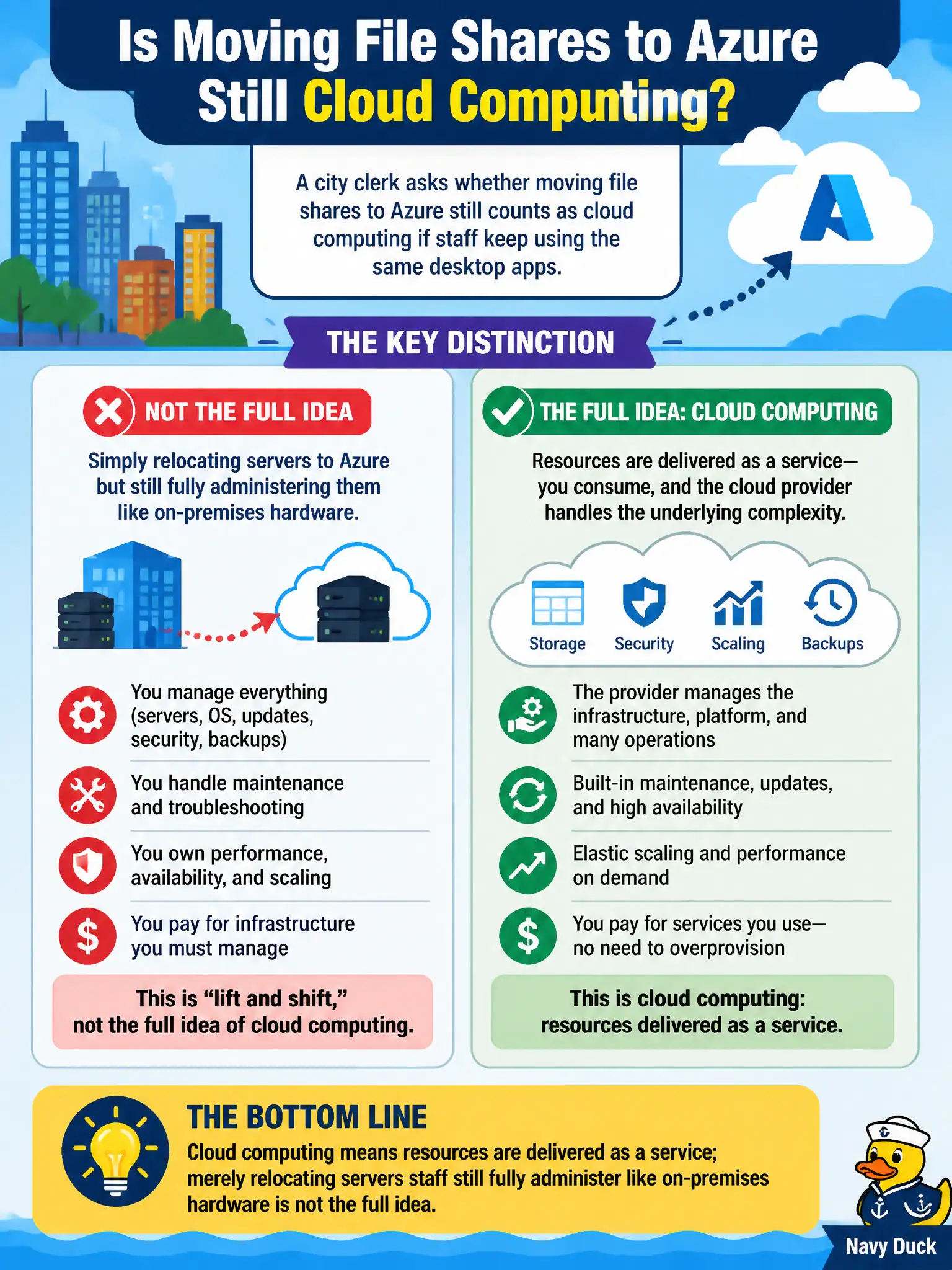
A city clerk asks whether moving file shares to Azure still counts as cloud computing if staff keep using the same desktop apps. Which distinction best answers the clerk?
Select an answer to reveal the explanation.
Short Explanation
Moving a box across town does not magically make it "cloud." Cloud is about consuming resources as a service—elastic, on-demand, measured—not just parking the same fully managed servers somewhere else. If staff still treat it like basement hardware, they have changed location more than the model.
Full Explanation
Cloud computing means IT resources are delivered as a service—typically on-demand, elastic, and measured—rather than simply relocated. For the city clerk’s file-share question, keeping familiar desktop apps is compatible with cloud file services; the decisive issue is whether staff are consuming a cloud service or still fully administering relocated servers as if they were basement hardware. Merely changing the street address of capacity does not complete the cloud idea if the operating model stays “own and babysit every guest OS.”
Saying any remote server automatically counts as cloud overstates the definition: remote hosting without service characteristics is still traditional administration with a different landlord. Requiring the city to delete every desktop application and switch to browser-only tools invents a false requirement; cloud file shares and sync clients routinely support existing desktop workflows. Claiming file shares never count as cloud unless Microsoft also owns the city’s identity provider mixes identity tenancy choices with the cloud-computing definition; identity integration is important operationally but is not the gate that decides whether a service is cloud.
Exam caveat: IaaS virtual machines in Azure are still cloud building blocks even when customers patch the guest OS—what fails the “full idea” is treating any off-site box as cloud without recognizing service delivery and shared-responsibility boundaries. Operational check: inventory whether file capacity is provisioned and billed as a service with provider-managed platform traits, or whether municipal staff still own full server lifecycle tasks identical to on-premises operations.