
A county parks department still runs every app in one basement server room and asks what "the cloud" means beyond someone else's computers. Which statement best defines cloud computing?
Select an answer to reveal the explanation.
Short Explanation
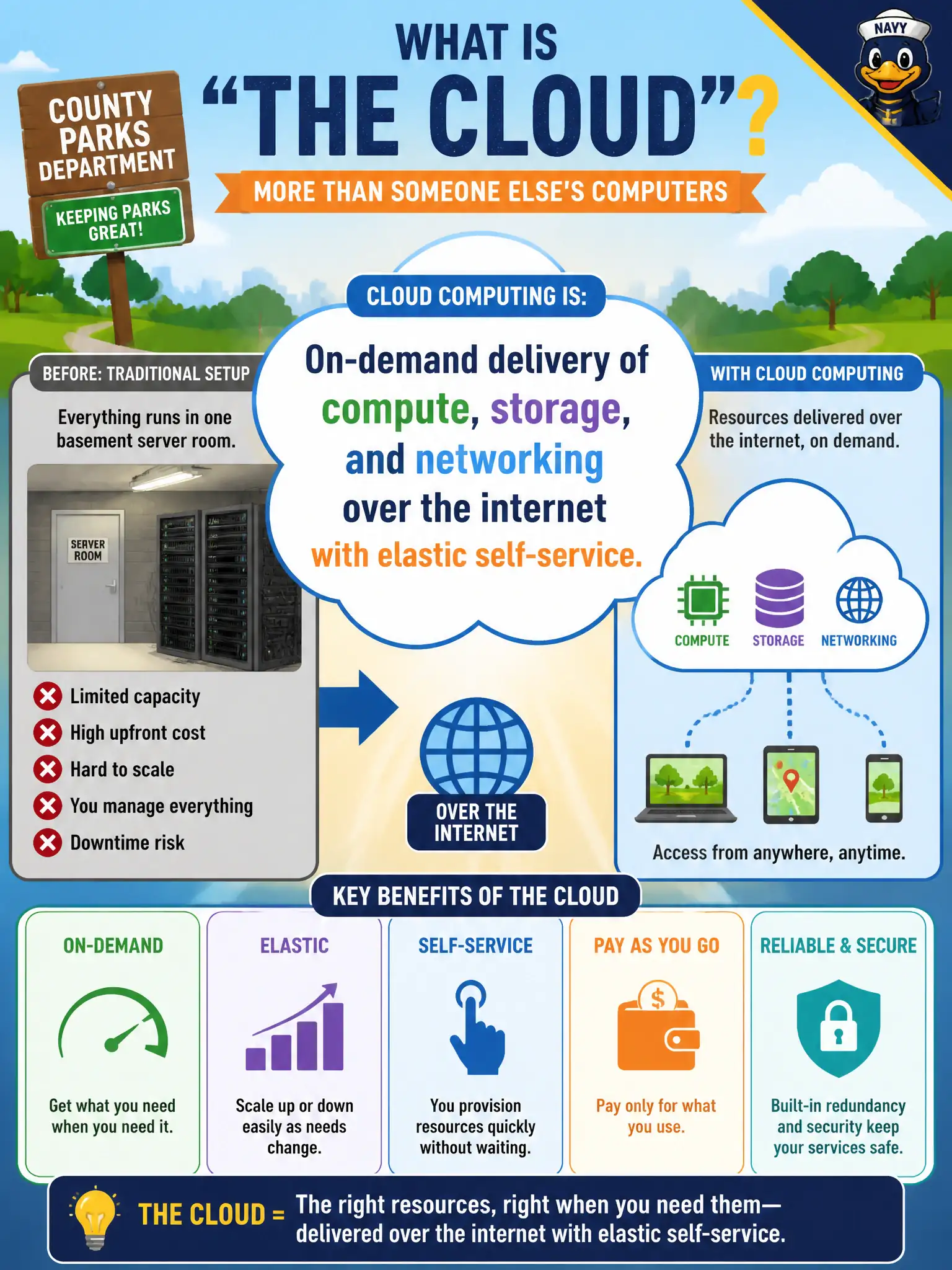
Think of cloud like a utility meter, not a basement full of boxes. You pull compute, storage, and network over the internet when you need them, and you can grow or shrink without a hardware shopping trip. That on-demand, elastic self-service idea is the core definition—not one vendor logo or one SKU.
Full Explanation
Cloud computing is defined by how IT capacity is delivered and consumed, not by where a municipal server room happens to sit. The correct framing is on-demand delivery of compute, storage, and networking over the internet, with elastic capacity and self-service provisioning so departments can obtain and release resources without a hardware purchase cycle. That service model is what fundamentals materials mean by “the cloud,” and it is why a parks department still running everything from one basement rack is asking a useful clarifying question.
Standardizing on one brand of basement servers is still traditional ownership: shared racks and common hardware do not create elasticity or metered internet delivery by themselves. Renting a locked cage at a colocation site moves physical location and facility services, but staff who still manage every machine like on-premises gear have not adopted cloud computing as a service model. Treating cloud as a single Microsoft product SKU that replaces all municipal software forever confuses a vendor catalog with the industry definition; Azure is one implementation of cloud services, not the definition itself.
Exam caveat: “someone else’s computers” is informal shorthand and can describe colo or managed hosting; exam answers hinge on on-demand, elastic, self-service characteristics rather than off-site location alone. Operational check: ask whether a department can provision capacity through a portal or API and pay based on use without waiting for capital hardware—if not, the estate is still operating like owned infrastructure even if some boxes sit elsewhere.