
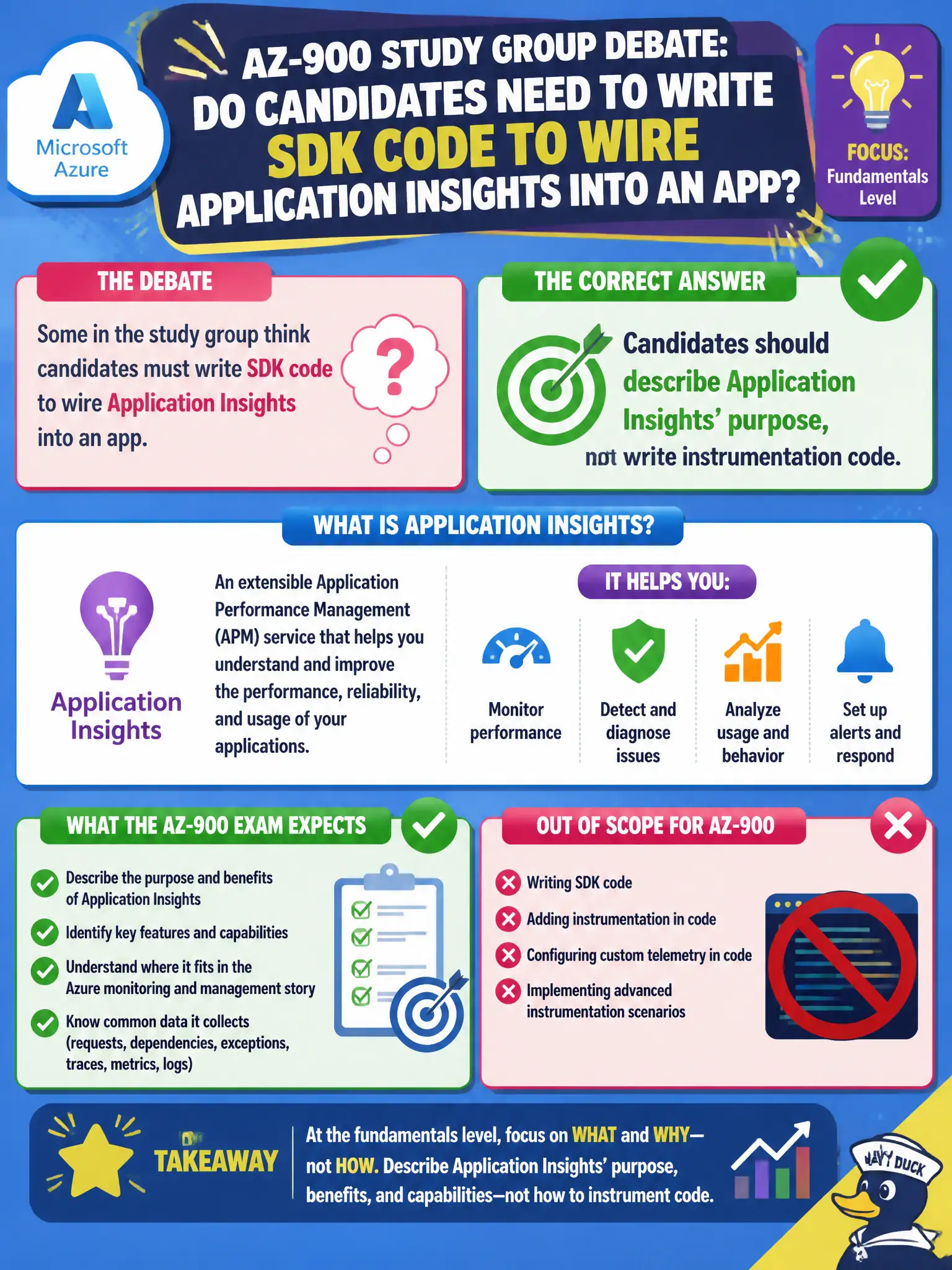
An AZ-900 study group argues about whether candidates must write SDK code to wire Application Insights into an app. What is the correct fundamentals-level expectation?
Select an answer to reveal the explanation.
Short Explanation
AZ-900 asks "what is Application Insights for?"—not "paste this SDK into Program.cs." Keep it at describe depth and leave the wiring drills for developer associate exams.
Full Explanation
AZ-900 fundamentals expect candidates to describe Application Insights' purpose—application performance monitoring for requests, failures, and dependencies—not to write instrumentation code during the exam. Study groups that drift into SDK processors, custom telemetry pipelines, or advanced Kusto authorship are operating at developer-associate depth beyond what this certification measures. Knowing what the service is for is sufficient.
Requiring custom telemetry processors in C# on the exam fails the fundamentals scope. Requiring Kusto functions that rewrite production binaries fails both scope and realism—query languages analyze data; they do not rewrite binaries as an AZ-900 task. Requiring Application Insights deployment only through Azure Bastion tunnels fails because Bastion is unrelated to how Application Insights is conceptually described or typically enabled for web apps at fundamentals level.
Exam caveat: real municipal projects will instrument apps, but the certification question is whether you can identify Application Insights as APM under the Monitor umbrella—not whether you can paste startup code.
Operational check: when studying, practice explaining Application Insights in one plain sentence and contrasting it with Service Health and Advisor; reserve SDK labs for later role-based learning paths.