
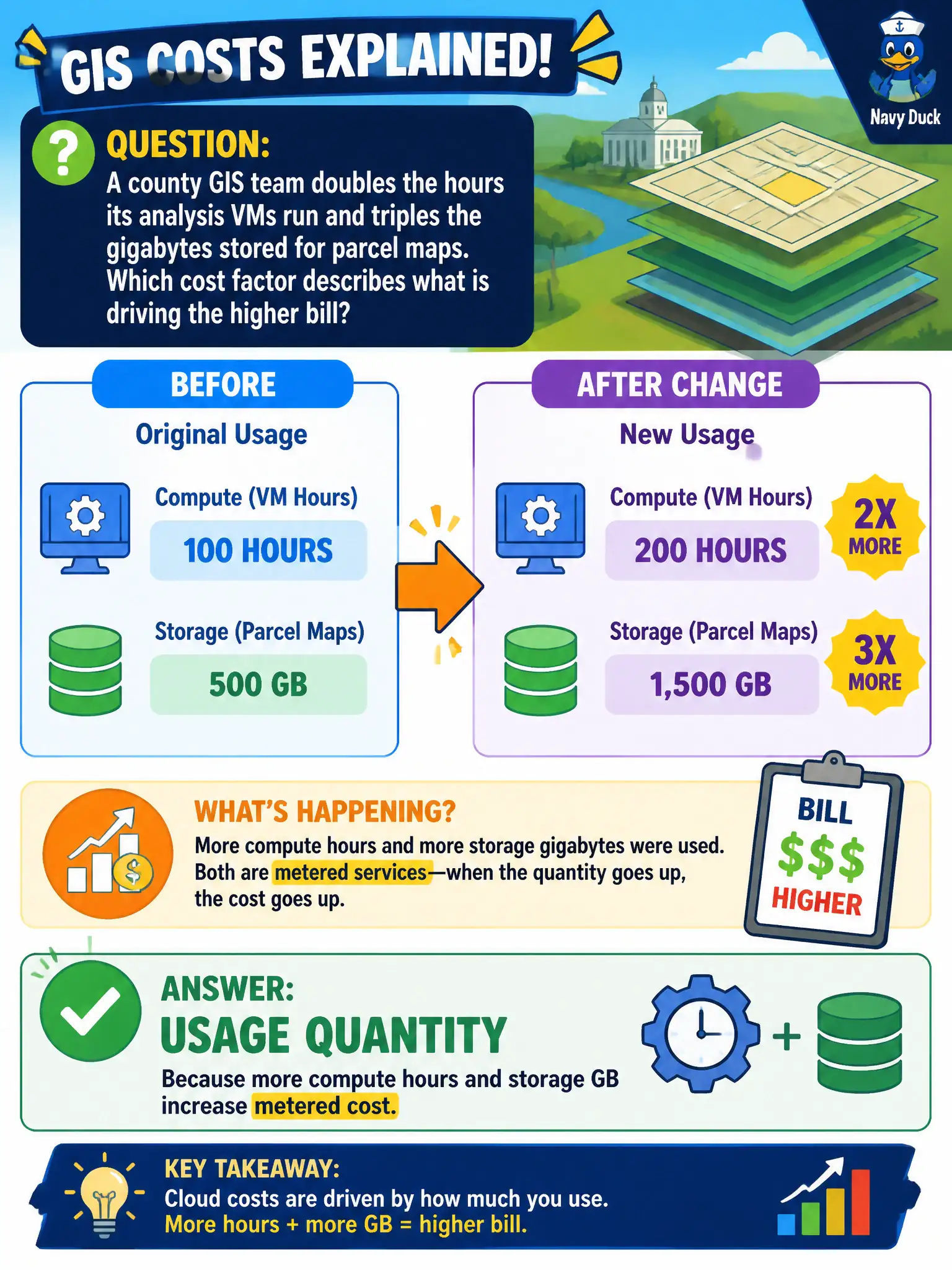
A county GIS team doubles the hours its analysis VMs run and triples the gigabytes stored for parcel maps. Which cost factor describes what is driving the higher bill?
Select an answer to reveal the explanation.
Short Explanation
More miles on the meter means a bigger fare. Azure mostly bills by how much you consume — hours, gigabytes, transactions. Turning up runtime and storage volume is a primary cost factor for that GIS workload.
Full Explanation
Usage quantity is a primary Azure cost factor under consumption-based billing. When a county GIS team doubles VM runtime hours and triples stored gigabytes for parcel maps, metered charges rise because compute hours and storage capacity are billed by how much is consumed. Even with the same region, SKU, and purchasing model, more hours and more GB increase the bill. Fundamentals framing treats usage volume alongside type/size, region, and purchasing options as core drivers.
Azure Blueprints gallery popularity (or template gallery fame) does not set meters for GIS VMs or storage. How many users casually opened Cost Management once is unrelated to the underlying consumption meters. Whether a resource group name includes the word "production" is a naming convention; names do not change compute-hour or GB pricing.
Exam caveat: some services also meter transactions, egress, or provisioned throughput—quantity is broader than "hours and GB only," but this scenario's explicit drivers are runtime and stored data. Operational check: in cost analysis, break down the GIS subscription or resource group by meter (compute vs storage), compare month-over-month quantity, and validate that increased hours and capacity match approved project growth rather than forgotten always-on labs or orphaned disks.