
After a parks pilot ends, a city engineer leaves unattached managed disks and unused public IP addresses in the subscription. Why can those leftovers still increase the Azure bill?
Select an answer to reveal the explanation.
Short Explanation
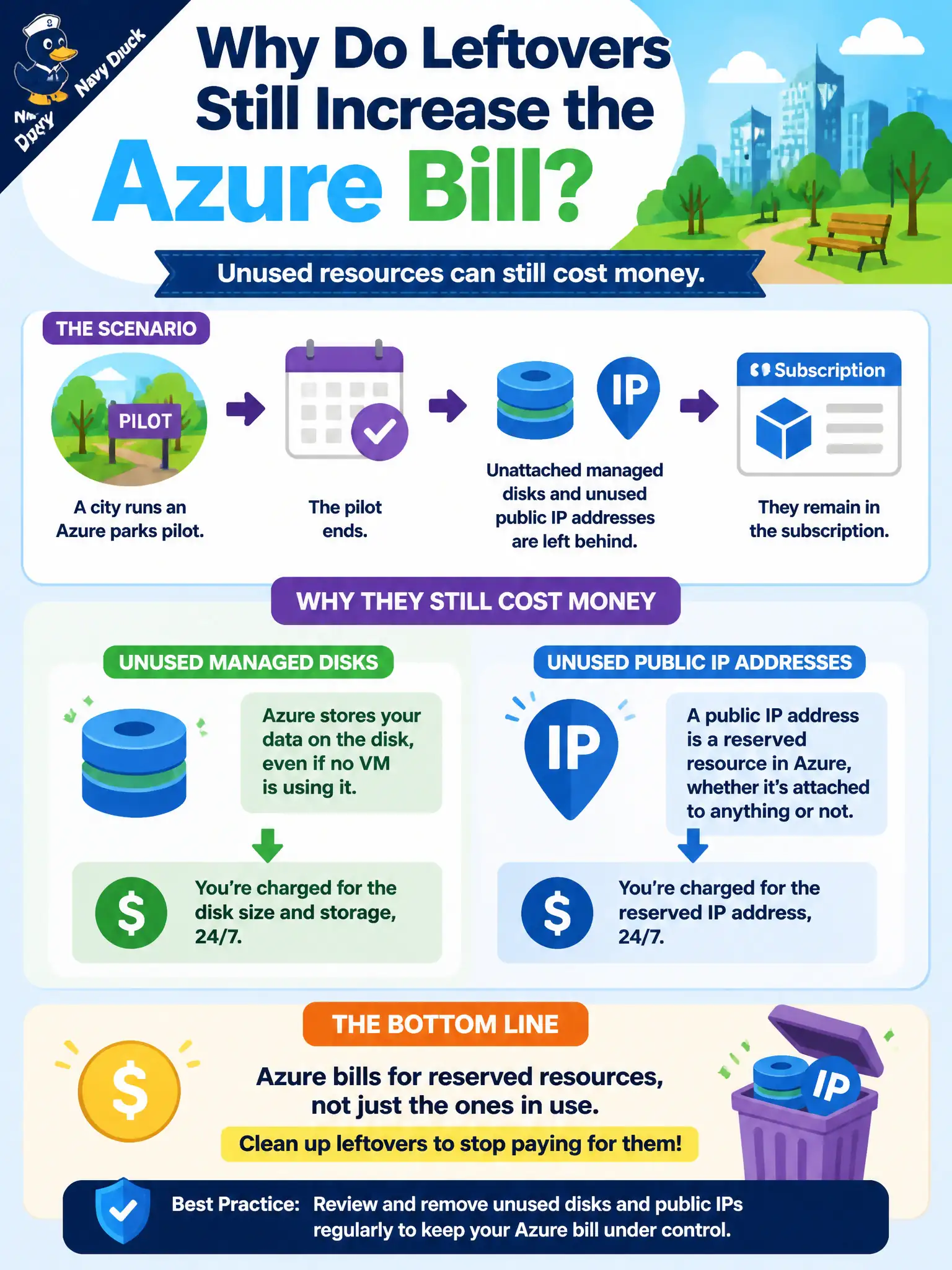
Leaving the lights on in an empty room still burns the bill. Unattached disks and idle public IPs often keep metering. Cleaning up leftover resources is a classic cost-control habit after a pilot wraps.
Full Explanation
Many Azure resources bill based on allocation, not solely on whether a virtual machine is powered on and using them. After a parks pilot ends, unattached managed disks continue to occupy provisioned storage capacity and can incur charges. Unused public IP addresses that remain allocated can also generate ongoing cost even when no NIC or VM references them. Leaving those leftovers in the subscription is a common post-pilot bill leak; cleanup is a core cost-control practice at fundamentals depth.
The claim that idle resources never meter until a VM runs is incorrect for disks and public IPs that stay provisioned. Azure Policy evaluations enforce compliance rules; they are not what creates idle-disk or idle-IP charges. Public IPs do not bill only when listed in Microsoft Service Health—Service Health communicates platform incidents and advisories, not the metering rule for unused addresses.
Exam caveat: deallocated VMs stop compute meters for the VM itself, but attached disks and reserved public IPs can still cost money—"VM off" is not the same as "all related resources cleaned up." Operational check: after the pilot, inventory unattached disks and unused public IPs in the subscription or resource group, snapshot or archive anything still needed for records retention, then delete the rest and confirm in the next Cost Management view that those meters drop.