
For Azure Fundamentals study, how should a municipal learner describe Microsoft Defender for Cloud without drifting into AZ-500 operations depth?
Select an answer to reveal the explanation.
Short Explanation
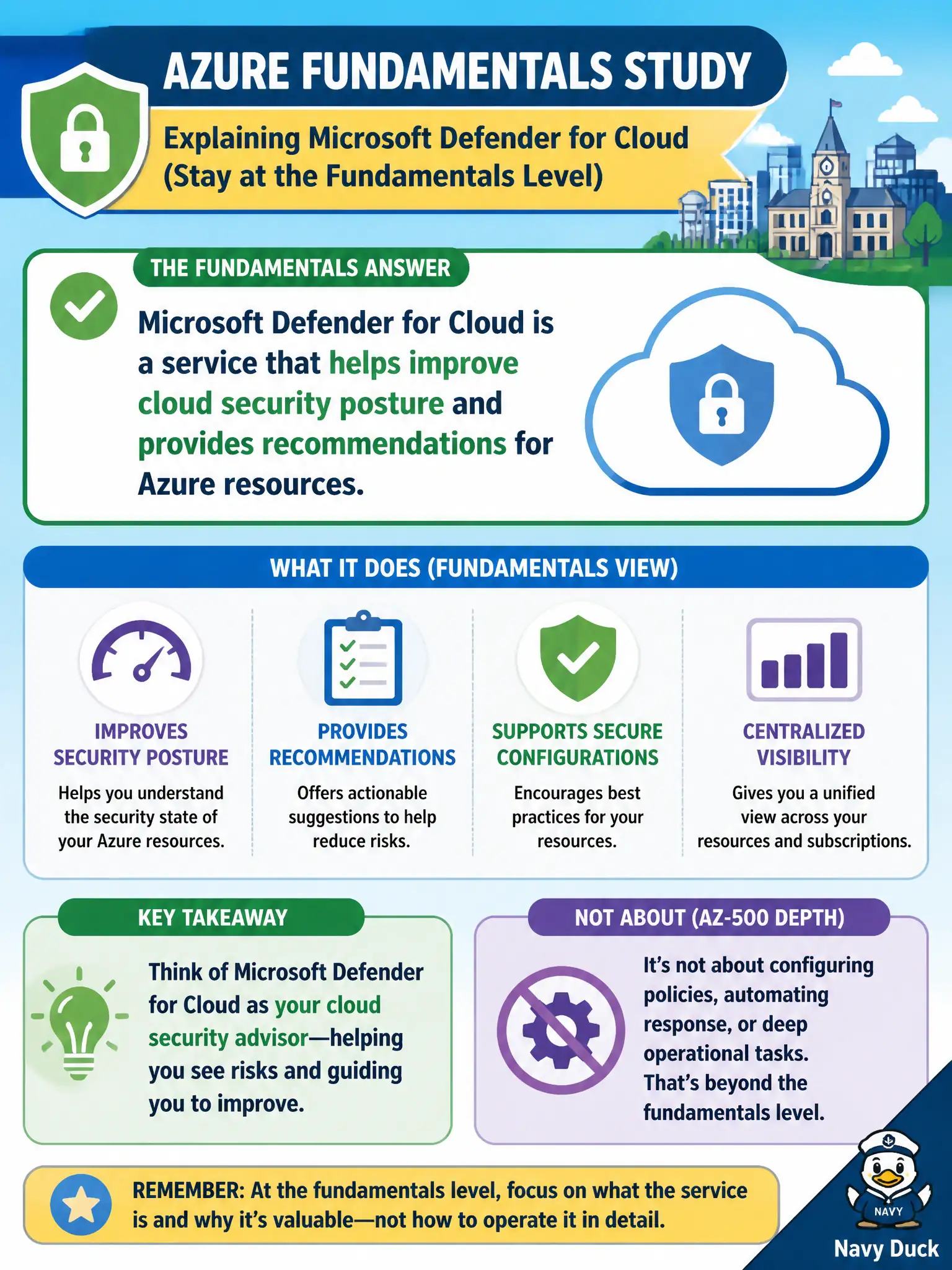
For AZ-900, keep Defender for Cloud at the "what is it for" level: posture help and recommendations. Skip the deep Sentinel SOAR lab and the SKU laundry list. Purpose beats product-engineering rabbit holes.
Full Explanation
For Azure Fundamentals study, describe Microsoft Defender for Cloud as a service that helps improve cloud security posture and provides recommendations for Azure resources. That framing stays at the right altitude: municipal learners should know what problem it solves—finding and guiding remediation of security weaknesses across cloud resources—without memorizing every plan SKU, pricing meter, or SOAR workflow. Secure score and recommendations are the memorable, exam-appropriate outcomes tied to that purpose.
It is not a full Microsoft Sentinel SOAR playbook engineering platform that must be mastered for AZ-900; Sentinel is a separate SIEM/SOAR product with deeper security-operations scope. It is not a mandatory list of every Defender plan SKU and pricing meter to memorize for fundamentals. It is not a replacement for Microsoft Entra ID and does not remove user authentication—identity remains with Entra, while Defender for Cloud addresses resource posture.
Exam caveat: if a question drifts into incident response playbooks or detailed threat hunting, you have left AZ-900 Defender-for-Cloud purpose territory; stay with posture and recommendations language.
Operational check: in a study lab, open Defender for Cloud, locate secure score and at least three recommendations, remediate one low-risk item, and confirm the recommendation status updates—reinforcing the posture-improvement story without entering AZ-500 operational depth.