
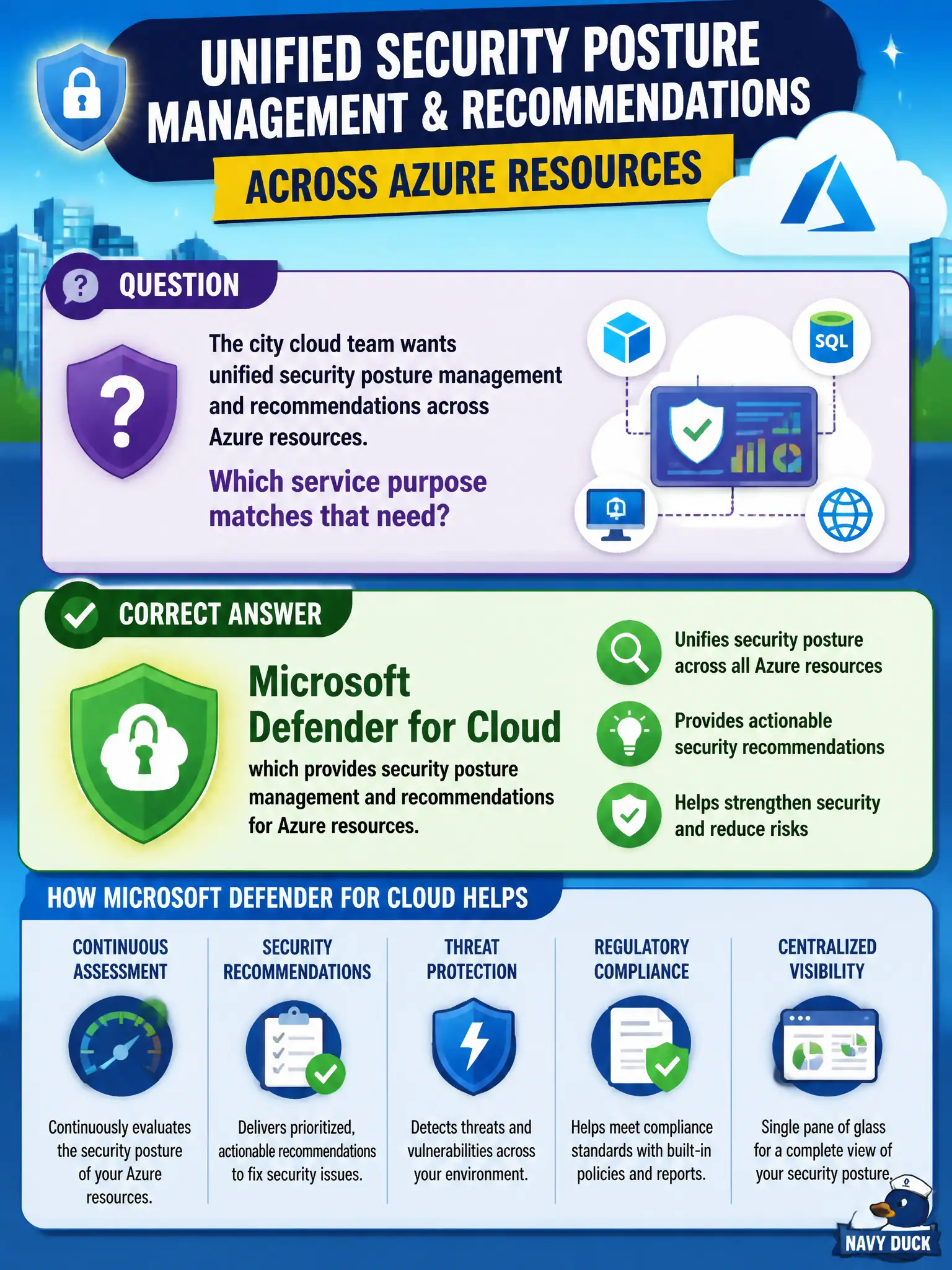
The city cloud team wants unified security posture management and recommendations across Azure resources. Which service purpose matches that need?
Select an answer to reveal the explanation.
Short Explanation
Defender for Cloud is the posture coach for Azure resources—how secure are we, and what should we fix next? Pricing calculators and storage tiers do not give that security scoreboard. Think recommendations and posture, not billing or cold storage.
Full Explanation
Microsoft Defender for Cloud provides cloud security posture management for Azure resources: visibility into misconfigurations, prioritized recommendations, and a posture score that helps teams improve security over time. When the city cloud team wants unified posture management and recommendations across Azure resources, Defender for Cloud is the fundamentals-aligned service for that outcome. It helps operators see what is weakly configured and what to fix next without requiring AZ-500-level threat-hunting expertise to understand its purpose.
The Azure Pricing Calculator estimates spend and does not assess security posture. Blob archive tier cools infrequently accessed data for cost; it is not a posture management dashboard. Availability Zones protect workloads from datacenter-level failure inside a region; they improve resiliency but do not score security recommendations.
Exam caveat: Defender for Cloud’s posture features are distinct from Microsoft Entra Conditional Access (identity sign-in policy) and from Microsoft Sentinel (SIEM/SOAR)—do not merge those products on AZ-900 items.
Operational check: open Microsoft Defender for Cloud in the Azure portal, review the secure score and recommendation list for a pilot subscription, assign owners to the highest-impact recommendations, and track score improvement after remediation.