
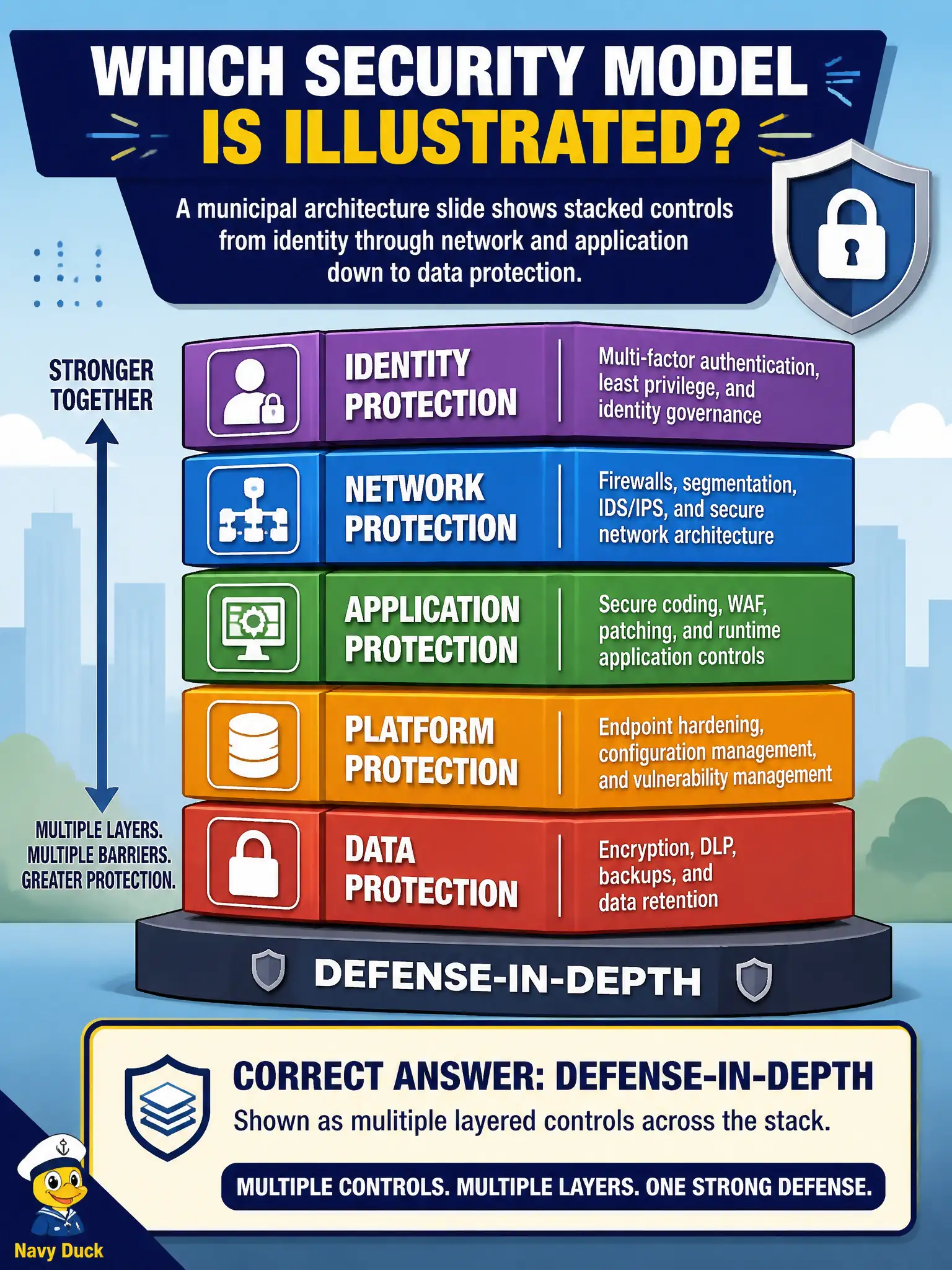
A municipal architecture slide shows stacked controls from identity through network and application down to data protection. Which security model is illustrated?
Select an answer to reveal the explanation.
Short Explanation
When the slide looks like stacked shields—identity, network, app, data—you are looking at defense-in-depth. Name the model from the picture of layers, not from a lone password or a pricing feature.
Full Explanation
When an architecture slide shows stacked controls from identity through network and application down to data protection, the illustrated security model is defense-in-depth. Each layer addresses different failure modes: stolen credentials, malicious network traffic, application flaws, and data exfiltration risks. Municipal diagrams that visualize that stack are teaching the fundamentals idea that security is composed of coordinated layers rather than a single product or password policy.
A single shared password policy with no additional layers is the opposite of a stacked model. Azure Spot pricing is a cost-optimization approach for interruptible compute capacity and does not substitute for security controls. Blob soft delete is a useful data-recovery feature against accidental or malicious deletion, but presenting it as the only required municipal safeguard collapses the stack into one storage capability.
Exam caveat: if the question’s visual or wording emphasizes multiple layers across the stack, answer defense-in-depth; if it emphasizes never trust and always verify, answer Zero Trust—even though real programs use both ideas together.
Operational check: align the slide’s layers to concrete Azure/Entra controls already deployed (for example MFA and Conditional Access for identity, NSGs/firewall for network, App Service authentication for application, encryption and soft delete for data) and note any empty layer for remediation.