
A help-desk trainee confuses an Azure storage account with a single blob container. Which hierarchy statement is correct?
Select an answer to reveal the explanation.
Short Explanation
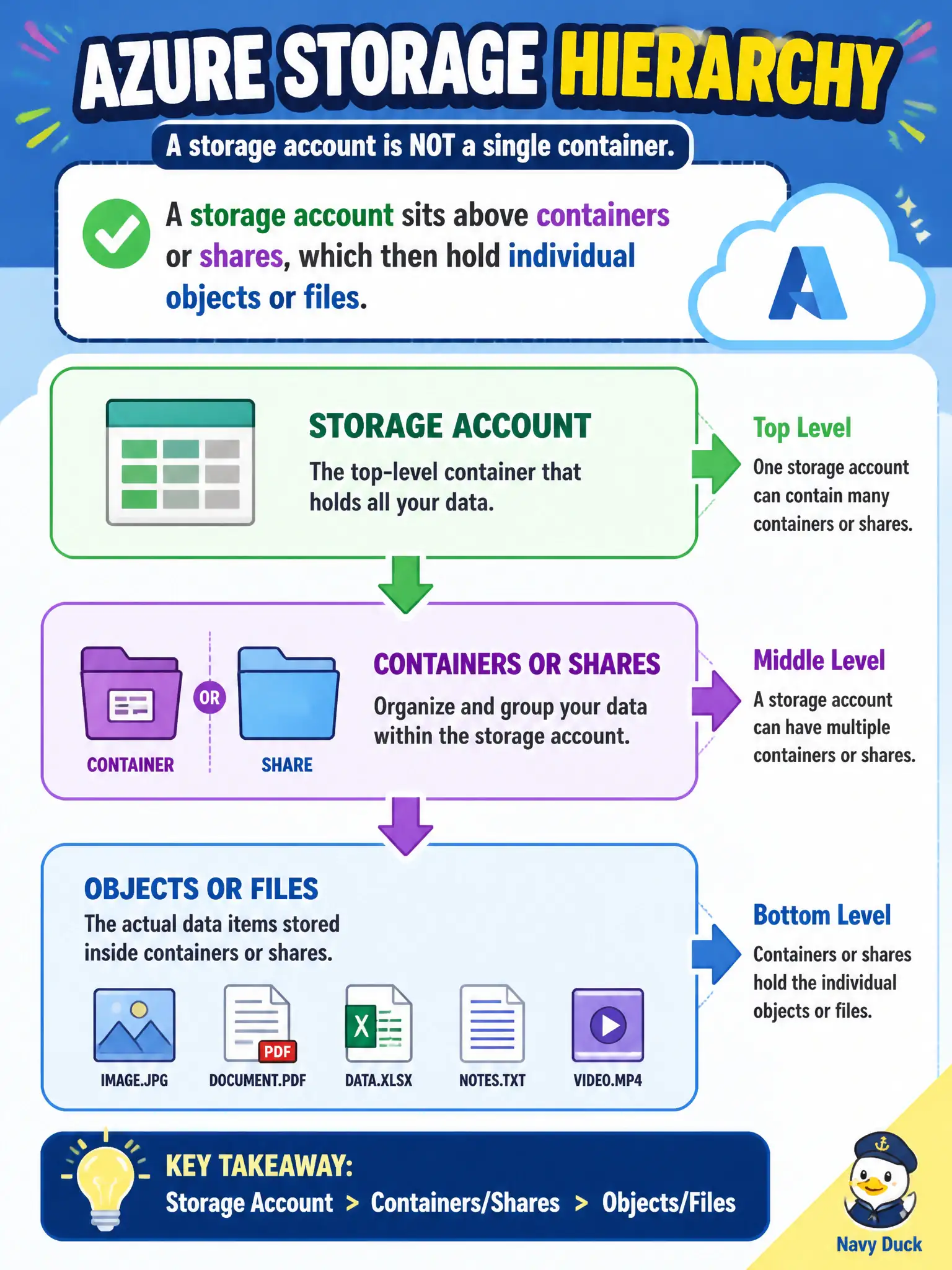
Think mailbox building (account), then labeled drawers (containers or shares), then the letters inside (blobs or files). The account is not inside a container—the hierarchy runs the other way. Get that mental model and the trainee stops mixing the layers.
Full Explanation
The correct hierarchy is that a storage account sits above containers or shares, which then hold individual objects or files. Help-desk trainees should learn account → container (or file share / queue / table as applicable) → object so they grant access and locate resident records at the right scope. Confusing a container with the account causes broken URLs, mis-scoped SAS or RBAC, and tickets that cannot find data.
A blob container is always a parent of the storage account in Azure reverses the hierarchy—containers live inside accounts. Object blobs own the storage account and invent regions for it invents an upside-down ownership model; objects do not parent accounts or invent regions. File shares replace the need for any storage account namespace is wrong—file shares themselves are hosted by a storage account.
Exam caveat: management planes (account networking, encryption, redundancy) differ from data-plane container permissions; trainees must know which level they are changing. Operational check: in a lab subscription, create a storage account, add a container, upload one blob, and have the trainee recite the path from account to container to object before touching production municipal data.