
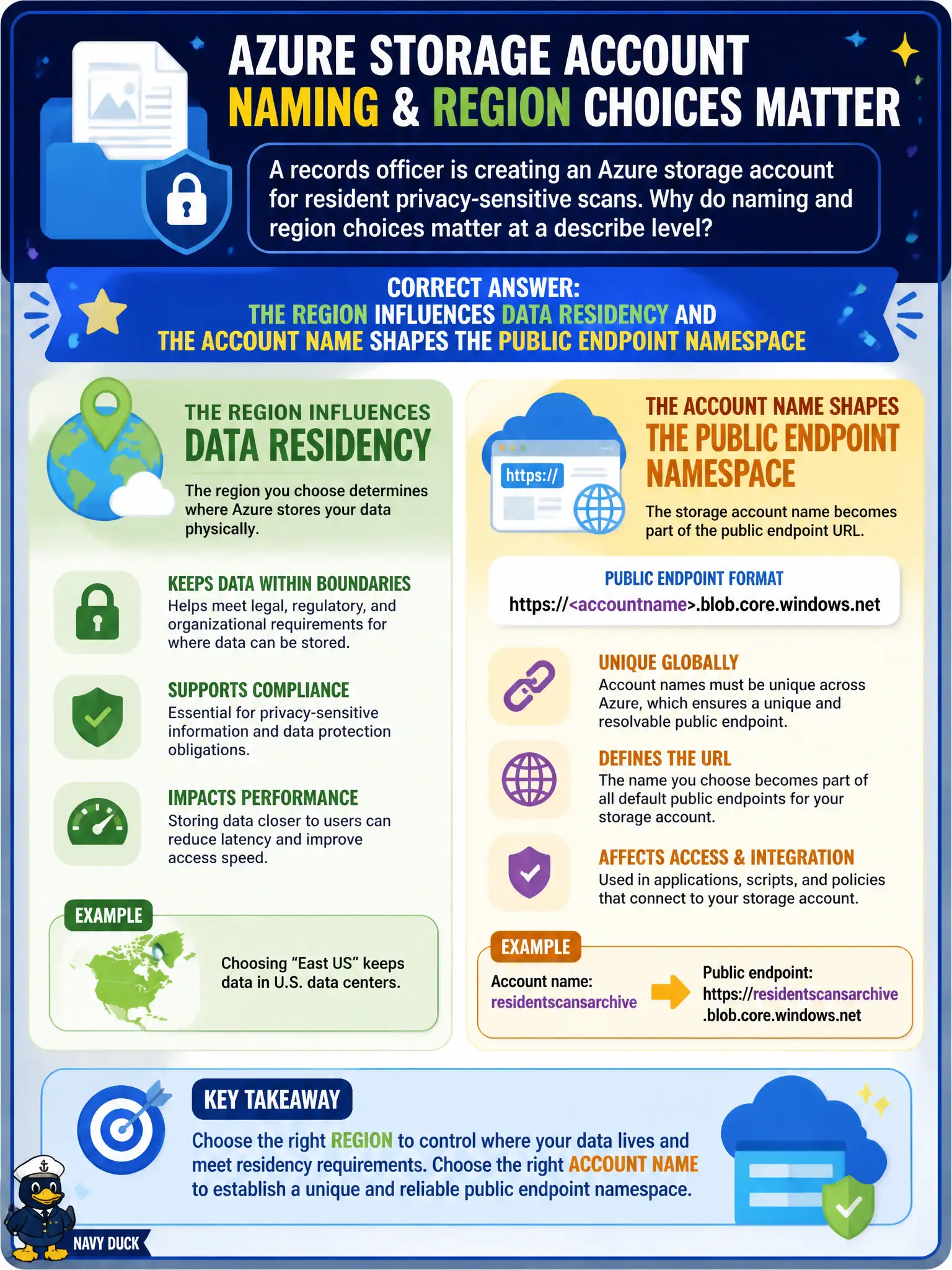
A records officer is creating an Azure storage account for resident privacy-sensitive scans. Why do naming and region choices matter at a describe level?
Select an answer to reveal the explanation.
Short Explanation
Where you plant the account (region) is where the data primarily lives, and the account name shows up in those *.core.windows.net style endpoints. Privacy-minded cities care about residency; ops cares that the name is unique and URL-friendly. It is not a desktop-only or PowerPoint-only decision.
Full Explanation
Region and naming matter because the region influences data residency and latency, while the account name shapes the public endpoint namespace used to reach Blob and other services. A records officer creating a storage account for resident privacy-sensitive scans should treat region as a compliance and locality decision and treat the globally unique account name as part of the URLs clients and apps will call. Those are describe-level configuration facts, not cosmetics.
Region is ignored because all Azure Storage is always stored only on desktops is false—Azure Storage resides in selected cloud regions, not on staff desktops. Account names never appear in endpoints and regions never affect residency denies both endpoint construction and residency implications. Naming only affects PowerPoint themes and never DNS endpoints trivializes a choice that becomes part of service DNS/URL identity.
Exam caveat: account names are globally unique and difficult to change later without creating a new account and migrating data, so privacy-sensitive municipal projects should pick names and regions deliberately up front. Operational check: choose an approved residency region for the scans account, reserve a compliant unique name, create the account, and confirm the blob endpoint embeds that name before loading resident documents.