
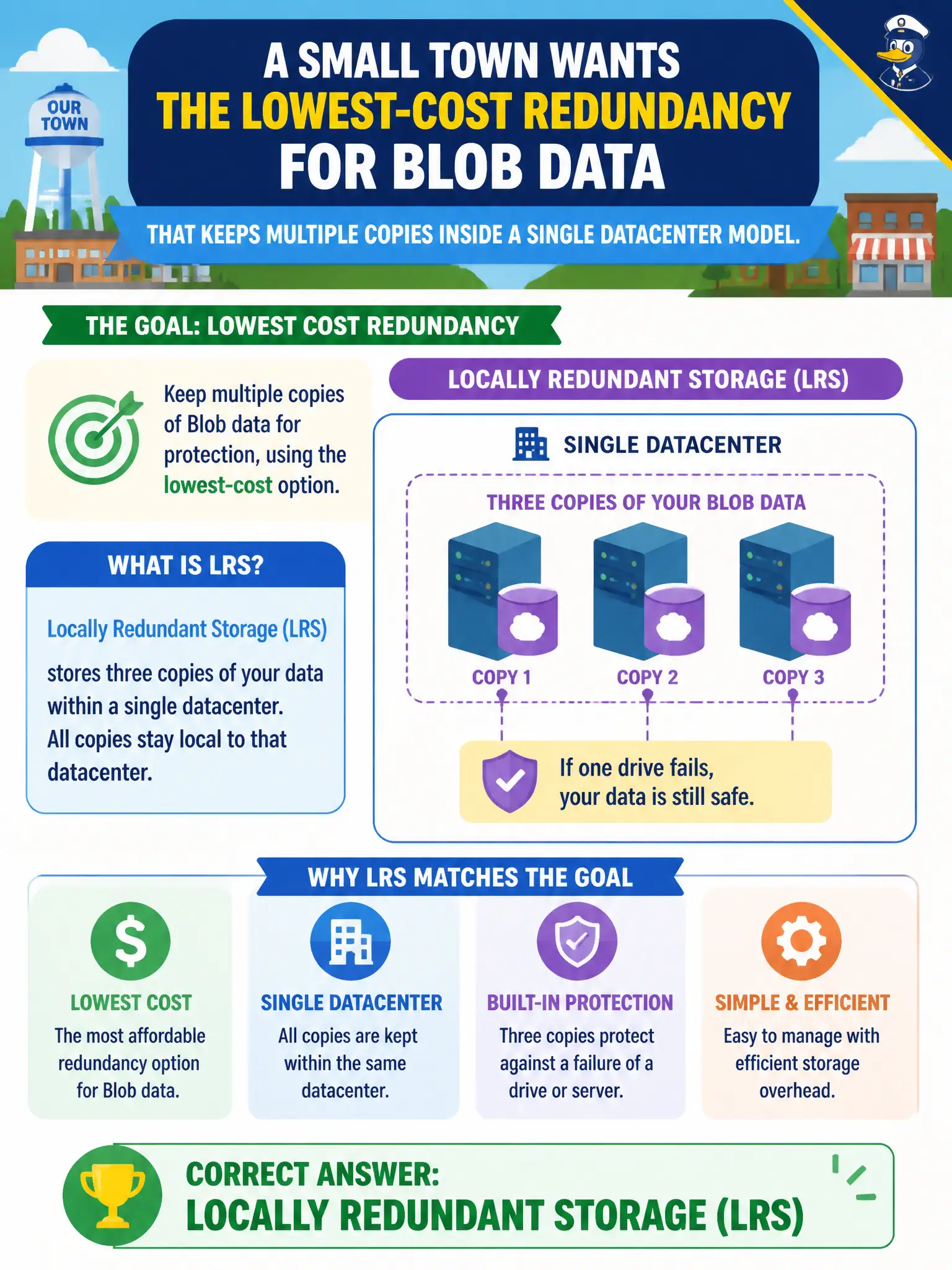
A small town wants the lowest-cost redundancy for Blob data that keeps multiple copies inside a single datacenter model. Which option matches that describe-level goal?
Select an answer to reveal the explanation.
Short Explanation
LRS is the budget photocopier in one building—several copies, same datacenter footprint. If the town only needs that local redundancy model and wants the cheapest option, LRS is the answer. Geo and zone options add broader protection and typically cost more.
Full Explanation
Locally redundant storage (LRS) matches a small town’s goal of the lowest-cost redundancy model that keeps multiple copies inside a single datacenter footprint. LRS synchronously replicates data within one physical location in the primary region, protecting against drive and rack-level failures while remaining the cheapest common redundancy choice. For Blob data that does not require zone or regional disaster copies, LRS is the describe-level fit.
Geo-redundant storage (GRS) only, because LRS never copies data, is wrong on both counts: LRS does keep multiple local copies, and GRS is not required when the goal is explicitly one-datacenter cost minimization. Zone-redundant storage (ZRS) stretched across paired regions by default misstates ZRS—ZRS spreads copies across availability zones in a region, not paired regions by default. Read-access geo-zone-redundant storage is a higher-protection, higher-cost geo/zone family option, not the cheapest one-datacenter choice.
Exam caveat: LRS does not protect against a full datacenter outage; towns that later need zone or regional resilience must plan a redundancy upgrade, not assume LRS already covers DR. Operational check: create or inspect a storage account set to LRS for a noncritical Blob container, verify the redundancy setting in the portal, and document for council that copies stay within one datacenter model.