
A city housing portal must keep Blob copies resilient across availability zones inside one Azure region. Which redundancy option describes that protection?
Select an answer to reveal the explanation.
Short Explanation
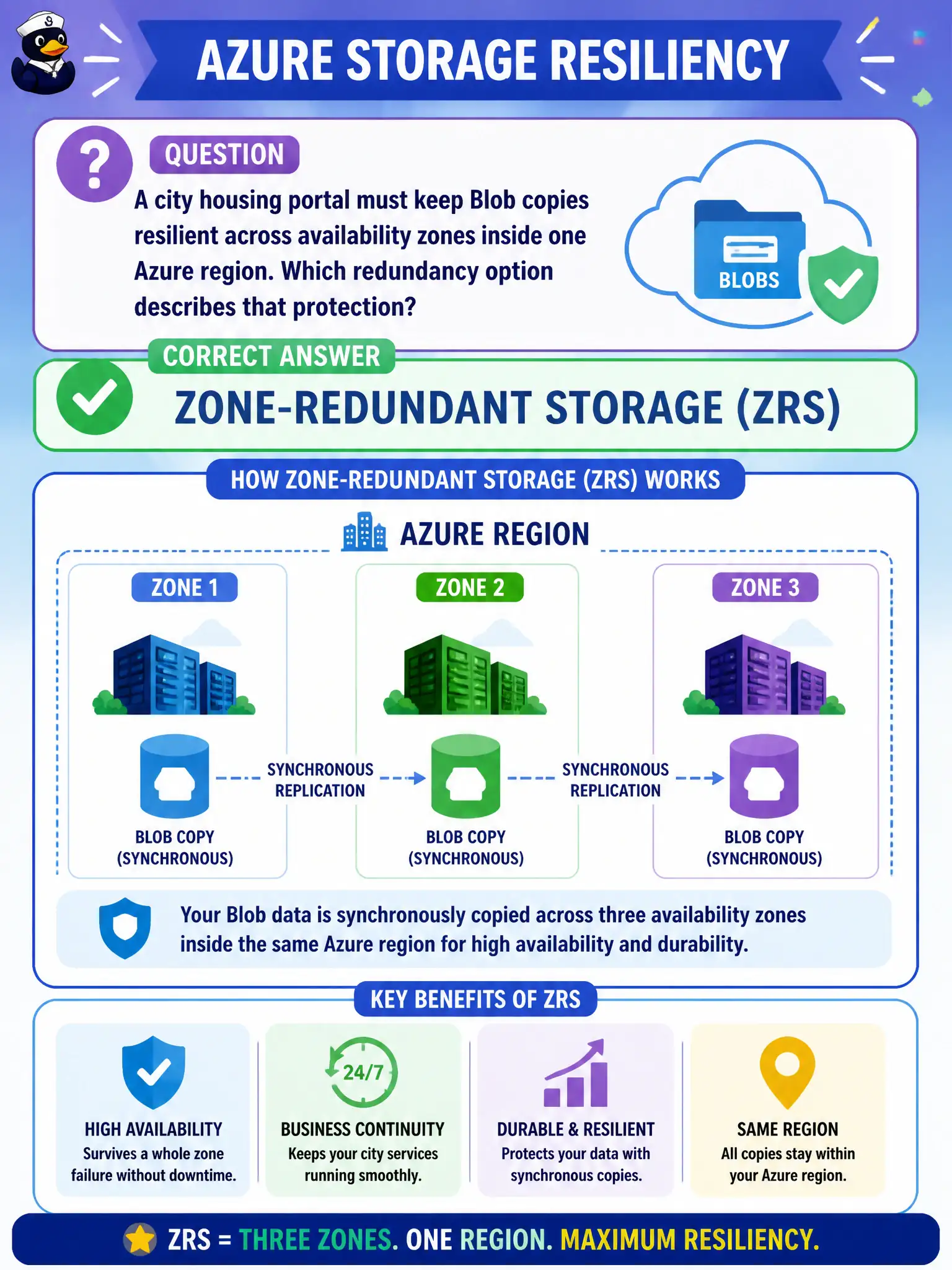
Availability zones are separate buildings with their own power—ZRS sprinkles copies across them in the same region. That is how the housing portal survives a single-zone hiccup without jumping to another region. Access tiers are about cost and access frequency, not zone redundancy.
Full Explanation
Zone-redundant storage (ZRS) describes Blob protection that keeps copies resilient across availability zones inside one Azure region. ZRS synchronously replicates data across three Azure availability zones in the primary region so a city housing portal can survive a single-zone failure without depending on a secondary region. When the requirement is multi-zone durability in-region, ZRS is the fundamentals match.
Locally redundant storage limited to a single rack with no zone spread does not meet a zone-resilience requirement—LRS keeps copies in one location. Cool tier selection alone fails because access tiers address how often data is read and storage cost, not whether copies span zones. Archive tier rehydration is a retrieval process for cold blobs, not a substitute for zone-redundant copies of live portal content.
Exam caveat: ZRS availability and feature support can vary by region and account configuration; architects should confirm ZRS is offered where the housing portal’s account will live. Operational check: set or review the storage account redundancy to ZRS for the portal’s Blob data, confirm the setting shows zone redundancy in the primary region, and note the cost difference versus LRS for budget planning.