
A municipal records team is choosing a Blob access tier for scanned permit packs. Which statement best describes the main trade-off they should weigh?
Select an answer to reveal the explanation.
Short Explanation
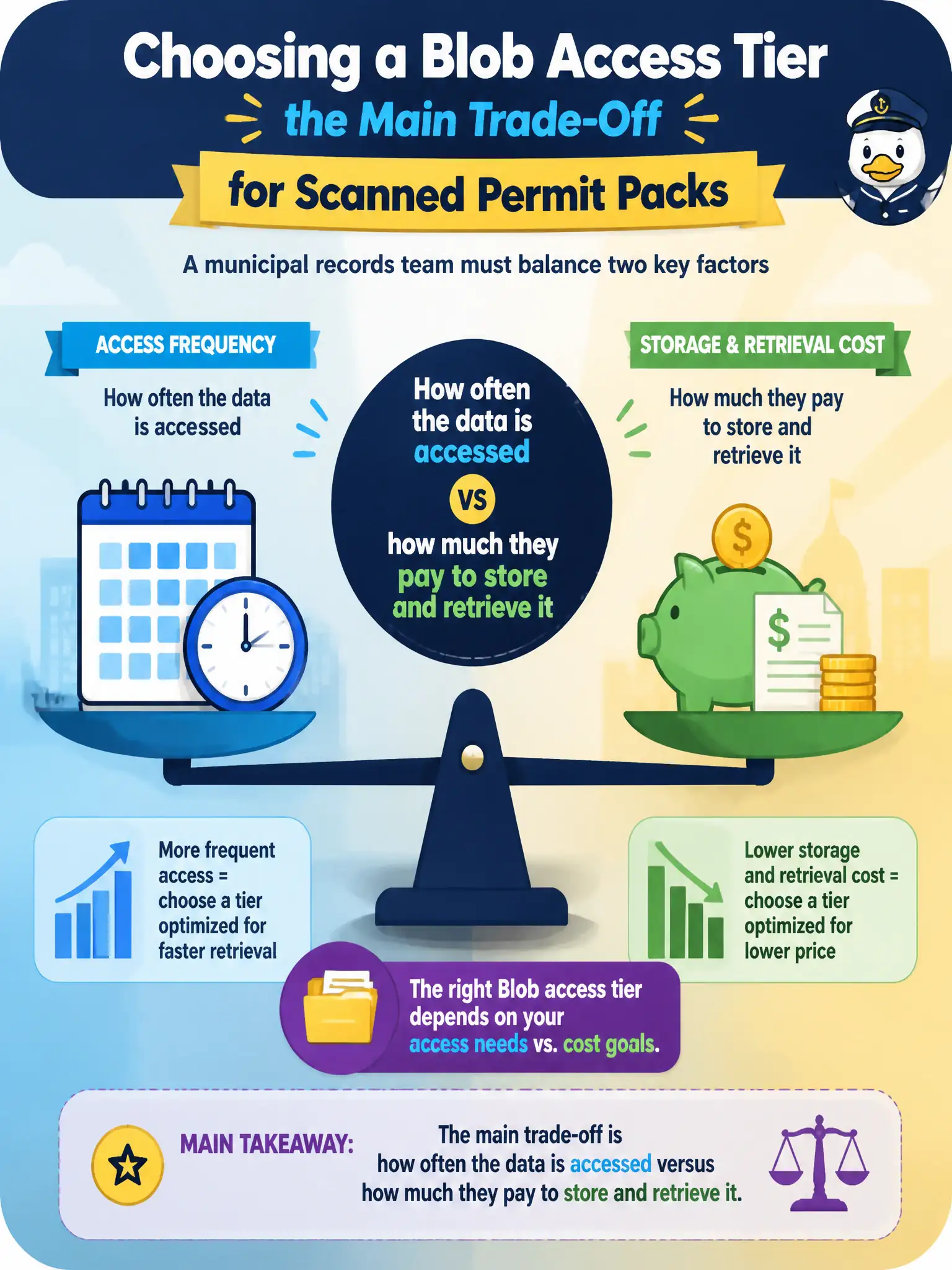
Blob tiers are basically a dial between “touch it often” and “park it cheap.” The more the city opens those permit packs, the hotter (and typically pricier to store) the tier tends to be. Access frequency drives the cost trade-off—not naming quirks or unrelated networking myths.
Full Explanation
The main trade-off when choosing a Blob access tier for scanned permit packs is how often the data is accessed versus how much the municipality pays to store and retrieve it. Hot, Cool, and Archive exist so civic records teams can align storage cost with real open rates: frequent hits favor Hot; infrequent online access favors Cool; rare long-term retention with delayed retrieval favors Archive. That access-frequency-versus-cost dial is the describe-level decision for permit packs and similar municipal document sets.
Whether the storage account name must include the mayor’s initials is unrelated to tier selection and invents a naming ceremony Azure does not require for access-tier choice. Whether Azure CDN replaces the need for any redundancy option confuses content delivery with durability and does not answer the tier trade-off. Claiming only virtual machines can host Blob Storage endpoints misstates Azure Storage—blobs are reached through storage-account endpoints, not by requiring a VM as the only host.
Exam caveat: cheaper storage tiers can carry higher access or retrieval costs, so a “set and forget” Cool or Archive choice can backfire if permit packs suddenly see heavy seasonal review. Operational check: sample thirty days of open rates on a permit-pack container, estimate Hot versus Cool monthly cost with those reads, and pick the tier that matches measured access rather than assumptions.