
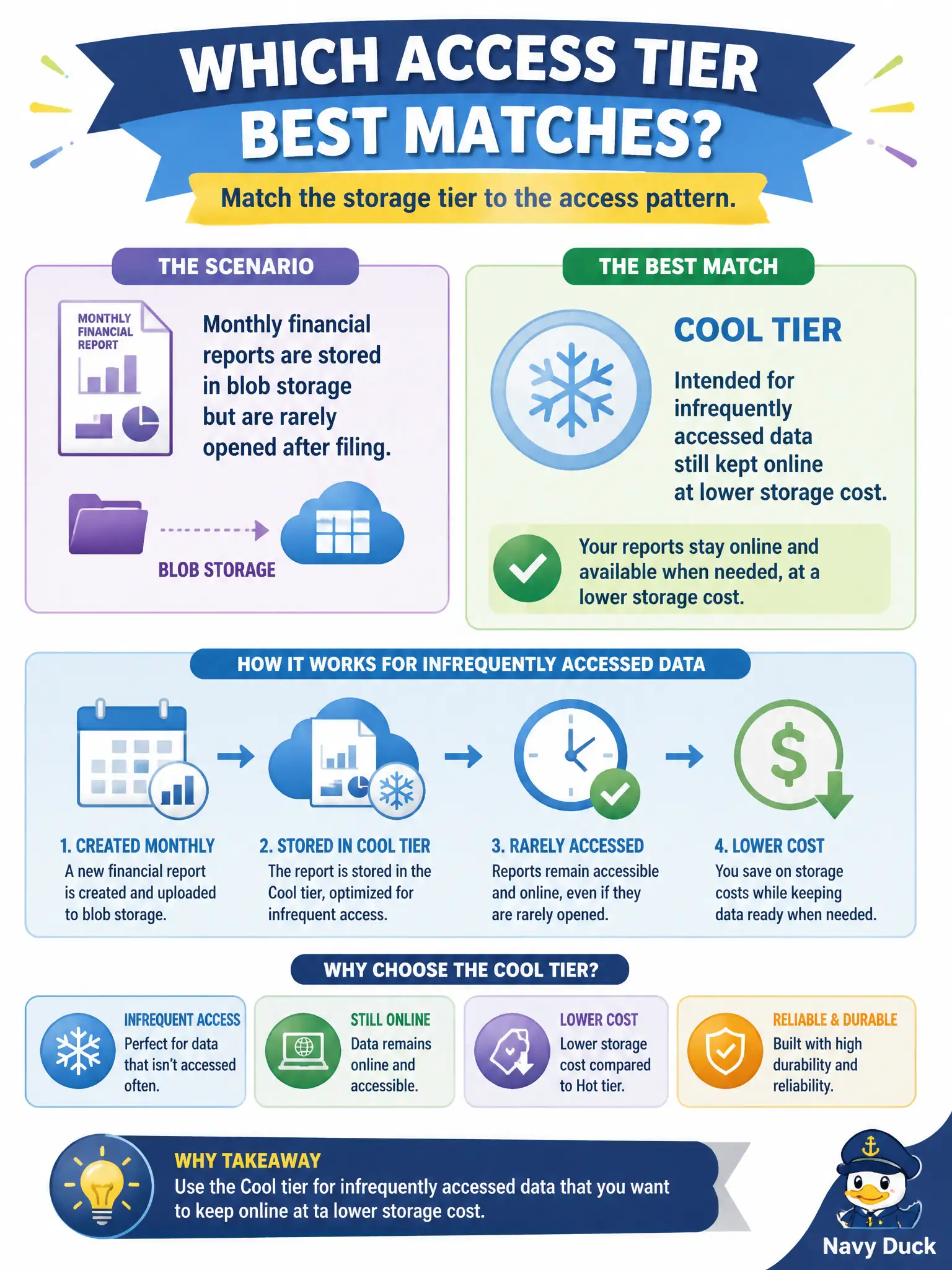
Monthly financial reports are stored in blob storage but are rarely opened after filing. Which access tier best matches that infrequent-access pattern?
Select an answer to reveal the explanation.
Short Explanation
Rarely cracked-open monthly reports fit Cool — still online, just not the hot shelf. Hot is for constant hits; archive is colder still with different retrieval trade-offs. Infrequent access points to cool.
Full Explanation
Cool tier is intended for infrequently accessed blob data that should remain online at lower storage cost than Hot. Monthly financial reports that are rarely opened after filing fit that pattern: still retrievable without archive rehydration delays, but not paying Hot rates for constant access. Hot tier is for frequent access patterns, not for data that is almost never read after archival filing. Archive tier is colder still and typically involves rehydration before read; it is not automatically required for every monthly report regardless of how quickly finance must restore a file during an audit. Table storage is an entity service and is not a blob access tier for report PDFs. Matching Cool to infrequent online access is the describe-level takeaway for this civic reporting scenario. Exam caveat: Cool has higher access costs than Hot—if a “rare” report set suddenly becomes heavily audited, bills and latency characteristics change; lifecycle policies should match real access telemetry. Operational check: move a sample monthly report blob to Cool, confirm it remains readable online for a finance user, and review capacity metrics plus early access logs before applying Cool broadly to the reports container.