
A city architect must pick hosting for a municipal API: maximum platform management, packaged portable images, or full guest OS control. Which describe-level mapping is correct?
Select an answer to reveal the explanation.
Short Explanation
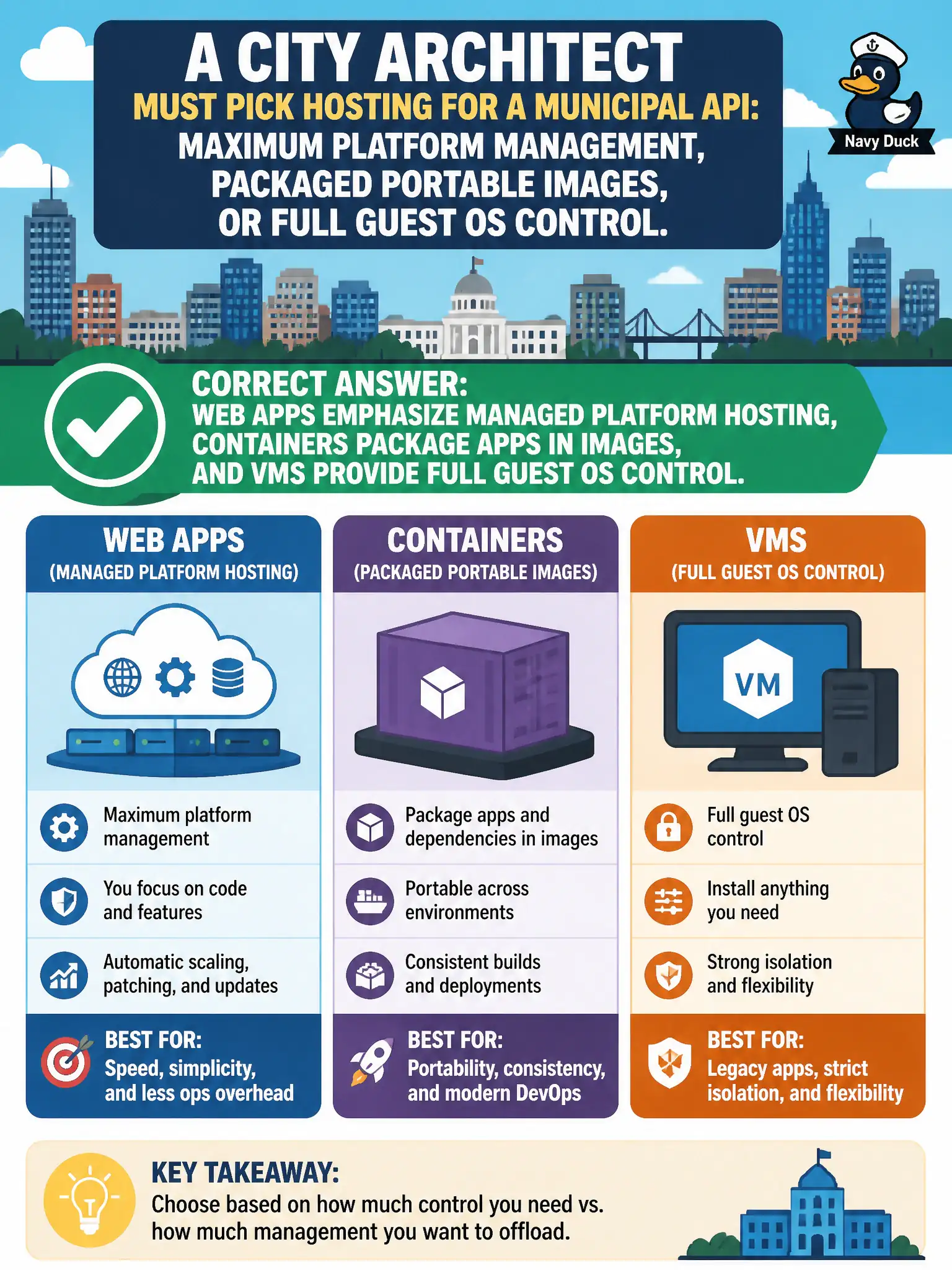
Think of three knobs: App Service hands you a managed platform, containers ship a packed image, and VMs hand you the whole OS wheel. Pick by how much control versus management the city wants. They are not the same product in different fonts.
Full Explanation
At a describe level, Azure’s common application hosting options map to different control-versus-management trade-offs. Web apps (App Service) emphasize managed platform hosting so teams focus on the application rather than the guest OS. Containers package applications and dependencies into portable images for consistent deployment across environments. Virtual machines provide full guest OS control when custom OS configuration or lift-and-shift parity is required. That triad is what a city architect should use when choosing how to host a municipal API. The claim that web apps always require guest OS patching, VMs never allow OS control, and containers only store blobs reverses or invents the model. Treating all three as identical SaaS products ignores real management differences boards must staff for. ExpressRoute is connectivity, not an application host; web apps, containers, and VMs all can run application code when chosen appropriately. Exam caveat: “best” depends on skills, compliance, and how much OS ownership the city accepts—not on a single always-correct product. Operational check: for the API candidates, write a one-page decision matrix covering patch ownership, portability, and custom OS needs, then pick the hosting lane that matches the city’s operational capacity.