
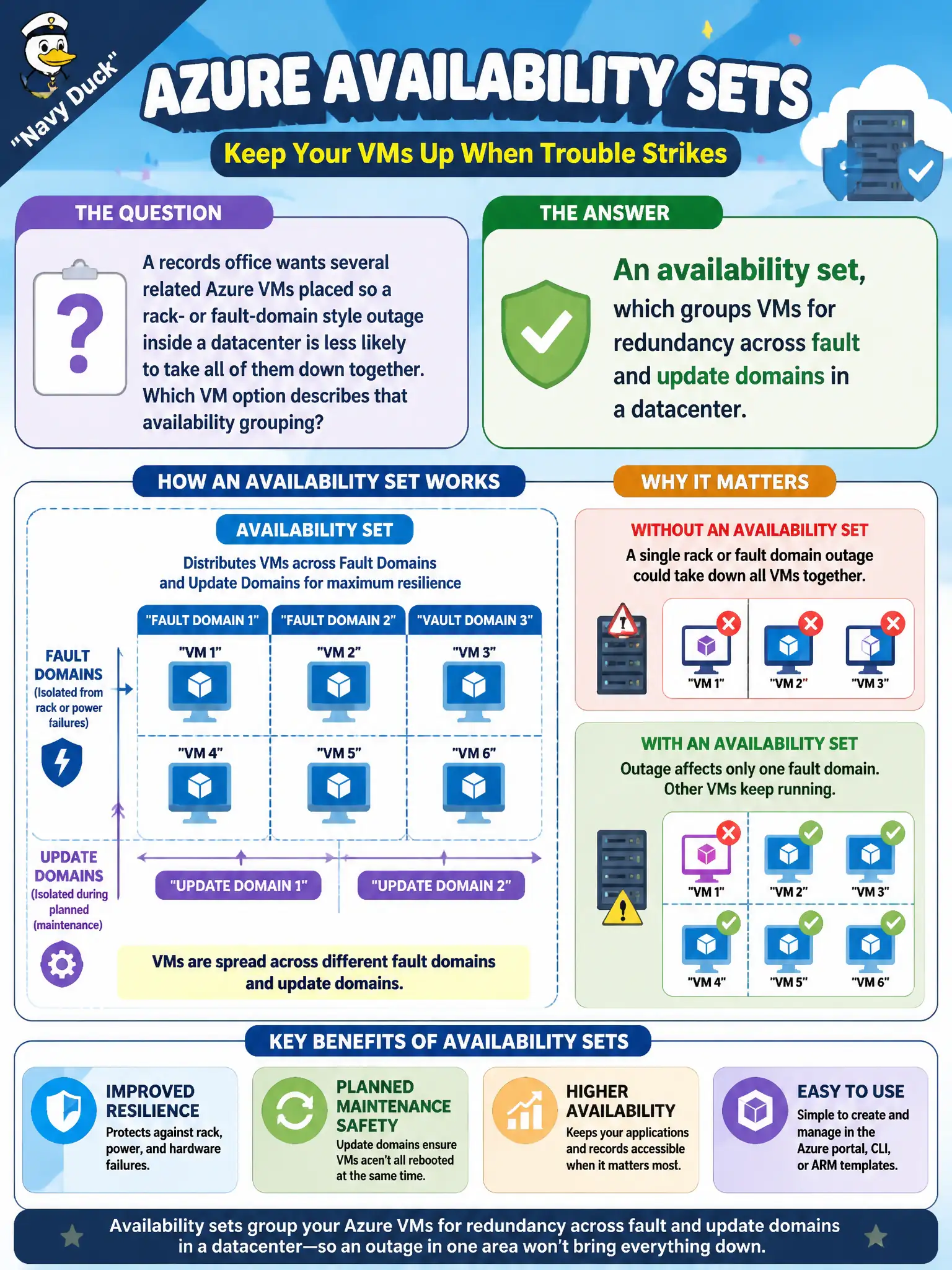
A records office wants several related Azure VMs placed so a rack- or fault-domain style outage inside a datacenter is less likely to take all of them down together. Which VM option describes that availability grouping?
Select an answer to reveal the explanation.
Short Explanation
Availability sets are the “do not put all eggs on one rack” grouping for VMs. They spread machines across fault and update domains in the classic datacenter story. Tags alone do not buy that spread.
Full Explanation
An availability set groups virtual machines so Azure can spread them across fault domains and update domains within a datacenter concept. For a records office that wants several related Azure VMs placed so a rack- or fault-domain style outage is less likely to take all of them down together, an availability set is the VM option that describes that availability grouping. It is about coordinated placement for resiliency of related VMs, not about tags or storage soft delete alone.
A single resource tag named “HA” is only metadata; tags do not place VMs on separate fault domains. Blob soft delete protects against accidental blob deletion and retention scenarios; it does not relocate running VMs across racks. Azure Front Door is a global application delivery and traffic service; it does not replace virtual machine availability-set redundancy features inside the compute tier.
Exam caveat: availability zones are a related but distinct resiliency concept (datacenter-level separation in a region); availability sets are the classic in-datacenter fault/update domain grouping—do not treat the names as interchangeable on the exam. Operational check: create an availability set, deploy the related records VMs into it, confirm the portal shows diversified fault and update domain assignments, and document that maintenance and failure domains were considered before go-live.