
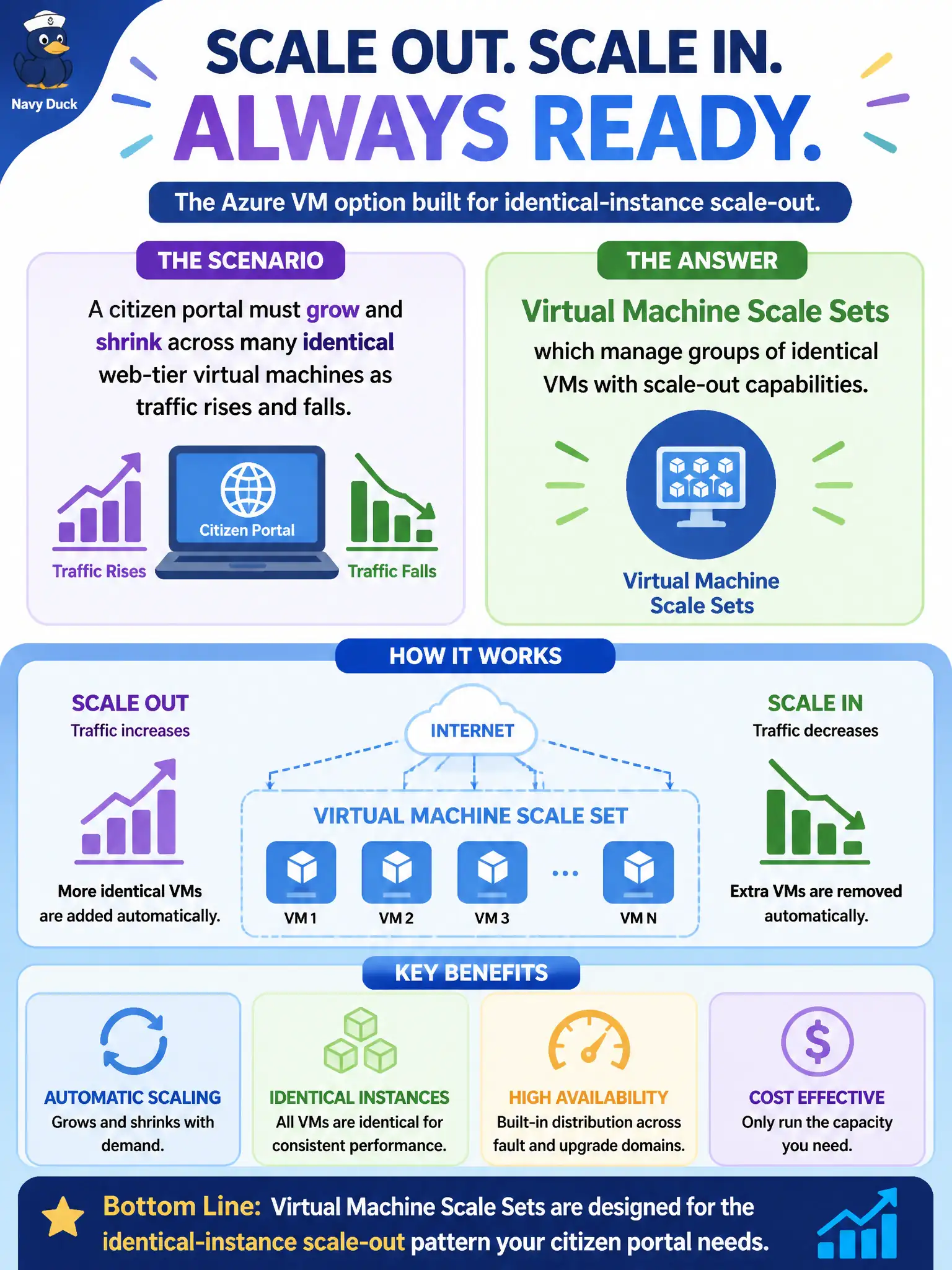
A citizen portal must grow and shrink across many identical web-tier virtual machines as traffic rises and falls. Which Azure VM option is designed for that identical-instance scale-out pattern?
Select an answer to reveal the explanation.
Short Explanation
Lots of the same VM stamping up and down with load? That is Virtual Machine Scale Sets territory. One lonely VM cannot stretch like a matching set that autoscale can grow.
Full Explanation
When a citizen portal must grow and shrink across many identical web-tier virtual machines as traffic rises and falls, Virtual Machine Scale Sets are the Azure VM option designed for that identical-instance scale-out pattern. Scale sets manage groups of like-configured VMs and support scaling out and in so capacity tracks load without manually building each web-tier clone as a one-off snowflake.
A single unmanaged data disk shared without any scale unit does not create or orchestrate a farm of identical VMs. One permanently fixed VM size that can never be associated with scale sets denies the scale-out mechanism the scenario needs. Azure Virtual Desktop delivers virtual desktops for users; it is not the primary pattern for scaling identical public web-tier VMs for a citizen portal.
Exam caveat: scale sets address horizontal scale of identical instances; they are not the same feature as availability sets, which focus on fault and update domain spreading for availability grouping. Operational check: define a scale set with a web-tier image or extension bootstrap, attach it behind a load balancer, configure autoscale rules on CPU or request metrics, and load-test to confirm instance count rises and falls as portal traffic changes.