
A training vendor starts explaining AKS node-pool design during an AZ-900 compute-types module for city staff. What should the instructor keep the lesson focused on instead?
Select an answer to reveal the explanation.
Short Explanation
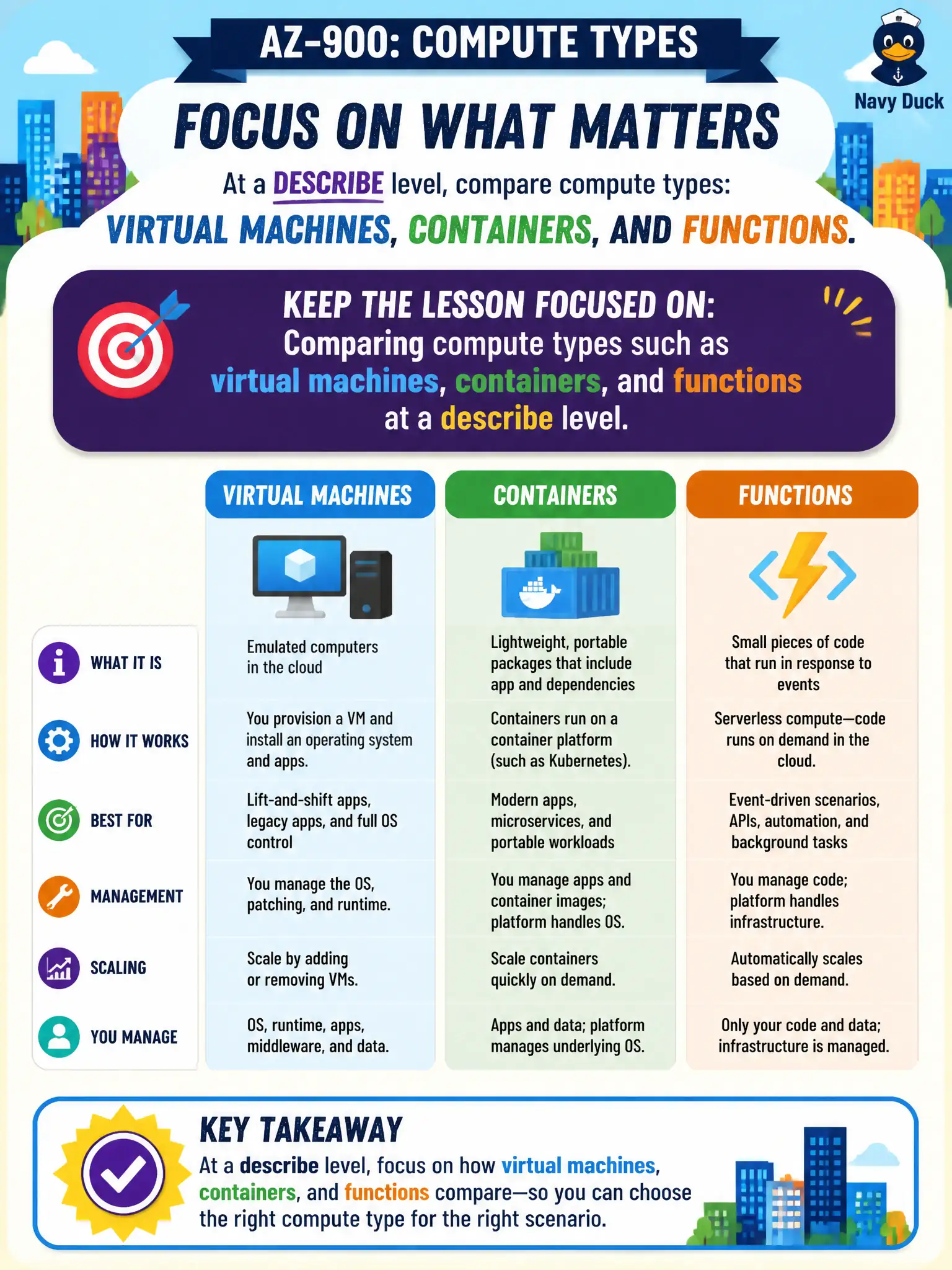
AZ-900 wants the big compute map — VMs, containers, functions — not a cluster admin workshop. Park the node-pool deep dive for another cert. Keep this module on what each compute style is for.
Full Explanation
AZ-900 compute modules should stay at a describe level: what virtual machines, containers, and functions are, when each fits, and how management responsibility differs. If a training vendor starts explaining AKS node-pool design during that module for city staff, the instructor should refocus on comparing those compute types rather than drifting into Kubernetes cluster administration. Node pools, CNI, and autoscaler internals belong to later, role-specific learning paths—not the Fundamentals map.
Authoring custom AKS autoscaler plugins and CNI policies for production clusters is administrator/specialty depth, not AZ-900. Writing SDK bindings and Application Insights custom telemetry processors is development and observability detail beyond compute-type comparison. Designing Sentinel analytics rules and Conditional Access policy JSON addresses security operations and identity, not the compute-types lesson.
Exam caveat: mentioning that Azure Kubernetes Service exists as a managed way to run containers can be appropriate, but designing node pools is past the Fundamentals line. Operational check: rewrite the lesson objective to “select VM, container, or functions for sample civic workloads,” remove node-pool labs from the AZ-900 outline, and park AKS operations content in a separate advanced workshop with clear prerequisites.