
For a city lunch-and-learn slide, which comparison best distinguishes virtual machines, containers, and functions at Azure Fundamentals depth?
Select an answer to reveal the explanation.
Short Explanation
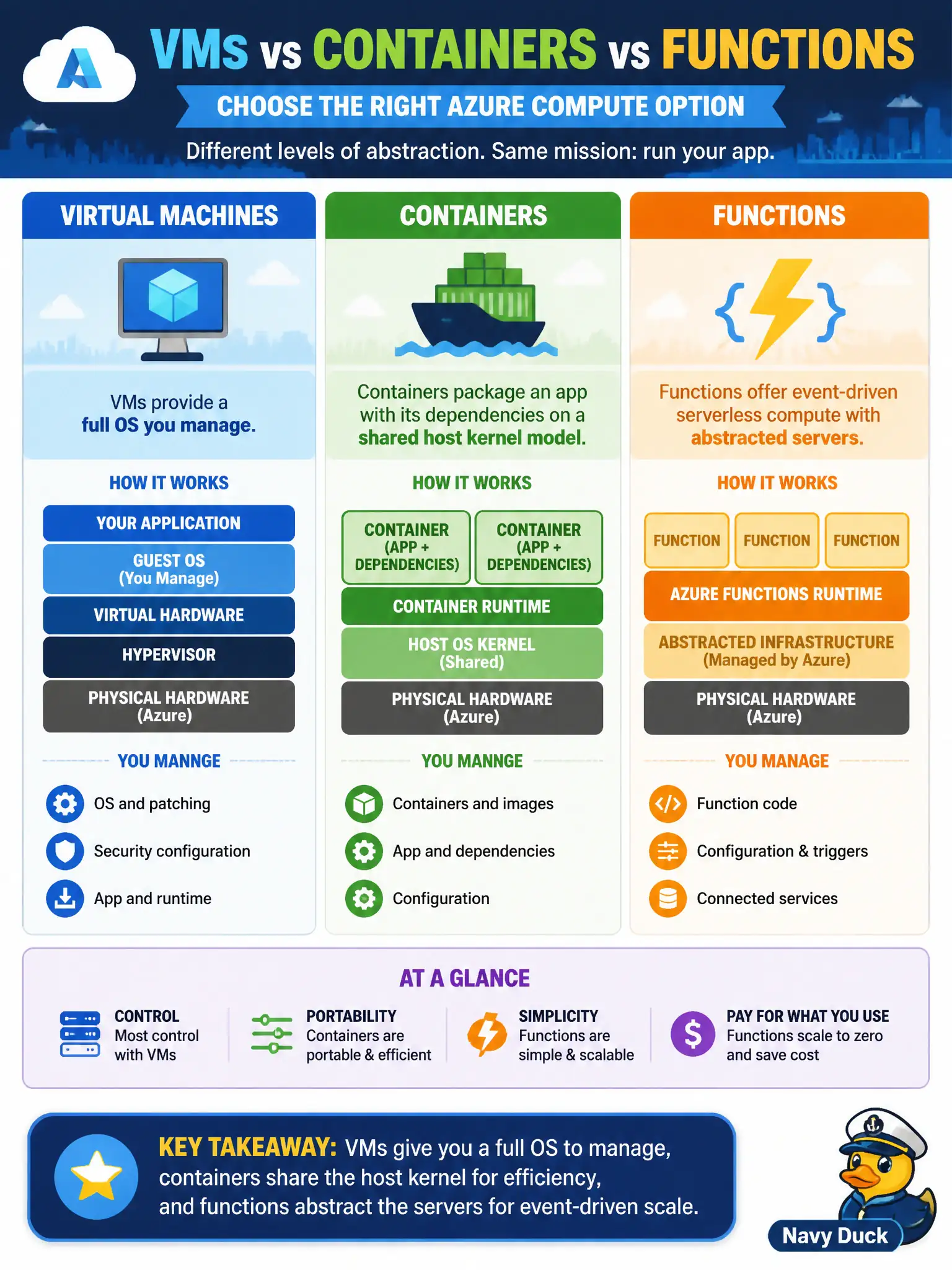
Full OS control? That is a VM. App packed with its deps on a lighter footprint? Container. Short event-driven code without babysitting servers? Functions. Same cloud, three different levels of responsibility.
Full Explanation
At Azure Fundamentals depth, virtual machines, containers, and functions differ mainly by how much infrastructure and operating-system responsibility the customer retains. Virtual machines provide a full guest operating system that the city manages, including patching and configuration inside that OS. Containers package an application with its dependencies and typically follow a shared host kernel model, giving a lighter footprint than a full VM for many apps. Functions offer event-driven serverless compute where the platform abstracts servers, so code runs in response to triggers without the team babysitting VMs for that workload.
Saying VMs, containers, and functions are identical IaaS offerings with the same management burden erases the responsibility gradient the exam tests. Saying functions always include a full guest OS that cities must patch weekly attributes VM-style duties to serverless compute. Saying containers replace Microsoft Entra ID and cannot run application code confuses identity services with a packaging and runtime approach for apps.
Exam caveat: “serverless” does not mean “no cost” or “no limits”—functions still consume executions, memory, and related platform quotas. Operational check: for a lunch-and-learn demo, deploy a tiny HTTP-triggered function, a sample container app or ACI-style demo if available in the lab, and a small VM, then have staff contrast who patches the OS and how each scales before choosing patterns for real civic apps.